Asus has become the first major gaming monitor brand to declare the end of an era, saying there’s no more room for TN LCD displays, at least not in the high end segment.
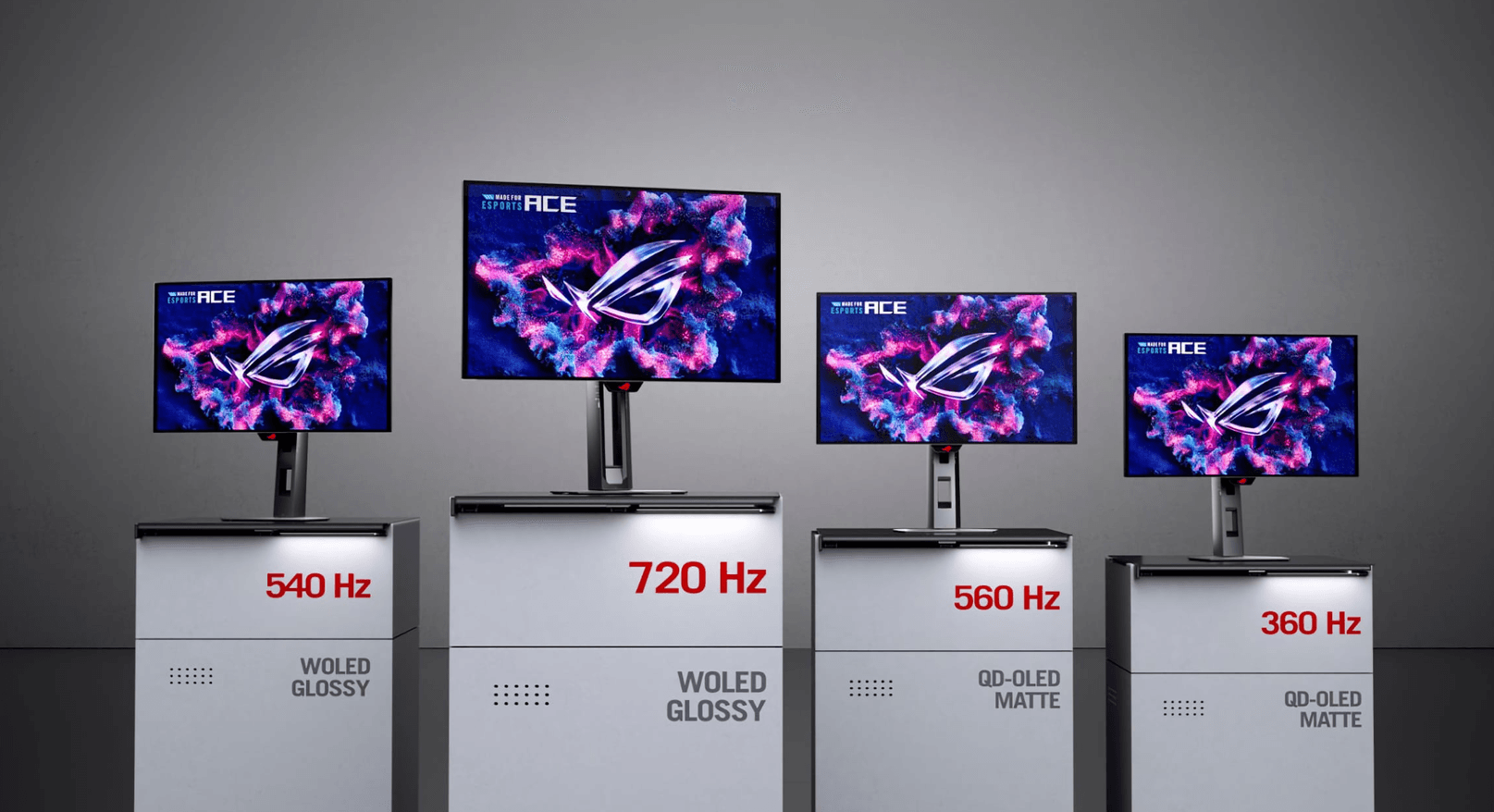
The company has just announced a slate of four new 25-inch OLED gaming monitors, and they’re all targeted at professional eSports gamers, for whom performance in terms of motion clarity, rapid refresh rates and near-instantenous response times is all that really matters.
The new monitors all come with 1080p resolution and support HDR, and they boast blazing fast speeds of up to 720Hz.
In a blog post announcing the new monitors, Asus said that TN LCD panels had ruled the roost in the eSports arena, where 25-inch panels are considered the “gold standard,” for years. “Built for pure speed, these monitors made stratospheric refresh rates possible,” Asus said in what is effectively an obituary for the technology.
“But they struggled to shake off the limitations of the tech: washed-out colours, shallow contrast and poor viewing angles, to name a few. The latest OLED panels kick those limitations to the curb.”
This is certainly not a new opinion by any means. Most video gamers have been saying that OLED is superior in just about every way for years. But transitions that see one dominant technology replaced by another do take time. However, OLED’s rise has seemed inevitable for quite some time.
Asus explained why this is the case:
“OLED panels offer head-turning visual quality, so they appeal to gamers of all kinds. There’s some discussion online about the value of things like inky blacks, vibrant colors, and professional-grade color accuracy from the perspective of esports gaming. Will they make your games more fun to play? Almost certainly. Will they bump up your K/D ratio? Maybe not. But here’s a quality of OLED panels that offers an inarguable competitive edge for esports gaming: incredible motion clarity.”
The problem with TN LCD displays is they suffer from significant motion blur, which is a challenge that the technology just hasn’t been able to overcome. LCD struggles with in terms of pixel transition speed, which is when they switch from showing one colour to another. “During transition, you see a temporary blended state that can appear blurry,” Asus explained.

Another challenge is what’s known as sample-and-hold, which refers to the way TN LCD monitors display each frame statically until the next one arrives, without any break between them. The problem is that the human eye registers this as a series of static images that shift from one point to the next, making them blurry even though the actual images are crystal clear.
Asus said OLED overcomes these challenges because it delivers a “generational leap” in terms of pixel transition speeds. “Comapre the response times of an OLED gaming monitor with an LCD, and OLED’s response time will be an order of magnitude faster, if not two,” Asus said.
OLED addresses the sample-and-hold problem through its sheer speed. “All told, the motion clarity on offer with OLED panels is off the charts, and that’s what’s so exciting about them for esports,” the company continued. “When the margin for victory depends on spotting, tracking, and responding to fast-moving opponents in impossibly small windows of time, you need every available weapon in your arsenal.”
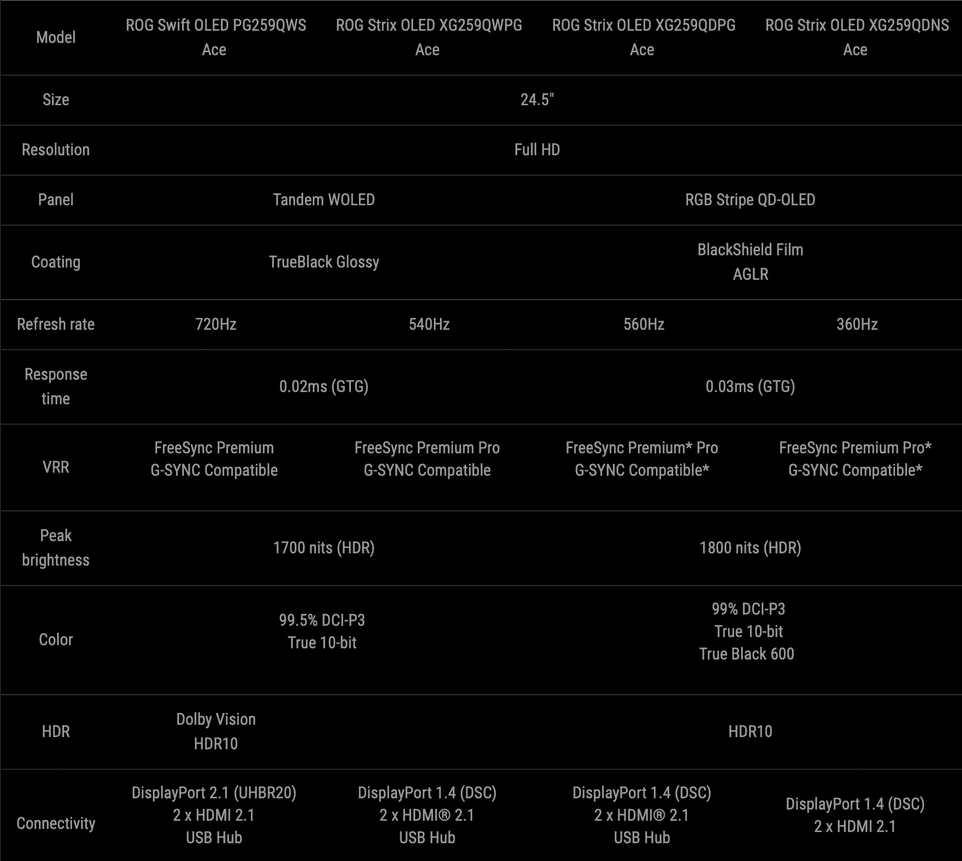
Because Asus’s new OLED monitors all have the same resolution and similar brightness levels, the most important differences are speed and the actual display technology used. The fastest of the bunch is the new Asus ROG Swift OLED PG259QWS Ace, which uses a Tandem WOLED panel from LG Display, supports Dolby Vision HDR and can hit an incredible 720Hz. The ROG Strix OLED XG259QWPG Ace also uses a Tandem WOLED panel, but its refresh rate is capped at 540Hz and there’s no support for Dolby Vision.
There’s also a couple of QD-OLED models that use panels supplied by Samsung Display. These include the ROG Strix OLED XG259QDPG Ace, which can hit 560Hz, and the ROG Strix OLED XG259QDNS Ace, which is limited to a still-very fast 360Hz. These models also lack Dolby Vision, but they are a bit brighter, capable of reaching 1,800 nits compared to the 1,700 nits of the two Tandem WOLED monitors. Another key difference is that the QD-OLED monitors have a matte coating that helps to deflect reflections so that gamers can remain focused on the action, while the WOLED models both have a glossy coating.
The ROG Swift OLED PG259QWS Ace also comes with a DisplayPort 2.1 connection, unlike the other three, which only have DisplayPort 1.4. All four displays support HDMI 2.1, however.
You can see the full specs for each monitor here:
Asus has not yet said when the new monitors will go on sale, and it has refrained from announcing any prices too. However, we do expect to learn more soon, and they should all launch later this year.
