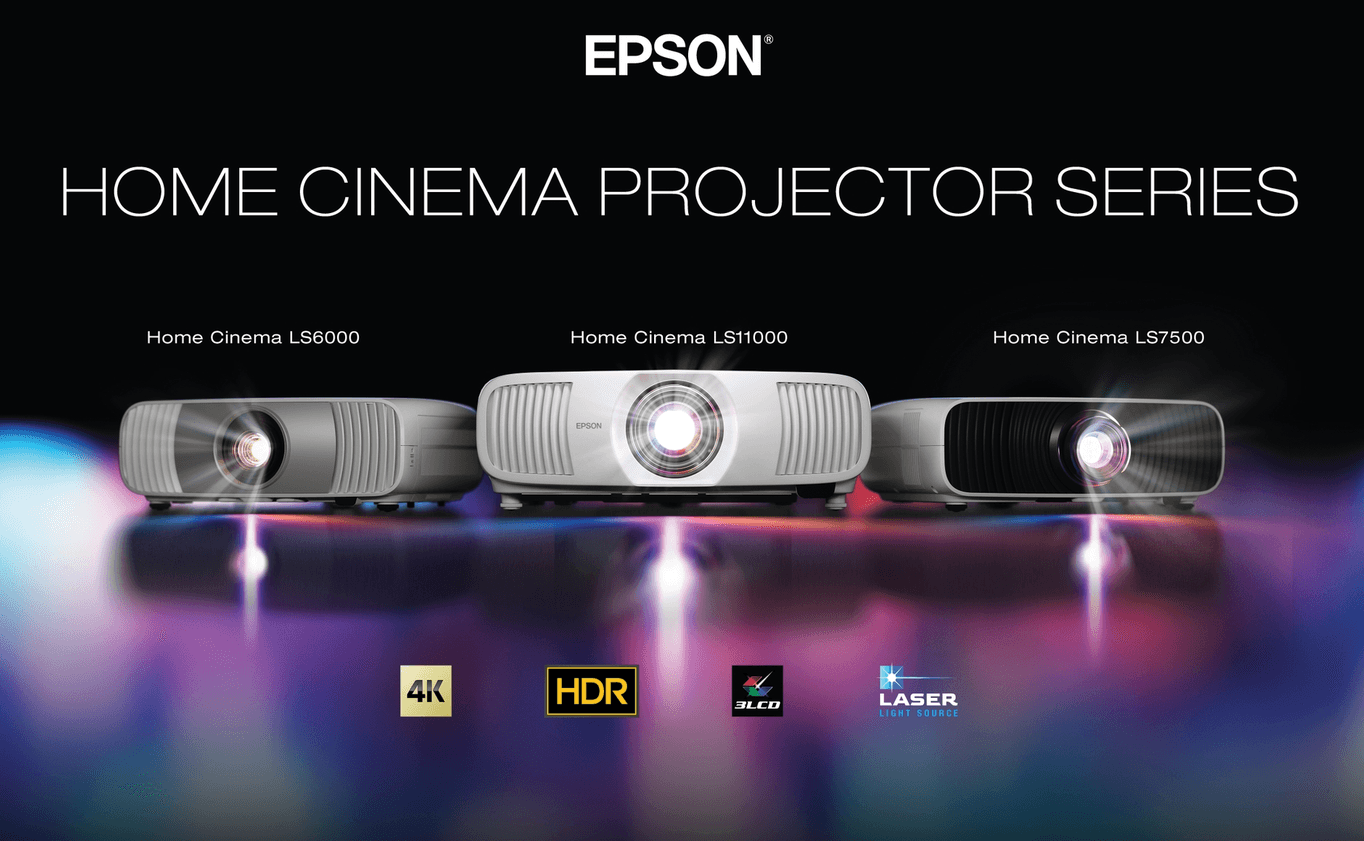
Epson is expanding its lineup of expensive Home Cinema projectors with three new models to sit below the flagship LS11000, and it’s really going all out in terms of size.
The new models, which include the Epson Home Cinema LS7500, LS6000 and LS5000, are all capable of beaming a massive, 300-inch picture onto any surface that’s big enough, and they’re bright enough for daytime viewing. Epson said all three combine three-chip 3LCD projection with laser-array illumination, full-screen 4K output and HDR support and have rapid 120Hz refresh rates to ensure glitch-free viewing and gaming experiences.
The best of the bunch is the LS7500, which comes with a specialised short-throw lens that enables it to be used in tighter spaces and still deliver massive visuals. But don’t let that confuse anyone, for it’s not an “ultra-short-throw” projector that can be placed just a few inches away from a screen or wall – it still requires a fair bit of distance, just not as much as conventional projectors require. According to Epson, the special lens means you should be able to close the distance to the wall or screen by around 90 centimetres or so to achieve a comparable-sized image.
Epson said the LS7500 offers ±21% horizontal and ±59% vertical adjustment and supports both 16:9 and 21:9 setups, making large images much more practical in smaller rooms. The other two, the LS6000 and the LS5000, both feature a standard Epson Cinema Lens with a "wide-range manual lens shift,” which is more characteristic of conventional beamers.
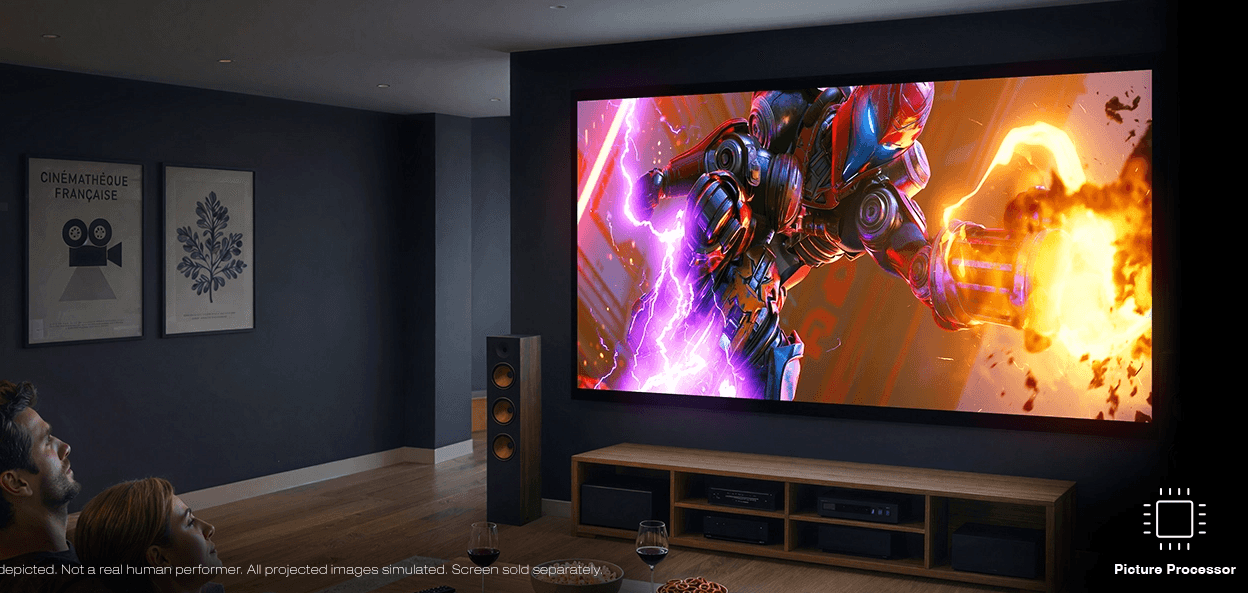
The LS7500 is also brighter than the other two models, rated at 3,500 lumens for both colour and white brightness, and has a 1,000,000:1 dynamic contrast ratio. It comes with Epson’s Picture Processor chip, which enables the optical engine to output 8.29 million-pixel 4K images. The other big selling point is high-refresh gaming. With the LS7500, there are two HDMI ports that both accept 4K signals at up to 120Hz, with one also supporting eARC. They also support Auto Low-Latency Mode, which should ensure super responsiveness, and they have an input lag of less than 20 milliseconds, albeit only when gaming at 4K/60Hz. It didn’t specify the input lag at 4K/120Hz.
All three new projectors support native 24Hz, 48Hz and 60Hz cinema frame rates, and both HDR10 and HLG high dynamic range formats are present. They also integrate Epson’s proprietary HDR scene correction technology, which should make them viable for viewing content such as fast-moving live sports.
Looking at the LS6000, this drops the brightness output down slightly to 3,400 lumens, while the LS5000 delivers 2,500 lumens, which means it might struggle a bit more in brighter environments, although it should still be decently watchable. Dynamic contrast on both is rated at 800,000:1, and they retain the 4K/120Hz refresh rates, 3LCD laser projection, dual HDMI with eARC and sub-20ms input lag of the LS7500. What this means is that the LS7500 is brighter, with stronger contrast and shorter-throw optics than the others, which sacrifice performance for greater affordability.
As for those prices, the LS7500 costs $2,699 (around £2,045), with the LS6000 priced at $2,199 (£1,665) and the LS5000 tagged at $1,999 (£1,510). None of them are cheap, but those prices aren’t bad for what you’re getting. They’re certainly much cheaper than the flagship Epson Home Cinema LS11000, which costs $4,999 (£3,785) and boosts the dynamic contrast ratio to a stunning 1,200,000:1 and adds Epson’s more powerful RX Picture Processor. However, the LS11000 is strangely not quite as bright, maxing out at 2,500 lumens.
Epson said all three new models are available to buy now via its website and from partner retailers. The main selling point is that Epson is pushing the projection limit to 300-inches, which is a truly massive image, but bear in mind that you’ll need a similarly massive living room or dedicated theatre room with an eight-metre wall or projection screen to actually make the most of it.
