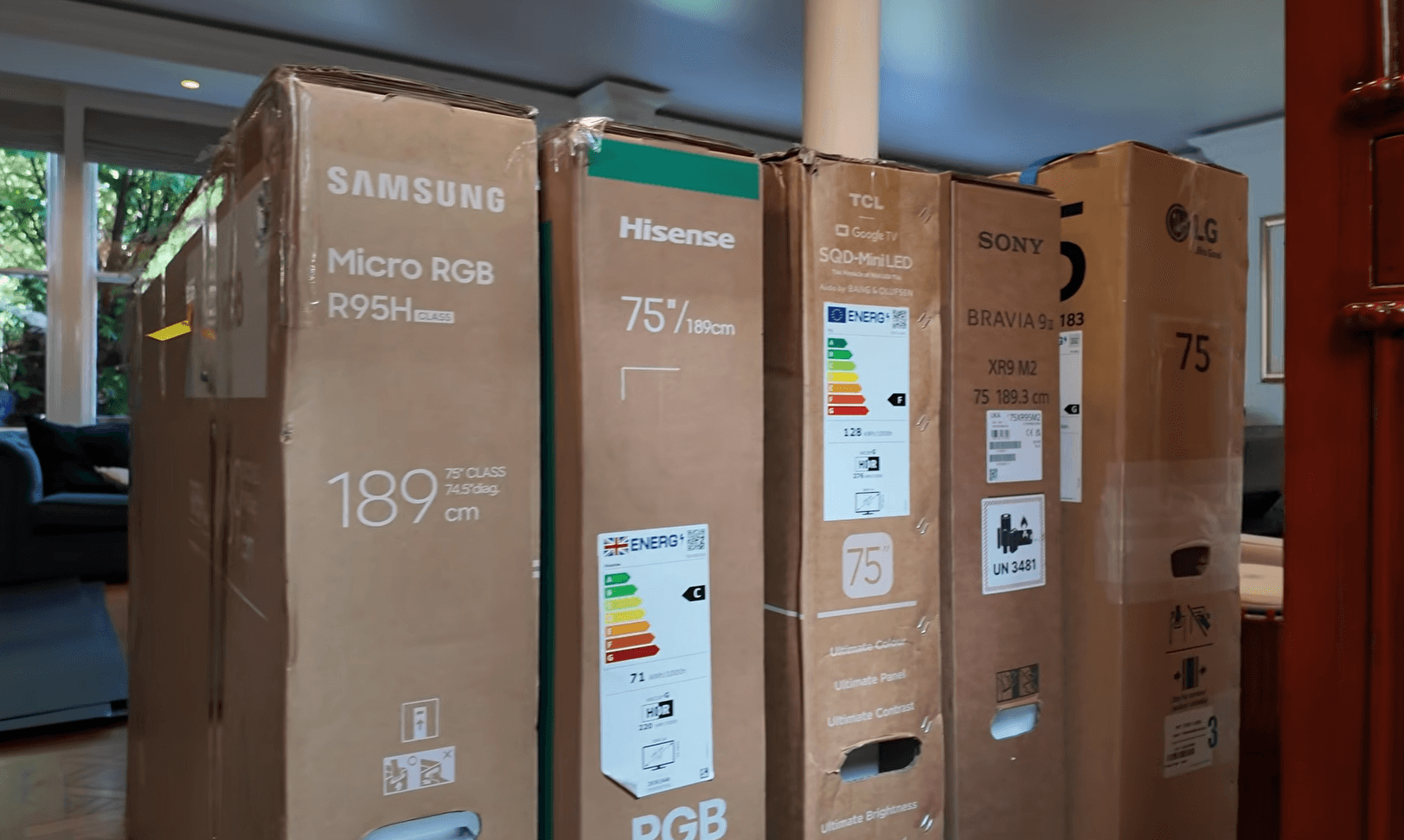
For years, AV enthusiasts have generally sneered at LED LCD televisions, dismissing their ability to go toe-to-toe with the best OLED models. But with the rise of newer display innovations like RGB LED and Super Quantum Dots, many believe that the gap between LED LCD technology is now much narrower, and that it can finally compete with the most premium OLED formats.
To see if that’s really the case, HDTVTest’s chief reviewer Vincent Teoh decided for the first time to include what has been independently judged as the best LED TV in this year’s HDTVTest TV of the Year Shootout.
But to do that, Vincent and his panel of independent judges first had to determine which LED TV really is the best, which is why they decided to change the format of the Shootout contest for the first time with a new two-stage structure. The first stage is a semi-final shootout involving the five most premium LED TVs money can buy in 2026, with the winner set to progress to the grand final against this year's best OLED televisions.
In the semi-final shootout, Vincent and his team decided to face off the 65-inch versions of the Hisense URS9 (based on RGB-Mini LED display technology) against the LG MRGB95 (Micro RGB), the Samsung R95H (Micro RGB), the Sony Bravia 9 II (True RGB LED) and the TCL X11L (SQD-Mini LED).
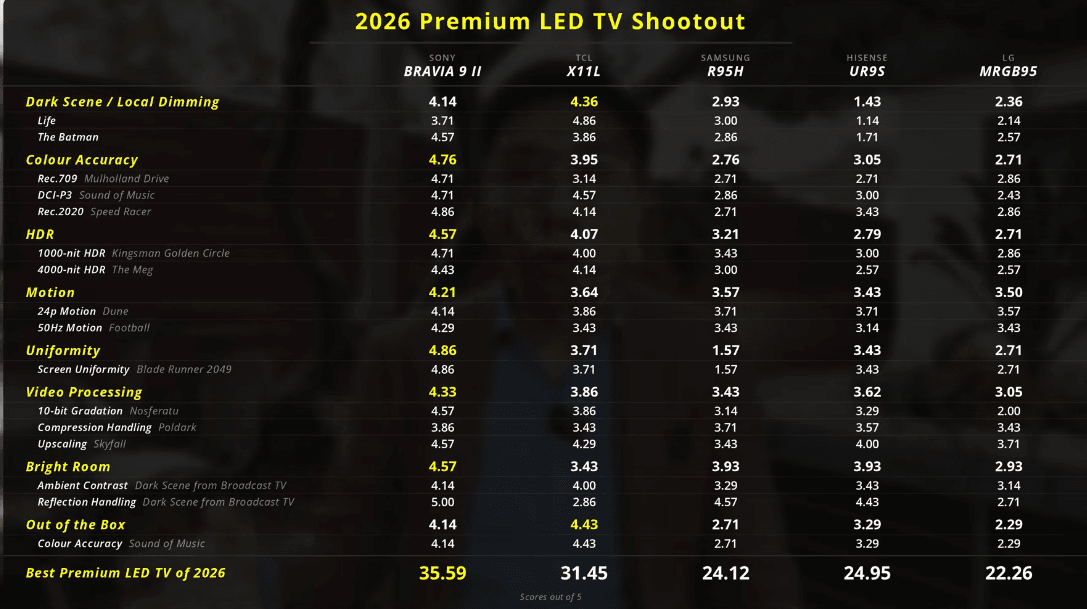
The judges used the Sony BVM-HX3110 reference monitor to analyze the TVs’ performance in a blind test environment across eight categories: dark scene/local dimming, colour accuracy, HDR performance, motion, uniformity, video processing, bright room and out-of-the-box performance, to determine which one came out on top.
You can watch this video and see Vincent explain the results and announce the best overall LED LCD TV in 2026:
With the dust settled and all of the scores tallied up, it becomes clear that Sony’s Bravia 9 II is by far the best LED TV model, with its True RGB LED backlight technology emerging as the winner in six of the eight categories overall.
Sony’s Bravia 9 II displayed peerless accuracy across almost every category it was tested for. While other brands have focused on intense brightness and squeezing in as many local dimming zones as they can, Sony’s TV stands out for its unparalleled near-black detail and blooming suppression capabilities. This was achieved without sacrificing shadow detail or using any tricks to artificially increase the EOTF curve, which Vincent said is a common problem with LED TVs.
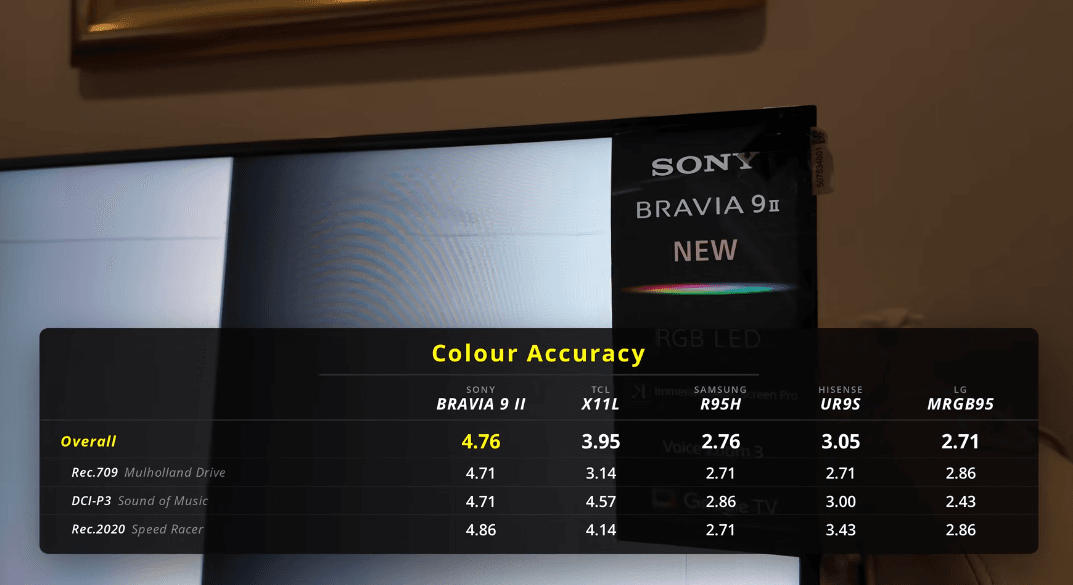
Sony’s competitors weren’t bad by any means. TCL’s X11L, which stands out as the only non-RGB LED TV, instead being based on that company’s SQD-Mini LED display tech, came out on top in terms of dark scene/local dimming performance and out-of-the-box colour accuracy to claim the overall runner-up spot. Samsung’s R95H was noted for its vibrant colour volume, though it tended to suffer from over-brightened highlights. As a result, Hisense’s UR9S sneaked into third place, with a particularly strong performance in terms of its uniformity, video processing, bright room and out-of-the-box performance.
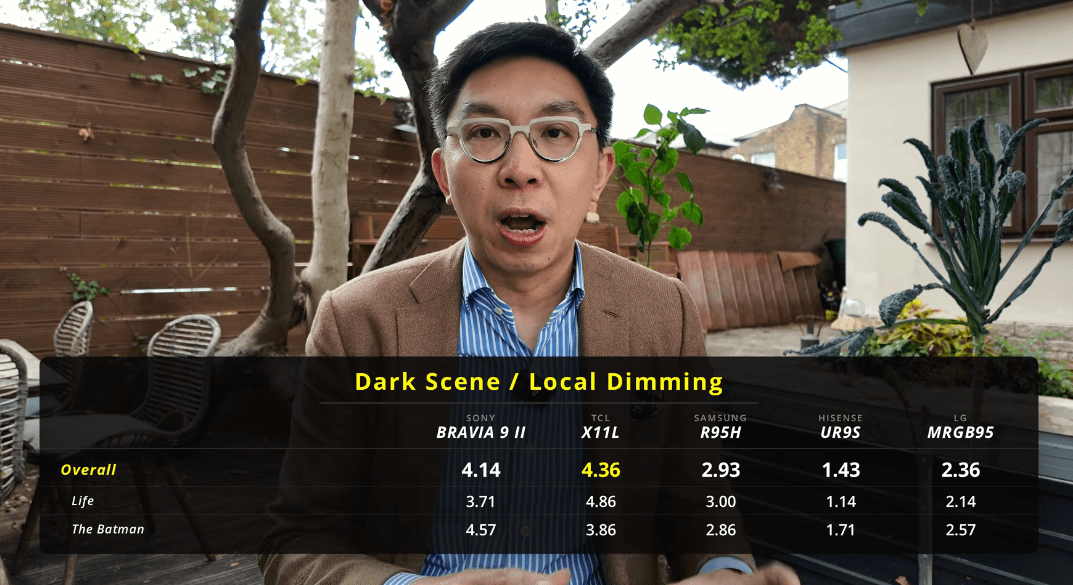
LG found itself in the unusual position of coming last, though that’s not to say the MRGB95 is a bad TV by any means, for its accuracy overall was pretty good, albeit slightly behind its rivals in terms of native panel contrast and absolute black uniformity. Maybe that’s just what happens when you devote so much time and energy to OLED instead.
As the overall winner, the Sony Bravia 9 II has won the opportunity to prove that its True RGB LED technology has what it takes to surpass the best OLED TVs in 2026: the LG G6 OLED, Samsung S95H and the Sony Bravia 8 II, which came out on top in last year’s HDTVTest TV of the Year Shootout and is being carried over into this year. In other words, it’s still Sony’s top OLED TV.
Perhaps, just perhaps, the results of this year’s final will demonstrate why Sony opted to abandon OLED in favour of RGB LED for its flagship 2026 TV model.
