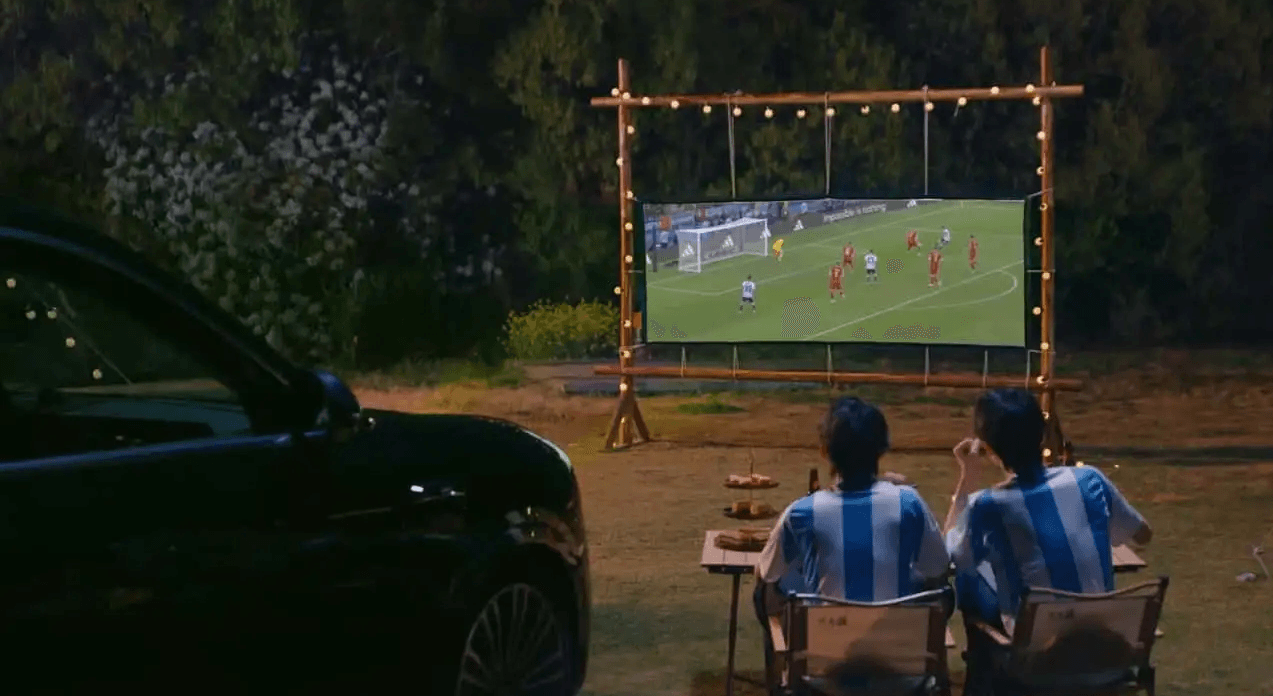
Outdoor projectors have become a popular gimmick in recent years thanks to advances in both projection technology and battery lifetimes, but Huawei is now extending the concept to cars.
The latest version of the company’s XPixel technology was shown off this week at a Beijing autoshow, and it promises to resurrect the old-skool American drive-in theatres that have long since become a relic of the past. Essentially, it transforms a car’s headlights into a full-fledged projector, enabling movies to be projected onto whatever wall it parks in front of.
The system is reportedly able to project a 100-inch, full colour image onto any wall, transforming the car itself into a drive-in cinema.
Huawei’s XPixel technology has been around for a few years, forming the basis of what’s known as “adaptive headlights” that can automatically adjust their light beam to avoid blinding oncoming drivers. However, it was always pretty limited, until now.
The newest version of the technology is able to project a full range of colours, and has multiple applications. For instance, a driver can use it for literal on-the-road guidance in the form of arrows that indicate the direction they need to drive to reach their destination, helping them to avoid missed turns. It can also serve as an entertainment system. In a video, Huawei showed how it can project games like hopscotch onto a pavement, or else a music synthesiser for an outdoor rave party.
However, it’s the “open-air cinema mode” that really caught our attention. It basically projects whatever is playing on the in-car infotainment system onto a wall or screen that can be placed in front of the car when it’s parked. It extends the entertainment experience beyond the vehicle, creating a shared viewing environment that’s not only for the passengers in the car.
Huawei said the technology will debut in the upcoming Aito M9 SUV and other models such as the Luxeed V9 and Qijing GT7, which are set to launch in China later this year. For now, it seems the tech is exclusive to Chinese cars only, likely because other countries like the U.K. and the U.S. have strict regulations about what car makers can and can’t do with adaptive headlights.
The drive-in theatre experience may seem a bit gimmicky, but it could appeal to anyone yearning for the nights of yesteryear, when it was a common way for younger people to entertain themselves. It may also come in handy to anyone driving an electric vehicle who needs to make a stop to recharge the battery. All the more so if they happen to have a bag of popcorn handy.
Unfortunately, Huawei didn’t say much about the actual picture quality its headlights can throw up. We’re guessing that we’re not talking 4K visuals here, but even so, the huge size of the picture may make it preferable to watching on the tiny, in-car displays we’re currently used to.
