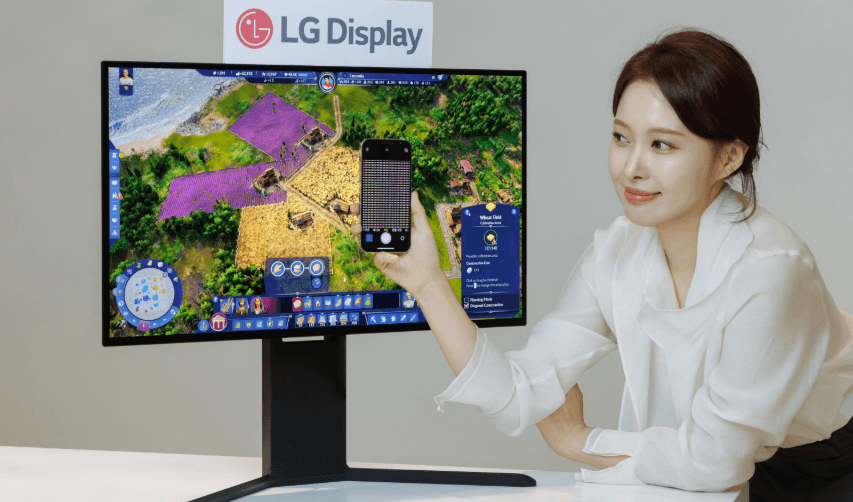
LG Display has announced what’s believed to be the world’s first RGB stripe OLED panel featuring a 240Hz refresh rate, and it will make its debut in an upcoming 27-inch 4K monitor that’s set to be unveiled at CES 2026 next month.
The RGB stripe OLED panel features a novel pixel structure that has never been used on high-end displays before, and it’s hoped that it will deliver a significant boost in overall picture quality.
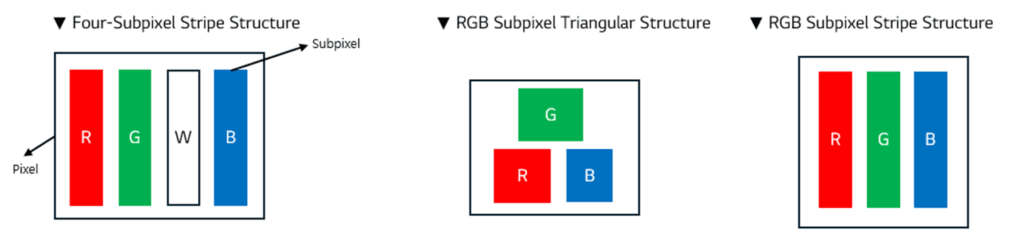
In its existing premium monitors, LG Display uses an RGWB structure made up of red, green and blue subpixels along with an additional white element, laid out in a kind of “striped” pattern. The extra white sub-pixel helps to increase the brightness of the display, but it can also reduce clarity, resulting in slightly blurred text. In addition, the RGWB structure also causes a problem known as colour fringing, which refers to the discoloured edges around high-contrast areas such as text and images.
LG’s rival Samsung Display uses an alternative pixel layout known as RGB, where the red, green and blue sub-pixels are laid out in a triangular shape, but this design also causes colour fringing.
You can learn more about the differences between the two in this video:
With its new RGB stripe OLED panel, LG Display is trying to improve on these pixel structures. The new panel unveiled this week echoes the striped layout of its RGWB panels, but it gets rid of the white sub-pixel, so only red, green and blue ones are present. By eliminating the white, LG Display said it has been able to minimise colour distortion, even at close range.
This is not the first time that an RGB stripe design has been used in an OLED panel, but the company’s earlier products were limited to just 60Hz and were lower resolution. By upping things to 4K and 240Hz, LG Display’s new 27-inch panel is likely to appeal to video gamers, especially as it features dual-mode technology, where users can reduce the resolution to Full HD to crank up the refresh rate to 480Hz.
LG Electronics will be one of the first customers to use the new panel in a soon-to-be-announced new monitor, and it’s likely that other brands such as Acer and Asus may also be interested in it. But these won’t just be for gamers, as LG Display said it’s targeting professional workloads such as media, text editing and graphics design.
The new monitor is said to be optimised for operating systems including Windows and also font-rendering engines to ensure “excellent text readability and high colour accuracy”, the company said. It will also deliver an enhanced pixel density of 160 pixels-per-inch to support “more detailed expression.” The panel also has an increased aperture ratio, which means that more of the pixel area emits light than before in order to enhance brightness – necessary due to the elimination of the white sub-pixels.
There may be some confusion over the new panel’s branding. Last week, LG Display announced that its OLED technologies will now fall under one of two new sub-brands it has created, known as Tandem WOLED and Tandem OLED. The “Tandem” part of the new brand names stems from the layered structure that was first utilised in LG’s Primary RGB Tandem OLED panels, which featured on some of the best TVs in 2025, including the LG G5 and the Panasonic Z95B.
LG Display said the Tandem WOLED sub-brand refers to displays that have the extra white light source in their pixel structure to enhance brightness, and will cover its larger panel lineup for televisions and monitors. Meanwhile, Tandem OLED displays lack the white subpixel and primarily cover medium and smaller panels used in tablets, laptops, smartphones and car infotainment systems.
However, the new RGB stripe OLED panel is clearly aimed at monitors, yet it does not fall within the Tandem WOLED definition, blurring the lines between the two sub-brands, somewhat.
