
Just weeks after LG Electronics was accused of carrying out extensive surveillance on its TV-owning customer base through the webOS platform, Samsung Electronics has been caught doing similar things with its Tizen-based software.
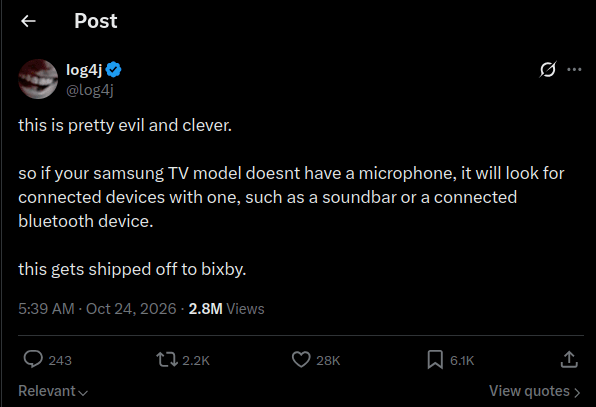
An anonymous security researcher on X who goes by the name of @log4j has discovered that his 2025 Samsung TV, is secretly feeding data to its digital assistant Bixby.
The researcher, who has a long history of investigating the Tizen OS platform, said Samsung is using its TVs’ microphones to send audio back to its own servers in the form of telemetry data. What’s alarming is that the data includes unique counters for events such as babies crying and dogs barking – basically creating a note each time it hears such sounds. The counters can be found under an event called EV201/SOUNDSENSOR_ON. Within that file, @log4j also discovered counters such as a software flag for the TV’s ambient light sensor, camera streaming duration and camera-state fields.
This telemetry is sent to Samsung’s servers and logged as key-value pairs, @log4j said.
While most consumers are unlikely to be aware that Samsung is secretly listening into them through third-party devices connected to the TV, it does disclose this practice. The warning is buried within the terms and conditions of its Pet Care and Family Care services, which are found in the Smart Things app that’s pre-installed on its 2025 Vision AI TVs. @log4j explained that both services use microphones and on-device AI to pick up sounds such as barking and crying, understand what those sounds are, before sending an alert to Samsung via the SmartThings application.
Samsung explains in its terms and conditions that Pet Care is only activated when the TV is in standby mode. The idea is that when it hears a dog barking, it automatically plays soothing music or videos designed to calm the pet down.

The thing that Samsung doesn’t disclose anywhere, according to @log4j, is that it sends counts of those events back to its own servers. N
While few people will be surprised this is happening, given how common TV surveillance is, Samsung also does something much sneakier on TVs that don’t have a built-in remote. When the AI realises that the TV doesn’t have a mic of its own, it will instead look for a connected device that does have one, such as a Bluetooth speaker or a soundbar. If it detects one it will then start registering the events and counters.
Later, @log4j posted again with a second development, saying that his TV now loads a region-specific neural network that tracks what is happening inside applications such as YouTube, including what the user has been watching and which ads they have skipped.
Fellow Samsung TV owners were apparently not too happy to learn about what Samsung is doing, but it's not clear if Samsung is actually breaking any laws or regulations.
@log4j’s findings don’t really come as a surprise, given that LG was recently accused by Gamers Nexus of continuously spying on TV owners by scanning local networks to map connected smartphones and other devices, logging and uploading data about what TV viewers are doing, recording audio while the TV is in standby and sampling inputs for audio and voice to see what people are watching.
LG later responded to Gamers Nexus’s claims, rejecting several of them and insisting that it only records audio when users have deliberately activated the mic’s Far-Field feature to listen out for wake words.
