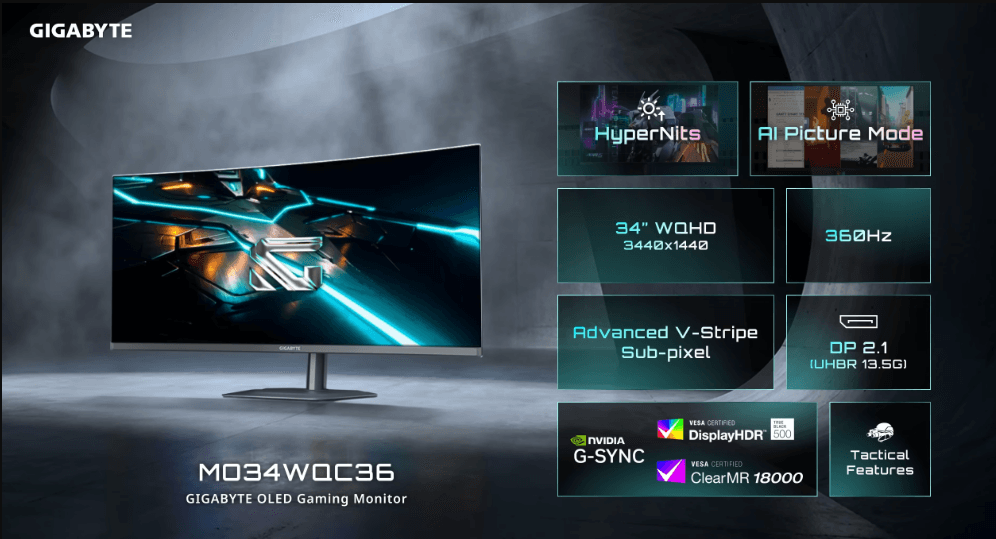
Gigabyte has confirmed it’s going to be one of the first companies to offer a new monitor featuring Samsung Display’s all-new V-Stripe QD-OLED panel, and it seems like Acer, and maybe also Dell, will do so too.
Gigabyte’s new monitor offerings, revealed at CES 2026 this week, also include a new glossy WOLED panel that may or may not be based on LG Display’s alternative to V-Stripe, which is simply called RGB Stripe WOLED. The new panels aim to enhance the usefulness of OLED monitor displays, which are mostly used for gaming but rarely used in professional work scenarios due to problems with colour fringing.
We reported on Samsung Display’s and LG Display’s moves last week, revealing that the new pixel structure should result in sharper text and images, making OLED monitors more suitable for tasks such as text editing and graphics design.
Gigabyte’s MO34WQC36 is a 34-inch QD-OLED monitor featuring the V-Stripe panel and it will combine 3440x1440 pixels in a 21:9 aspect ratio with a rapid 360Hz refresh rate, 0.03 milliseconds response time and HDR support, the company said. It’s said to cover 99% of the DCI-P3 colour gamut and deliver 1,300 nits peak brightness, with full-bandwidth HDMI 2.1 and DisplayPort 2.1 connections available.
Other attributes of the Gigabyte MO34WQC36 include an improved anti-reflective film that should enable 40% deeper blacks and reduced colour tint. The company says it’s primarily a “gaming monitor”, but the V-Stripe panel means it’s also suited for other tasks.
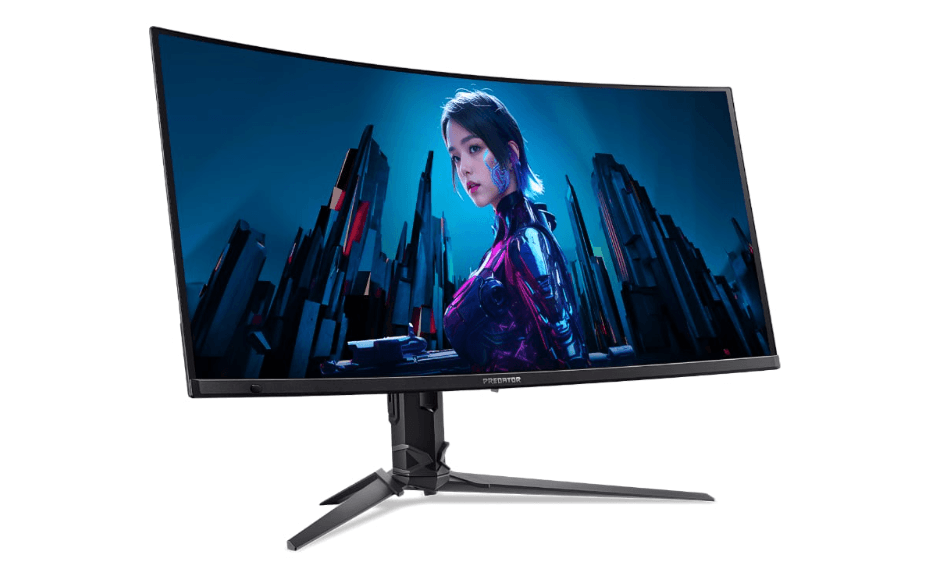
Another company that could be using the new V-Stripe QD-OLED panel is Acer, which unveiled a new X34 F3 gaming monitor at CES 2026. It sports a curved, 34-inch 1440p ultrawide resolution QD-OLED panel and has a 360Hz refresh rate with 0.03ms response times, but only 500 nits peak brightness. Aside from the reduced brightness, it sounds almost exactly the same as the display used on Gigabyte’s MO34WQC36, which would mean it is indeed a V-Stripe panel, though Acer has not yet confirmed this.
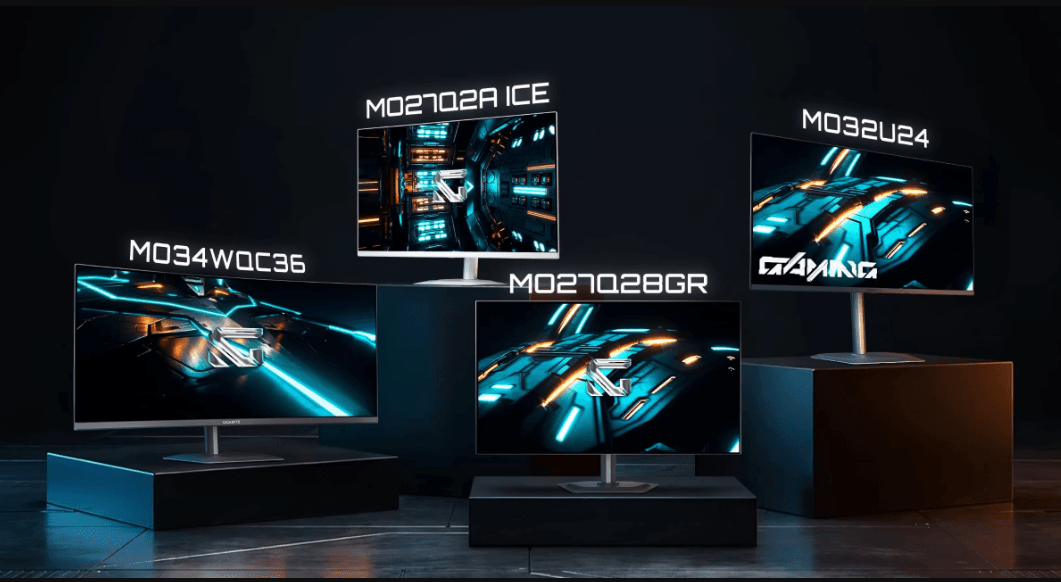
Gigabyte’s and Acer’s new monitors were just two of dozens that were showcased at CES this week. In addition, Gigabyte also revealed a 32-inch MO32U24 monitor featuring what seems to be a standard QD-OLED panel. It has 3840x2160 pixels, a 240Hz refresh rate and HDMI 2.1 ports and features the company’s 'ObsidianShield' anti-reflective film. There’s also a new 27-inch MO27Q2A ICE gaming monitor with 2560x1440 pixels. Once again it’s using a QD-OLED display that maxes out at 280Hz and can hit 1,000 nits peak brightness, although it appears to be an older panel from 2025.
Another interesting one is Gigabyte’s new 27-inch glossy OLED monitor, based on an updated Tandem WOLED panel from LG Display. It’s called the MO27Q28GR and it has 2560x1440 resolution, 99.5% DCI-P3 coverage, 84% BT.2020 and a 280Hz refresh rate. Its peak brightness is rated at 1,500 nits, and there’s a “RealBlack Glossy” coating on the panel, which should interest anyone seeking an alternative to the increasingly common but less colourful matte finishes used on most modern gaming monitors.
Meanwhile, Acer’s flagship monitor for gamers this year might just be the 27-inch XB273U F6 due to the way it smashes through the 1,000Hz barrier with its ultra-fast refresh rates that clocks in at 1,040Hz. It’s an LCD monitor, though, and so it might not actually match the performance of existing 720Hz OLED monitors, due to their much faster response times.
Acer said the XB273U F6 can do 1,000Hz at 720p or 500Hz at its native 1440p resolution. The IPS LCD panel covers 95% of the DCI-P3 colour gamut and offers a low 2,000:1 contrast ratio with 350 nits brightness.
For non-gamers, Acer offered up the professional 32-inch 6K resolution PE320QX, which also features an IPS LCD panel. It has 6016x3384 pixels and a 60Hz refresh rate with 98% coverage of the DCI-P3. The specifications look similar to the existing Acer PE320QXT, but this one has been upgraded for the panel is a touchscreen.
Elsewhere, we saw a host of new monitors from Dell, including the Dell UltraSharp U3226Q that uses one of Samsung’s QD-OLED panels. It has 4K resolution, 99% DCI-P3 and supports Dolby Vision, and is designed for tasks such as video, photo and graphics editing and similar professional use cases, the company said. It’ll launch next month, priced at around $2,600 in the U.S.
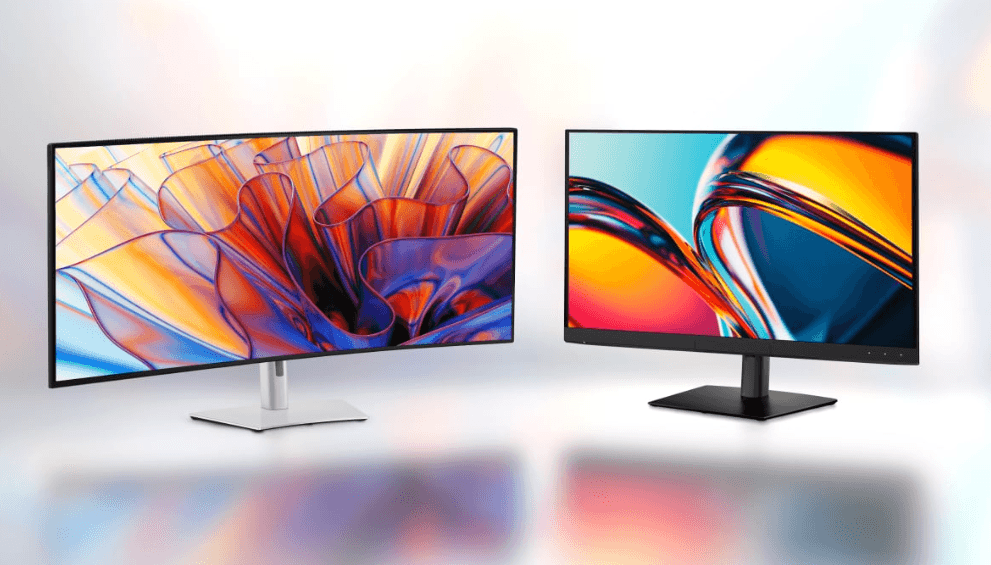
What’s interesting is that the Dell UltraSharp U3226Q doesn’t appear to be using Samsung’s new V-Stripe QD-OLED panel, so we do wonder how useful it really will be for professionals. When Samsung announced V-Stripe, it only spoke of a single, 34-inch panel, but the U3226Q is a 32-inch monitor. So if it’s not V-Stripe, it remains to be seen what Dell has done about the colour fringing problem that’s so common with OLED monitors.
Dell said the UltraSharp U3226Q has Thunderbolt 4 connectivity, an anti-reflective matte coating and has been certified for DisplayHDR True Black 500. This means that unlike Dell’s existing UltraSharp LCD monitors, it’s capable of displaying true HDR quality images.
Elsewhere, Dell announced a huge 52-inch LCD monitor with 6K resolution called the Dell UltraSharp U5226KW. It has a slightly curved display with a 21:9 aspect ratio, making it the first of its kind in this size category, Dell said, with more pixels than two 27-inch monitors plus a 43-inch 4K monitor combined. According to Dell, it’s aimed at users that like to multitask with multiple open windows at once, and it supports picture-in-picture and the ability to connect to up to four PCs simultaneously. It’s based on an IPS Black LCD panel with a low contrast ratio of 2,000:1, which likely makes it unsuitable for image editing tasks.
