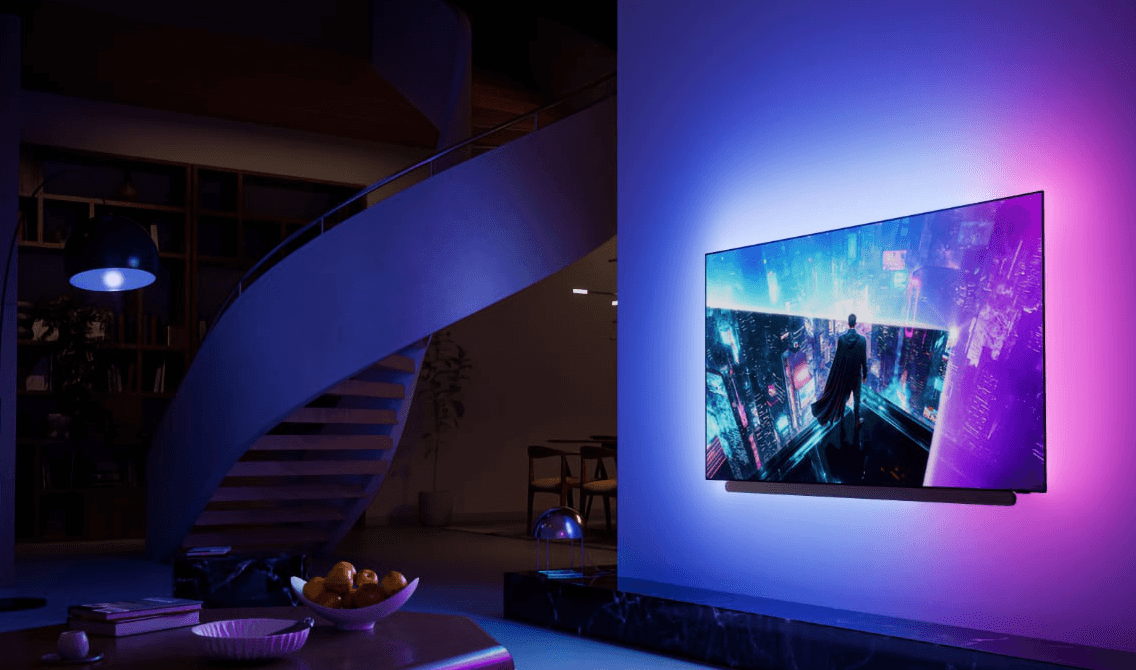
Philips has established a tradition of waiting for a few months until the fanfare surrounding its rival’s TV announcements dies down, launching its own televisions at a moment when everyone else is quiet. It’s a smart strategy that gets its TVs the attention they deserve, and in the case of its new 2026 models, it’s well earned.
The company has just announced its 2026 OLED TV lineup as well as its latest Mini-LED models and its first RGB LED screen, and they don’t disappoint.
For 2026, the top tier models in Philips’ OLED lineup will be the OLED951 and OLED911 (pictured, above), with the latter the successor to the excellent OLED910. Both of the models feature Philips’ new AmbiScape technology, which makes it possible for them to interface with smart lights sold by Philips Hue and third-parties such as IKEA and NanoLeaf in order to create the most immersive AmbiLight experience yet.
The OLED951 and OLED911 utilise LG Display’s latest Primary RGB Tandem WOLED 2.0 panel, which means that the company has once again snubbed Samsung Display’s QD-OLED technology. Philips reckons the new panel will allow the TVs to hit a highly impressive 4,500 nits peak brightness. The TVs also have enhanced anti-reflective capabilities to mitigate 99% of ambient light and ensure their pictures reflect every detail under any viewing conditions.
Philips said the new OLED TVs pack a MediaTek Pentonic 800 chipset. This means they come with 165Hz refresh rates and have four HDMI 2.1 ports, joining the likes of LG and Samsung, which offer the same number. All four support VRR and ALLM, so there’s a lot of flexibility here. As usual with Philips, the TVs support the full scope of HDR formats, including Dolby Vision, HDR10+, HDR10 and HLG. In addition, the OLED951 and OLED911 will be the first televisions in the world to support Dolby Vision 2 Max.
Dolby announced its newest HDR technology last year. It uses AI algorithms to enhance the HDR experience, optimising it for the particular type of content being viewed. It applies Precision Black and Authentic Motion picture settings when necessary to ensure the visuals really ‘jump’ at viewers.
In terms of sound, Dolby Atmos is supported – of course – and both models have excellent sound systems. The best sound system is reserved for the OLED911, which integrates a Bowers & Wilkins-made 3.1-channel speaker system. It’s a bottom-mounted speaker that looks and sounds very much like a dedicated lozenge-style soundbar, with different sizes available based on the chosen screen size. The speaker integrates dedicated left, right and centre channels, with each one consisting of a pair of 45 millimetre mid-range glass-fibre drivers and a 19mm titanium dome tweeter. According to Philips, the mid-range drivers are isolated from the main system enclosure through the use of new “high-damping TPE isolation mountings” that help to reduce vibration.
The OLED911 features a slimmer 75mm subwoofer than the one found on the OLED910, supported by four passive, force-cancelling radiators. This has allowed Philips to reduce the overall thickness of the TV to just 39.9mm, down from 47.3mm in the OLED910. All told, these components add up to a thumping 81-watts of sound output, with eight dedicated amplification channels for each speaker.
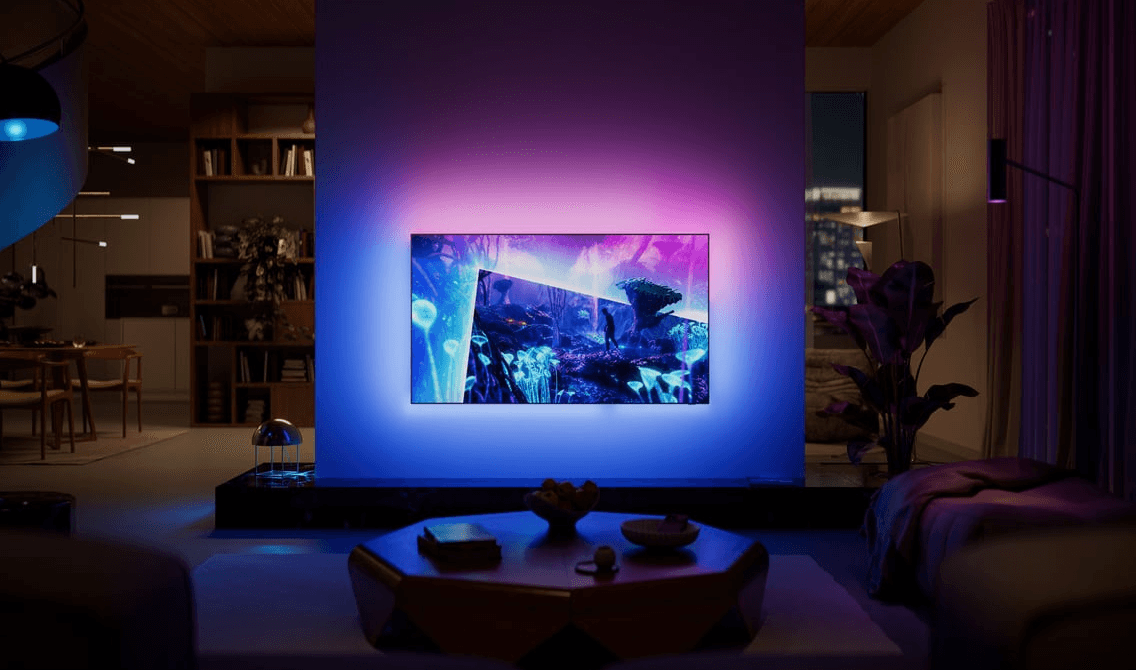
In the OLED951 (pictured above), users will find a discreet 70-watt 2.2 channel sound system that consists of two-way left and right speakers, which are controlled via a digital crossover. It has replaced the single woofer found on last year’s OLED950 with a pair of smaller bass drivers, which sit in their own enclosures. According to Philips, this redesign makes the OLED951 even slimmer than last year’s model, without any performance compromises.
There has been no upgrade on the processor front. The Philips OLED951 and OLED911 both come with the 10th Gen P5 AI chip found on last year’s models, but the former model now comes with a dual-processor set, so it has twice the processing power. The OLED911 still only has one.
Philips said the OLED951’s extra processing power is there to support new AI-enabled picture processing capabilities, such as precision AI HDR tone mapping and AI HDR expansion and restore. This particular feature conducts “frame-by-frame analysis” of the incoming HDR signal so it can replicate the original light output of the source material, and match this with the display’s peak light.
Perhaps the biggest surprise is that Philips has abandoned Google TV. Instead, the OLED951 and OLED911 will both come with TitanOS, which may be a disappointment to some given that it will probably never be able to match Google’s app catalogue. Still, it has all of the major streaming services, bar Apple TV+, but that will be added soon through an update, the company said.
As for size options, Philips said the OLED951 will be available in 55- and 65-inch sizes only, while the OLED911 will have the same, plus 48-inch and 77-inch options.
The company has not yet provided any details about prices, but the OLED951 and OLED911 are likely to be expensive, which is why some of the brand’s fans will be curious to know what its midrange OLED sets have to offer.
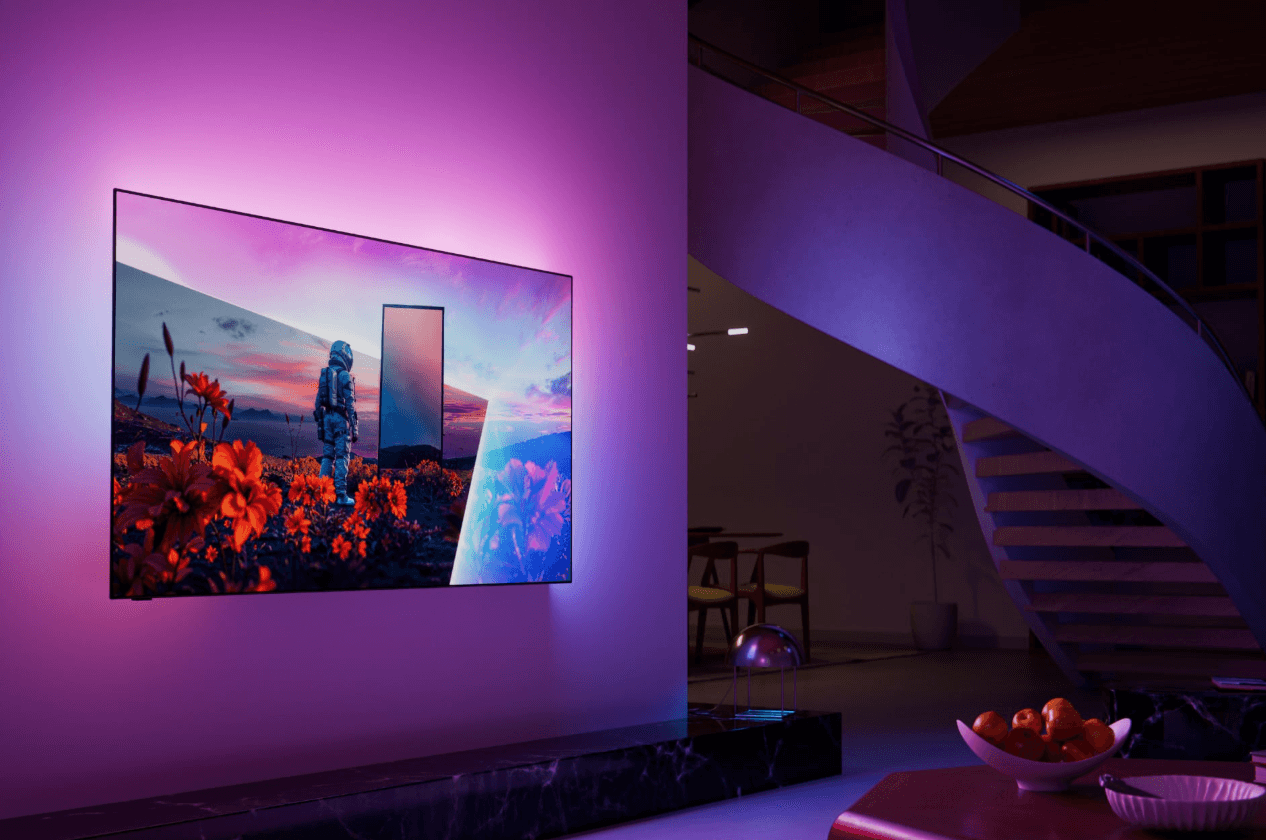
These include the new Philips OLED811 (above), which is equipped with an OLED EX panel instead of the more advanced Primary RGB Tandem WOLED displays found on the higher-end models. The OLED EX panel was formerly LG’s best technology until it was displaced by Primary RGB Tandem, and it’s certainly not too shabby in the brightness department, with Philips saying the OLED811 can hit up to 2,500 nits across its larger 55-inch, 65-inch and 77-inch models. Expect the smaller 42-inch and 48-inch models to be a bit less bright than that.
The OLED811 gets the same processor as the one found in the big boys, though. That’s quite an upgrade, and the Pentonic 800 chip is also there, which means four HDMI 2.1 slots, positioning the TV as a solid, affordable offering for gamers. It also has support for the new AmbiScape light system and all of the major HDR formats, including Dolby Vision 2 Max. Like the OLED951, it has a 70-watt 2.2-channel sound system and runs TitanOS.
Below the OLED811 is the OLED761, which succeeds last year’s OLED760, which was widely rated as one of the best affordable OLED models money could buy. It’s fitted with LG Display’s new, lower cost OLED SE panel, which provides around 1,000 nits of brightness. AmbiScape is present, but the chip is not quite so powerful. The OLED761 is equipped with Philips’ 7th Gen P5 AI processor. Still, it also has four HDMI 2.1 ports to enable 4K gaming at 120Hz.
The OLED761 will come in 55-inch, 65-inch and 77-inch sizes, Philips said.
As usual, Philips has also launched a broad range of LCD TVs, with the headline act here being the upcoming Philips MLED918, which is the company’s first RGB LED TV, also known as MicroRGB or RGB Mini-LED.
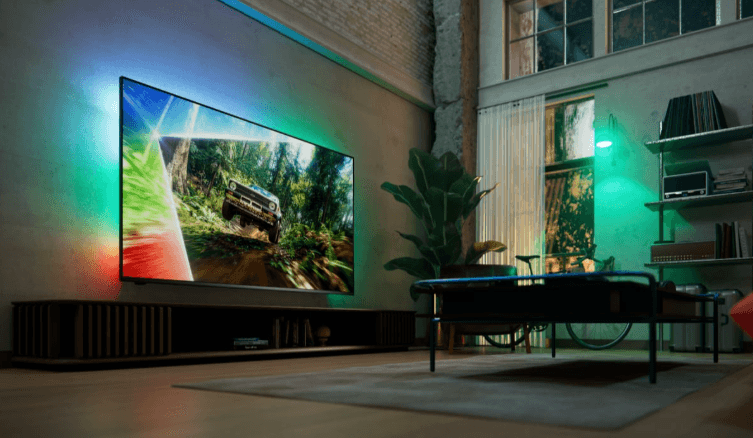
While the MLED981 will sit above all of Philips’ traditional Mini-LED TVs, it will surprisingly sit below the entire OLED range, including the OLED761 entry-level model. So it may well prove to be surprisingly cheap by the time it hits the shops in October.
Philips said the MLED981 will come in a single 85-inch size. It’s said to include an impressive 11,520 local dimming zones and will hit a peak brightness of 2,500 nits. The numerous zones should ensure enhanced halo control and reduced motion artefacts, the company promised. It runs the 10th Gen P5 AI, has many of the AI features found in the OLED models and supports Dolby Vision 2 Max, and TitanOS sits inside. The audio is provided by a 70-watt 4.1-channel sound system that features two down-firing drivers, two side-firing units and a subwoofer mounted at the rear of the TV.
Further down, there’s the new Philips PQS9001 TV, branded as “The One.” It’s a standard QLED model that will come in sizes ranging from 43-inches to 100-inches. It will support the more basic version of Dolby Vision 2, with sound capabilities varying, depending on the size of the TV. For instance, the 43-inch model will come with a 20-watt 2.0-channel system, while the 75-inch, 85-inch and 100-inch versions will have a 50-watt 2.1-channel system. As for the 50-inch, 55-inch and 65-inch models, these will have a 40-watt, 4.0-channel system.
