Samsung Display’s researchers have teamed up with academics at the Korean University POSTECH to carve out a significant breakthrough in 3D TV visuals. According to reports, they have developed a way to switch between extremely high resolution 2D images and realistic, glasses-free 3D pictures at the click of a button.
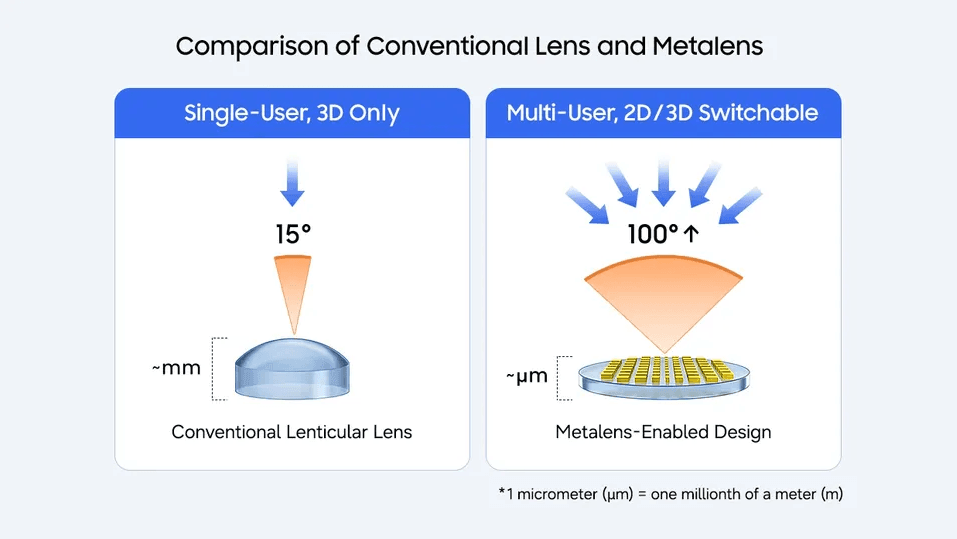
Glasses-free TV is not a new concept, with both TCL and Visual Semiconductor showing off prototypes based on plenoptic, or “light-field” displays recently. However, Samsung is pursuing a different take on light-field screens that uses a “metasurface lenticular lens” layer made up of “nanoscale structures” that enables the seamless transition between flat 2D and stereoscopic 3D images.
Korean trade journal The Elec proclaimed the breakthrough as significant, because conventional light-field displays have always required extremely bulky lenses and suffer from narrow viewing angles and low resolutions. Some implementations also require “real-time eye tracking” to enable 3D. But Samsung says its new approach eliminates these issues.
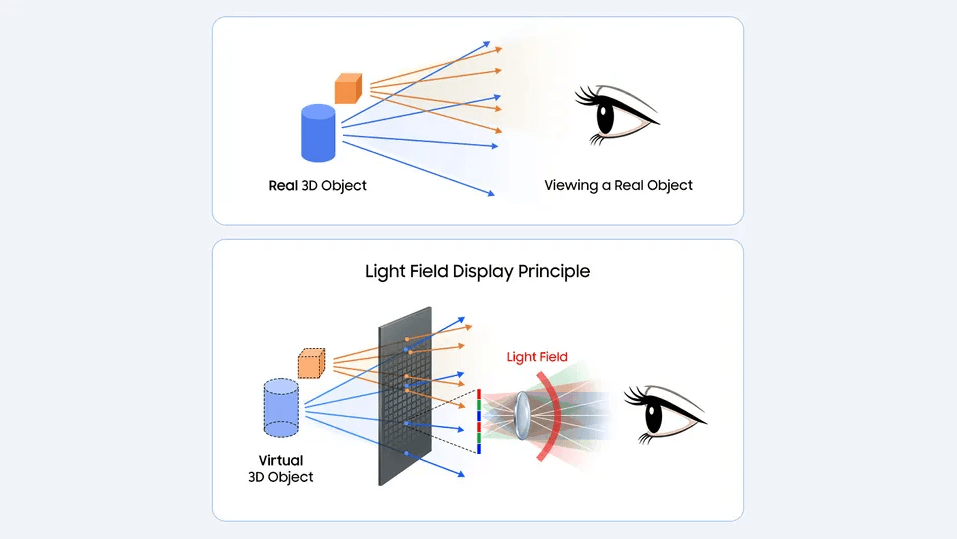
Samsung’s system is similar to existing light-field displays in that it transmits light from multiple directions simultaneously in an effort to copy the way light reaches the eye when looking at objects in the real world. The idea is to trick the brain into thinking it’s seeing a 3D object, even though the screen is flat. The goal is to eliminate that “sweet spot” where you’d normally have to sit to realise the 3D effect. Because if 3D TVs only have narrow viewing angles, they’re unlikely to become popular.
With its novel metasurfaces, Samsung appears to have hit on a solution. They enable the complex optics without requiring a bulky lens array. Moreover, the lens can adapt its focal properties on the fly to switch between 2D and 3D simply by adjusting the voltage. The Elec said the prototype display enables the 3D effect at viewing angles of up to 100 degrees, despite it being just 1.2 millimetres thick.
While promising, the technology is still in the very early stages of development. Samsung’s lens was tiny, measuring just 25 square centimetres, or about a quarter of the size of a typical smartphone display. Scaling the tech up to TV size will be a challenge.
It’s likely that any commercial applications of this tech will initially be on the small side, but it could still be pretty cool. Samsung said a smartphone might be able to reproduce someone’s photos in 3D, thanks to the depth metadata modern cameras record.
Whether or not the technology ever makes it into TVs is an open question. We’ve seen multiple dawns of the “3D TV era” over the years, only for the technology’s popularity to fade. The first 3D cinemas in the world opened way back in the 1950s, and they were revisited in the 1980s, followed by a spate of actual 3D TVs in the early 2010s that never really caught on, due to the need for glasses.
But if Samsung finds a way to scale up its glasses-free tech to TV sizes and keep it relatively low cost, there’s a chance that the 3D trend may have more staying power.
