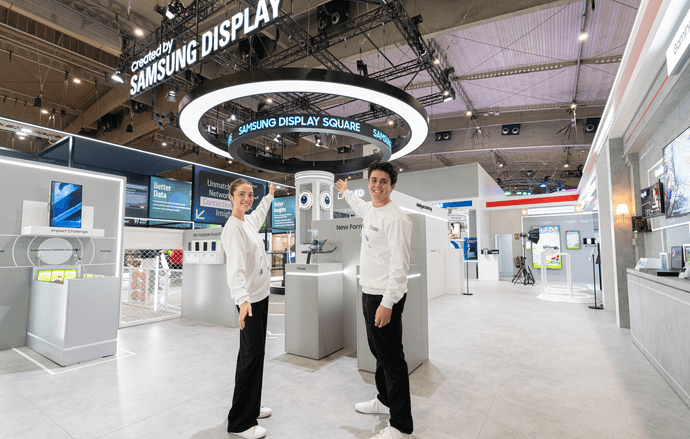
Samsung Display is taking center stage at MWC Barcelona 2026 this week, showing off how its vision of a future in which AI technologies become closely integrated with a range of flexible and innovative OLED display concepts.
The company’s exhibits at MWC can be found within an “Intelligent OLED City” that’s divided into four separate zones – the AI Square, AI Edge District, AI Entertainment District and the AI Sports District.
One of the most intriguing innovations is Samsung’s Flex Magic Pixel technology, which aims to protect OLED displays from prying eyes and ensure user privacy. Whereas most TV display makers are interested in expanding viewing angles, such a capability is not nearly as desirable on smartphones, which are far more personal devices. Very often, people might be looking at something on their smartphone that they don’t want others to see – such as a personal message. In such cases, wide viewing angles are a problem.
Samsung’s Flex Magic Pixel tech is meant to solve this. Found in the AI Square section of the sprawling exhibit, it works by precisely controlling the direction in which the light from the pixels is diffused, and basically ensures that all of the light is beamed straight ahead into the eyes of the person viewing the smartphone. They’’ll see a perfectly clear and vibrant image, but if anyone is looking at the display from a slight angle (such as standing to their side, trying to look over their shoulder), they’ll barely be able to see anything.
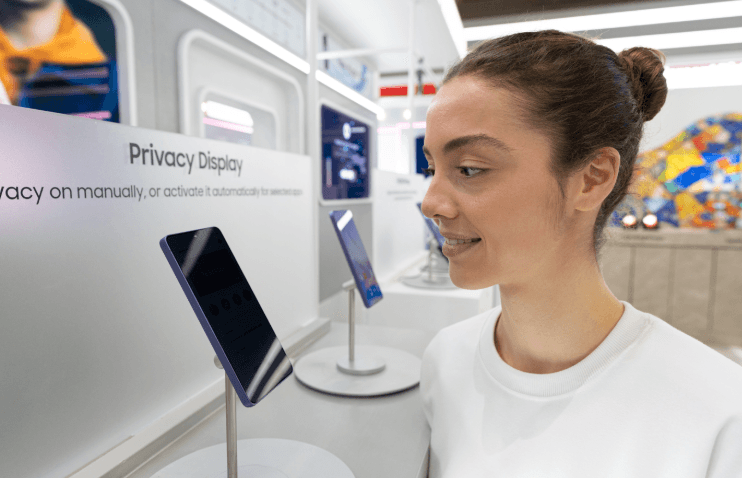
Flex Magic Pixel is built atop of Samsung Display’s LEAD display technology, which stands for Low-power, High-brightness Emitting Array Display. It integrates a “multi-shielding structure” with that tech that utilises ultra-fine, patterned black matrix layers to prevent light from the pixels from escaping at various angles, and ensure it only goes directly ahead, to the viewer. The tech made its debut in the new Samsung Galaxy S26 Ultra, which launched late last year, but this is the first time it has been shown in other devices.
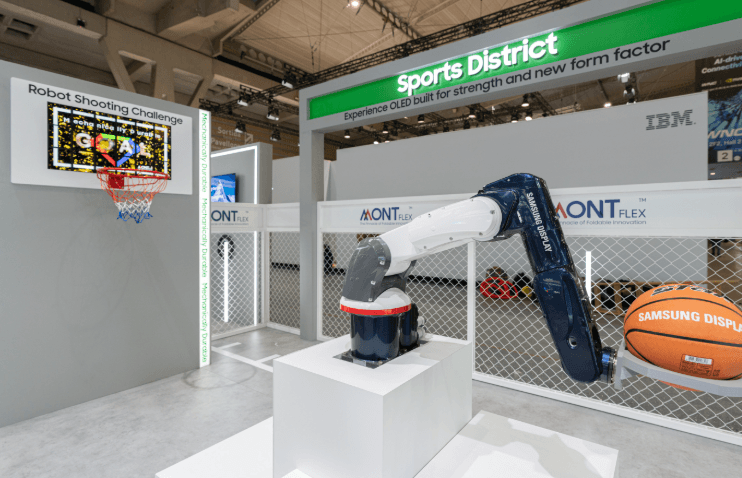
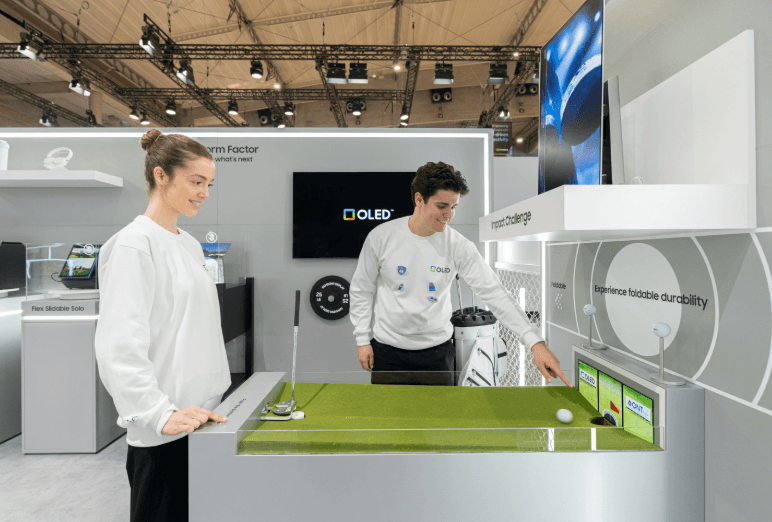
There are plenty of other innovations on show. In the AI Sports District, Samsung Display is inviting visitors to see for themselves the enhanced durability of its foldable OLED displays, which have been deployed in various novel applications. For instance, the company has created an automated golf putting machine that uses a foldable OLED smartphone as the “hole.” In addition, Samsung Display has set up an impact resistance test that uses a robotic arm to throw basketball balls against a backboard that’s made up of 18 foldable smartphones in order to demonstrate their incredible durability.
Moving to the AI Edge District, Samsung Display is showing its vision for connected devices with a number of previously unseen new concepts. These include the Mini Petbot, which is a pocket-sized robot companion equipped with a 1.34-inch circular OLED display for its face, enabling it to showcase a wide array of different emotions, based on its experiences and its “moods.” According to the company, it’s an example of how displays are evolving from simple information panels to become more intuitive AI interfaces that can visualise and also control AI applications.
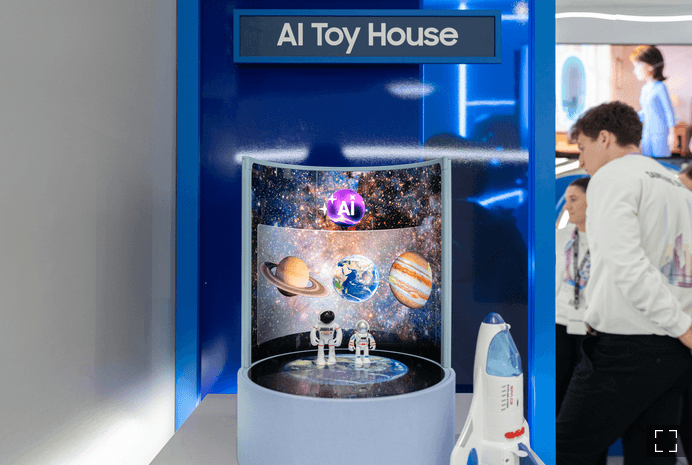
The AI Toy House is another intriguing concept that incorporates two separate displays – a 13.4-inch circular OLED display alongside an 18.1-inch flexible OLED display that can be folded or bent out of shape. The company said this enables tons of flexibility – for instance, it can serve as a display stand for figurines or dolls, or else transform into a fancy interior decor item. The company plans to integrate voice AI functions with the device, so it will be able to automatically adjust what’s shown on the display.
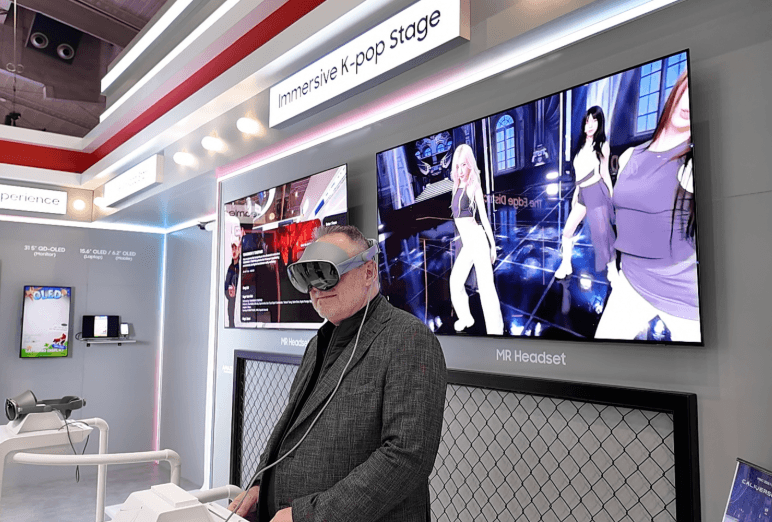
Last but not least is the AI Entertainment District, where the focus is on “next-generation viewing experiences.” Here, the company is showcasing its prototype red, green and blue Organic Light-Emitting Diodes on Silicon technology, otherwise known as RGB OLEDoS. It’s an ultra-high-resolution display with microscopic pixels that can be fitted onto a tiny silicon wafer. It’s made by depositing RBG OLEDs without a separate colour filter, enabling it to achieve a much wider colour range and more consistent colour integrity, the company said.
RGB OLEDoS is primarily designed for virtual reality and mixed reality headsets. One of the concepts involves a MR headset with a 1.4-inch RGB OLEDoS display that boasts an impressive density of 5,000 pixels-per-inch. What that means is that users can expect to see extremely vivid detail on the tiny display, with Samsung claiming that it’s about ten-times sharper than the average smartphone, which typically have between 400 and 500 PPI.
The AI Entertainment District also hosts a Bezel-less OLED Wall that combines two 6.8-inch and two 27-inch OLED panels in a panel configuration to illustrate just how slim its bezels really are – looking at the combined display, it’s barely possible to make out the boundaries between the different screens.
