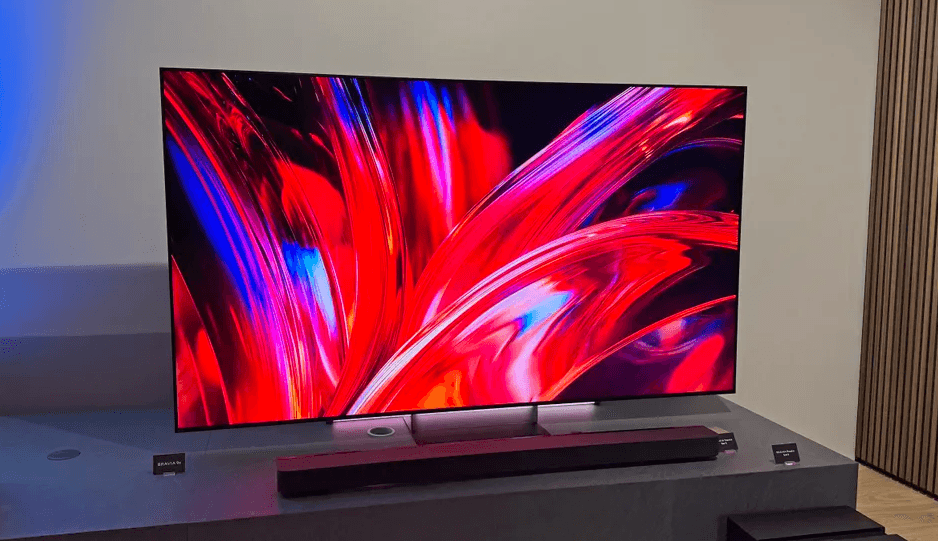
Sony has finally announced its extremely eagerly anticipated “True RGB” televisions, which are the first from the legendary company to be powered by RGB Mini-LED backlights. The new TVs are called the Sony Bravia 9 II and Sony Bravia 7 II, and they're available to pre-order in the U.K. from today.
The TVs are widely expected to be among the best that money can buy in 2026, particularly given how long Sony has been refining its take on RGB LED technology. The company first showcased its True RGB concept in March 2025, then provided an even more detailed look in September, and then again just a couple of months back. So it’s a relief to learn that they’re finally ready to ship.
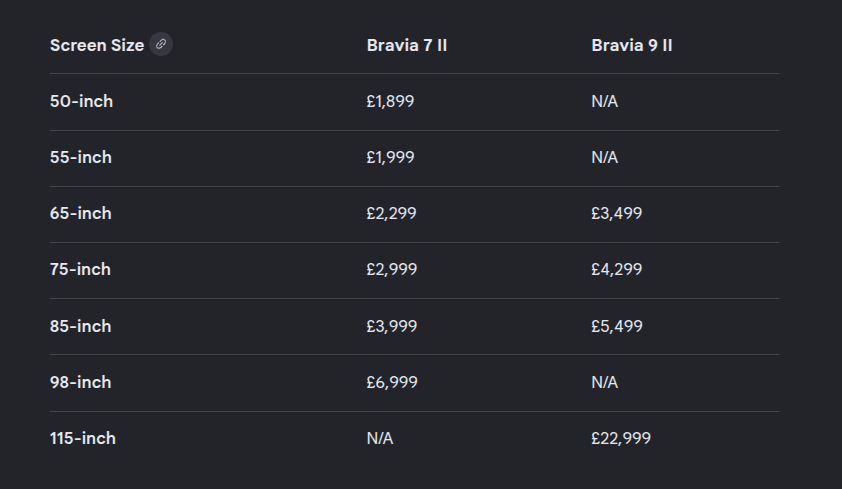
The flagship model is the Sony Bravia 9 II, and it will be sold in 65-, 75-, 85- and 115-inch sizes. Meanwhile the Sony Bravia 7 II is the step-down model that still promises to be really awesome, and it’s notably the first RGB LED TV from any brand to come in a smaller 50-inch size. Until now, the smallest we’ve seen was 55-inches.
Regular readers will know all about RGB LED technology, which first emerged last year with Samsung Electronics’ and Hisense’s gigantic models. It’s based on standard Mini-LED tech, but the backlight is made up of miniature red, green and blue LED sub-pixels that allow it to better match what the pixels in front are supposed to show. Sony explained that this enables the TVs to create a wider range of colour, and because there’s no colour filter, it means the display has fewer layers than regular Mini-LED TVs, boosting its energy efficiency.
Sony’s True RGB TVs also feature the company’s proprietary X-Wide Angle Pro technology, which enables wider viewing angles, and there’s a new anti-reflective coating too. The company did not disclose much about what went into this new coating, but it appears that some kind of matte element was used to help deal with ambient light reflections.
The flagship model has a significantly more powerful backlight than the Bravia 7 II, but Sony did not offer a direct comparison of the two TVs, because it likes to keep the intricacies of its display technology close to its chest. However, the company was willing to contrast the Bravia 9 II with last year’s Sony Bravia 8 II QD-OLED TV and the original Sony Bravia 9 Mini-LED model (with a non-RGB panel) from 2024 and let attendees at its launch event see the difference. It also included its Hollywood-standard reference studio monitor – used for grading blockbuster movies – in the comparison.
HDTVTest’s chief reviewer Vincent Teoh was on hand in Tokyo to see the comparison for himself, and he reported back with his findings in this video:
Sony has been saying for some time that its goal is to make its TVs replicate the HDR experience seen on its new reference monitor, which has a brightness rated at 4,000 nits. Until now, most movies have been mastered at just 1,000 nits, but the company believes that since its monitors are the standard among Hollywood studios, most newer films will be mastered at 4,000 nits brightness, and that means viewers will need a comparable TV to replicate the full tonal range and get the best possible picture quality.
Obviously, that means existing TVs simply won’t cut the mustard, but the Sony Bravia 9 II will change that. In the direct comparison versus the Bravia 8 II and Bravia 9, the Bravia 9 II showed significantly more colour saturation than the others, and was by far the closest match to the BVM-HX3110 reference monitor. Notably, the new Sony TV lost a lot less detail than the other two.
Sony did not confirm the exact brightness of the Bravia 9 II, but some early reviews have measured it at around 3,900 nits, which is pretty close to the Sony BVM-HX3110. In some of the brightest scenes, it more or less matched the monitor’s brightness level, including when it showed a 4,000 nit demo clip from the movie Alpha.
While Sony didn’t confirm any numbers, it did say that the Bravia 9 II is around twice as bright as the Bravia 7 II, so that would suggest the stepdown model may be able to reach around 2,000 nits peak brightness. One interesting thing to note is that both the Bravia 9 II and Bravia 7 II demonstrated superior BT.2020 colour gamut coverage than the reference monitor.
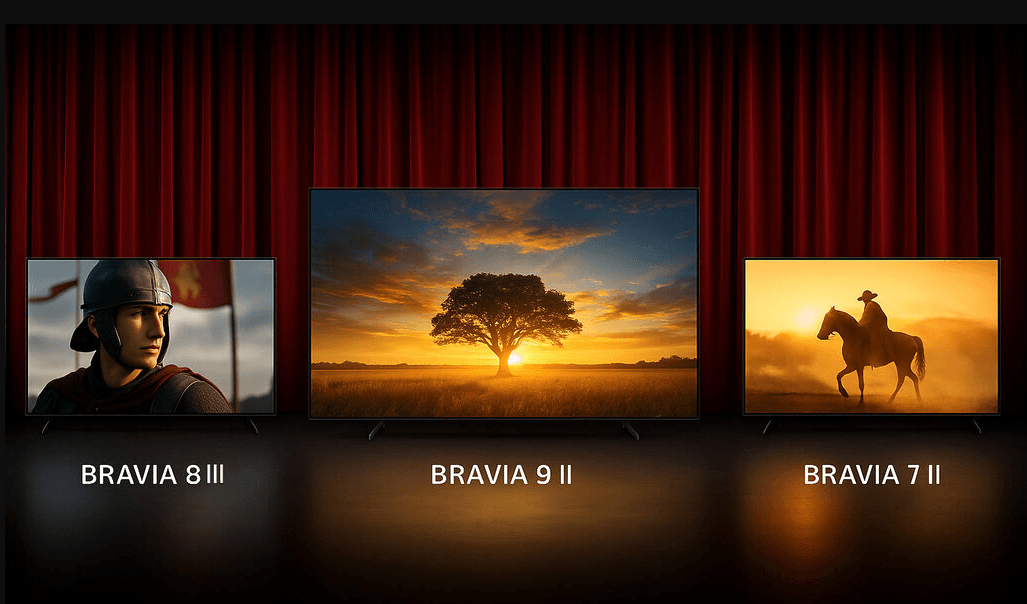
In addition, the Bravia 9 II also displayed less colour banding and enhanced dark grey gradation in Sony’s demonstration. The company also highlighted the energy efficiency of the RGB LED panel, which means the TV can either consume less power or achieve higher brightness. A third demo showcased the TV’s wide viewing angles, which were also superior to the other models.
While we haven’t yet had a chance to review the Sony Bravia 9 II, the first look is incredibly promising, with the TV displaying higher colour volume, extremely high brightness and widener BT.2020 coverage – a clear improvement over the company’s highly-rated Bravia 9 and Bravia 8 II models. The matte screen coating was also effective at suppressing ambient light reflections, although like with Samsung’s matte display, it does also appear to reduce the intensity of highlights somewhat.
As mentioned, Sony said the Bravia 9 II and Bravia 7 II are available to pre-order now globally, and they should ship in “late spring,” which suggests they’ll be on sale in retail stores imminently. Just beware that Sony, as always, asks for a significant premium on its TVs compared to competing models with similar specifications. We asked Gemini to whip up this little price chart so you can see the costs at a glance:
Sony’s focus was clearly on refining the RGB LED backlight to try and make it superior to those of rivals like Samsung, Hisense and TCL, and it does appear to have neglected the underlying hardware, for both TVs appear to be powered by the aging MediaTek Pentonic 1000 SoC.
Sony hasn’t confirmed this, but it makes sense because the TVs still only come with two HDMI 2.1 ports, which is obviously less than the four found on the back of many of its rival’s higher-end TVs. According to FlatPanelsHD, Sony said at the event that the decision to retain the older chipset was taken at the beginning of the lengthy RGB LED development process.
The older chipset also means that neither the Bravia 9 II nor the Bravia 7 II will be able to support Dolby Vision 2, though they do support the original Dolby Vision standard.
With the launch of the new TVs, Sony has discontinued the popular A95L QD-OLED TV that was launched in 2024, which means buyers will soon no longer be able to buy a 77-inch Sony OLED TV, once existing stocks are sold out. The Bravia 8 (featuring a WOLED panel) and Bravia 8 II will carry over into this year, but they’re only available in smaller sizes (55- and 65-inches).
