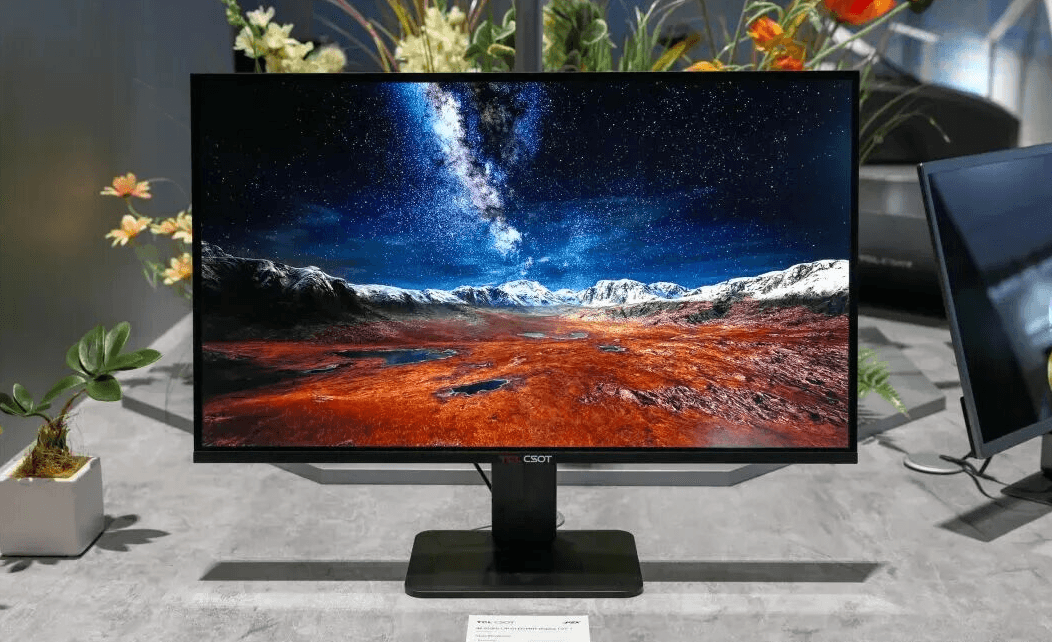
Last week came the news that TCL is launching its first ever OLED-based monitor, and it’s pretty damn sleek. But now there’s even bigger news, for the company’s display making subsidiary TCL CSOT is about to start mass producing its very own inkjet printed OLED monitor panel, well ahead of schedule.
Chinese language publications Sina and EET China reported this weekend that TCL CSOT’s first OLED display will be a 27-inch, 120Hz 4K resolution panel based on an RGB-stripe pixel architecture. The reports said that the panel has just secured the internal verification required for it to go into mass production, and it could start flying off the production line as soon as July 2026.
Supposing the reports are accurate, it would mean that TCL CSOT has gotten its new 8.6G OLED manufacturing facility up and running far faster than anyone expected. When the company announced it had broken ground on the facility last year, it said it was expecting it to go into operation in 2027 at the earliest. However, it’s not surprising that the company is putting its foot down, for rivals such as BOE and Samsung Display are also trying to accelerate the construction of their own 8.6G OLED plants.
The T8 facility is likely to become the world’s first 8.6G OLED plant. Inkjet printing is an alterative manufacturing technique for OLED displays that involves depositing organic light-emitting materials with high precision onto substrates using advanced printing technologies. According to the company, it “delivers excellent colour performance, high resolution, energy efficiency, and cost-effectiveness, making it ideal for a wide range of applications from small devices to large panels.”
The process is different from the one employed by LG Display and Samsung Display, which simply use a mask in order to spray the OLED materials onto their substrates, resulting in much more waste – that’s why TCL CSOT claims that IJP will be much more cost-effective. The company believes it will be able to reduce the production costs of OLED panels and pass these lower costs onto consumers, resulting in lower-priced OLED products.
The company is initially focusing on medium-sized panels, which means monitors, laptops and tablets, but it eventually wants to start manufacturing larger displays for television too.
It remains to be seen how TCL CSOT’s OLED panels will compare with those of LG Display and Samsung Display, however. While the company has showcased multiple prototypes, including at last year’s SID Display Week, it has not discussed the specifications. No doubt, we’ll have to wait until the first actual products are available before we can see how they stand up to the competition.
As to when that happens, that’s also uncertain. The supposed July launch data only refers to the panel itself, which will then be sold on to monitor makers, who will have the job of integrating it with actual monitors and bringing them to market. So we don’t expect to see anything launch until the end of the year.
Parent company TCL will likely be one of the first monitor brands to use the new panel, but its first OLED display will not be based on its own technology. Rather, the 32-inch TCL 32X3A announced last week is equipped with one of LG Display’s WOLED panels. It sounds like a beast, though, with its 3,840x2,160 resolution display, 240Hz refresh rate that can be cranked up to 480Hz at 1,080p and 0.03 ms response time putting it into the top tier of gaming monitors.
