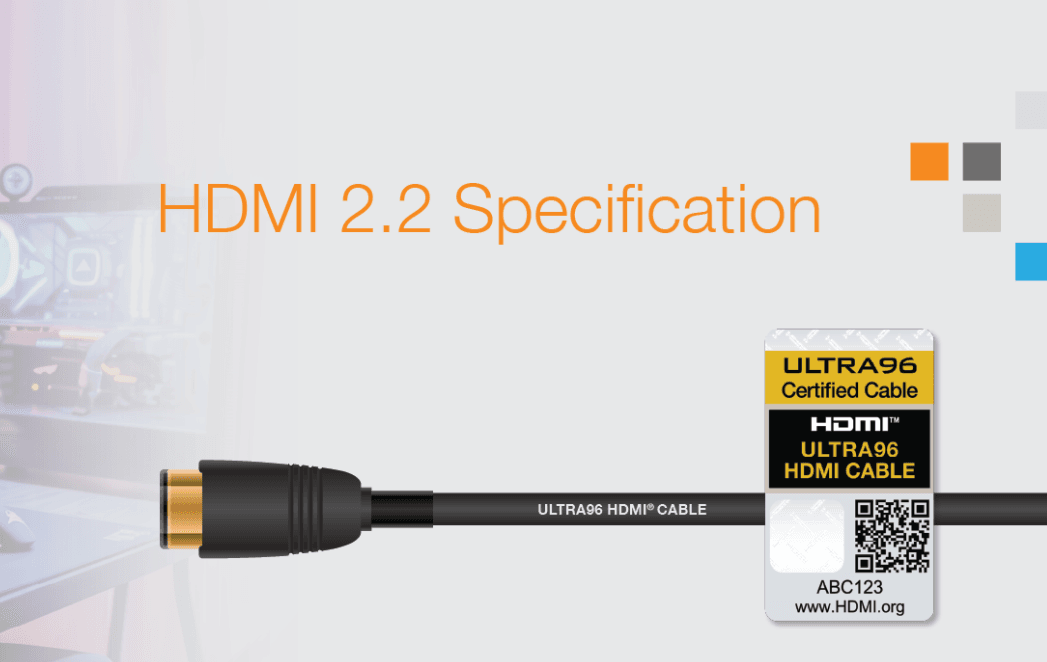
The specifications of the new HDMI 2.2 standard were unveiled last year, but we’re going to have to wait until next year before we see the first devices that support it, according to an update from the HDMI Licensing Administrator.
The organization told ARMdevices.com at the Computex 2026 event in Taiwan earlier this month that it’s already engaged in testing and certification for the new standard, according to a report by FlatpanelsHD.
It suggests a similar timeline to what we saw with HDMI 2.1. The existing standard was first announced in 2017, and it wasn’t until 2019 that the first devices capable of supporting it were launched, starting with LG Electronics’ 2019 televisions. The HDMI Forum first announced HDMI 2.2 in January 2025, and it was officially released six months later, so the 2027 arrival date of the first devices would also mean a two-year wait to see it in the real world.
Rob Tobias, CEO and President of the HDMI Licensing Administrator, told FlatpanelsHD that some chipmakers are already sampling the FRL2 chips required to support HDMI 2.2, and he expects them to reach volume production soon. “We should start to see some 96 or up to 96-gigabit HDMI 2.2 products next year,” he added.
The first Ultra96 cables necessary to take advantage of HDMI 2.2 should be released this year, but hardware such as TVs, games consoles and media players take a lot longer to prepare, Tobias said. He did not specify what kinds of devices we’re likely to see first, but there’s no reason why premium TVs won’t be among them.
According to Tobias, the implementation of HDMI 2.2 should be much simpler than the transition from HDMI 2.0 to HDMI 2.1, because that update required hardware makers to use a brand new signalling system. Companies had to move from TMDS to the first generation of FRL to support HDMI 2.1 devices. The transition from FRL to FRL2 involves a lot less hassle, and will hopefully result in fewer problems, such as some of the issues we saw with the first generation of HDMI 2.1 AV receivers.
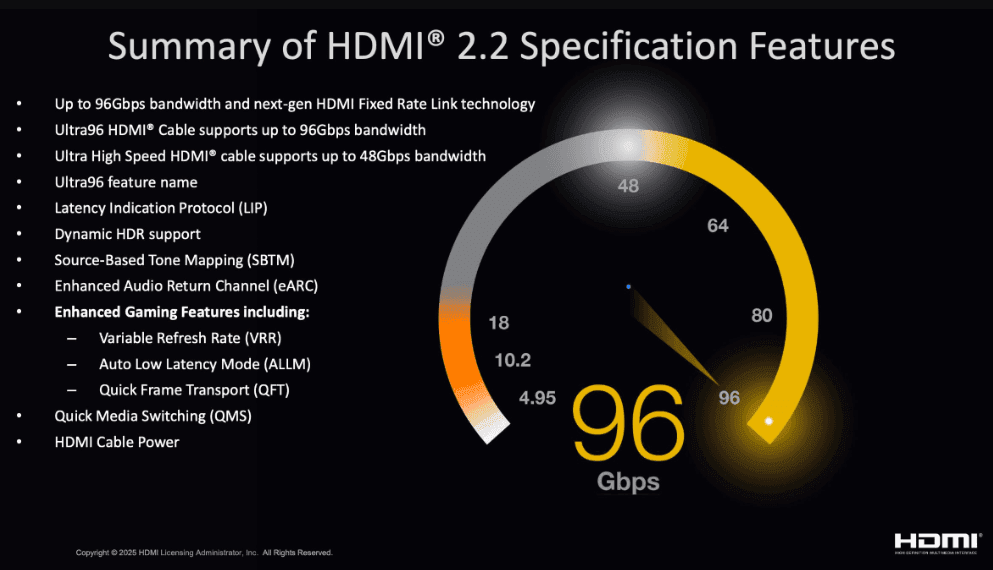
It’s important to note that HDMI 2.2 is the first version of the specification to arrive in different flavors. While the standard expands the bandwidth to 96Gbps, this is actually optional. It could cause some confusion, with some devices being marketed as HDMI 2.2 despite having a lot less bandwidth. The onus will be on consumers to check that the devices they’re buying do actually support the higher bandwidth, even if they’re marketed as HDMI 2.2.
In fact, HDMI 2.2 supports three bandwidth tiers, with the lowest being 64Gbps, followed by 80Gbps and then 96Gbps. At least, they’re all in excess of the 48Gbps supported by HDMI 2.1, so any device marketed as HDMI 2.2 will be faster.
Devices that come with the full-fat 96Gbps bandwidth will theoretically be able to support 4K at a blazing-fast 240Hz, or 8K at 120Hz. They will also be able to handle even higher resolutions, such as 12K at 120Hz or 16K at 60Hz, which would enable the creation of displays capable of reproducing mind-blowing detail and accuracy – if, but only if, you can find native content shot at such crazy high resolutions. This is why it’s considered by some to be the first version of HDMI to have native 8K support.
Monitors that support HDMI 2.2 should be able to playback 1440p at over 1,000Hz. However, it’s TV enthusiasts that have more reason to be excited, for many monitors already support the alternative DisplayPort 2.1 standard, which delivers up to 80Gbps bandwidth.
Tobias said the first TVs capable of showing context at 4K 240Hz are already being tested with HDMI 2.2, though he didn’t name any of the companies involved.
It may not be too long before we see the first devices that can support an alternative to HDMI 2.2. Last year, a consortium of Chinese technology firms unveiled a rival specification known as the General Purpose Media Interface or GPMI, and it also comes in distinct flavors. But notably, the higher tier, known as Type-C, promises to support a blazing-fast 192Gbps bandwidth. Type-B will match HDMI 2.2 at 96Gbps.
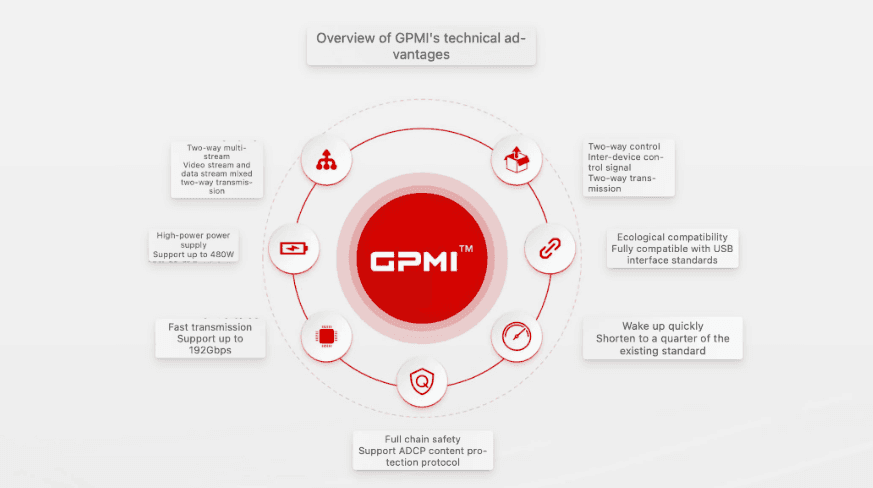
The GPMI’s creators say that in addition to its support for 8K UHD video transmission, it will provide other advantages. For instance, it’s able to deliver power as well as data, similar to Apple’s Thunderbolt 5 standard, which is used by MacBooks. HDMI 2.2 is limited to only pictures and audio signals. This means that a GPMI-enabled TV would be able to send power to another device that’s connected to it, such as a games console or an amplifier, with no need for that device to have its own power cable.
Another benefit of GPMI is that Type-C will be compatible with the existing USB Type-C connections found on millions of existing devices, allowing it to send up to 240-watts of power. Type-B will have a proprietary interface that bumps this up to 480-watts.
HDMI 2.2 could have a fight on its hands, but its lower bandwidth is offset by the fact that it has become entrenched as the default cable specification on almost every television, streaming device and console in the world. We can’t see a world where brands start dropping it in favor of a Chinese alternative.
