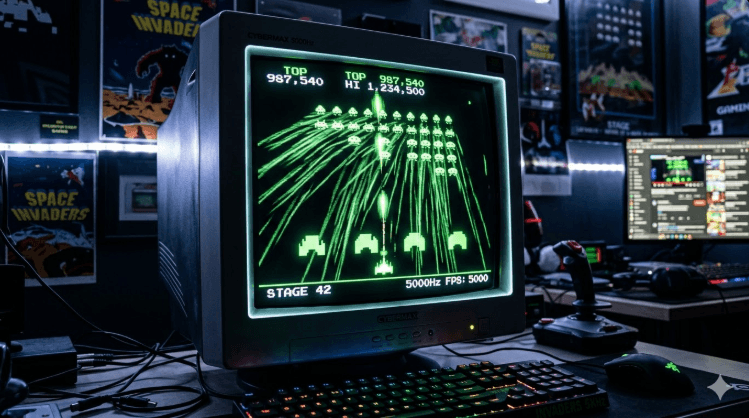
Microsoft is planning to update Windows 11 and enable support for breathtakingly fast monitors of up to 5,000Hz.
The company said in release notes that Windows 11 monitors “can now report refresh rates higher than 1,000Hz, but Blur Buster’s Mark Rejhon claims that the upper limit far exceeds that number in reality.
Rejhon has been one of the primary advocates of support for much faster refresh rates, and claims to have single-handedly pushed Microsoft’s engineers to make this possible.
In his own blog post, he cited his communications with a contact at Microsoft, who said in a February email that “I just put a change in that will raise the limit to 5000 Hz on retail Windows 24H2 and later 😁. It should be available in the Windows Insider Dev channel soon and will rollout to retail.”
Rejhon has previously reported that multiple monitor brands are working on the development of 2,000Hz displays and hope to launch these products by 2030
At present, the fastest monitors available can reach a maximum of 1,040Hz. Several companies, including Samsung, Philips, TCL and AOC, are planning to launch monitors capable of those speeds this year, although they’re all LCD models. The fastest OLED monitors are currently capped at 720Hz. However, it’s believed that such OLED models still outperform the faster LCD displays, because of their superior motion clarity.
It was just a few years ago that we became giddy with excitement about the arrival of 120Hz TVs and monitors and their impact on video games especially. With monitor speeds now accelerating dramatically, the question becomes at what point do the benefits become pointless?
The answer is that we still have a significant way to go. Rejhon explained in two earlier articles that human retina refresh rates can actually perceive speeds as high as 20,000Hz, partly because “higher resolutions and faster pixel response amplifies refresh rate differences.” That’s why Rejhon and Blur Busters are advocating for the industry to embrace speeds of up to 10,000Hz in future.
Such incredibly rapid monitors are still some way off, though. For now, we’re eagerly anticipating the first 1,040Hz monitors and waiting for news of when OLED displays will follow. To go beyond this, the industry will have to catch up in other ways, as such speeds can only be supported by emerging standards such as HDMI 2.2, China’s GPMI interface and DisplayPort 2.1b.
