
The Alliance for Open Media released the new AV2 video codec in early June, and it’s already demonstrating solid ecosystem traction, with the likes of Google, YouTube, Meta, Netflix, Amazon and Apple all expressing support for the format.
AV2 promises 30% more compression efficiency compared to its predecessor, the AV1 codec, which translates to either better video quality overall or much lower bandwidth/bitrate requirements to achieve the same quality as AV1. It also brings other benefits, such as enhanced multi-view video capabilities, and so news of its growing traction is a welcome development in the streaming industry.
Netflix research scientist Andrey Norkin discussed many of the benefits of AV2 in a video presentation last year, noting that in addition to its improved video compression efficiency, it also has a higher peak signal-to-noise ratio or PSNR than AV1. PSNR is a metric that measures the quality of compressed images after they’re decompressed by comparing them to the original.
AV2 also showed a 32.6% gain on the Video Multi-Method Assessment Fusion benchmark, which assesses video quality by comparing a reference video to a distorted version to measure how accurately they’re perceived by human eyes.
Norkin also pointed to AV2’s support for augmented reality, virtual reality and 3D content streams at much higher resolutions, as well as its multi-stream video capabilities, which is when multiple streams of the same event are streamed simultaneously. This bodes especially well for AV2 in live sports streaming, as it can enable multiple camera views during football games or picture-in-picture views of F1 racing, for example.
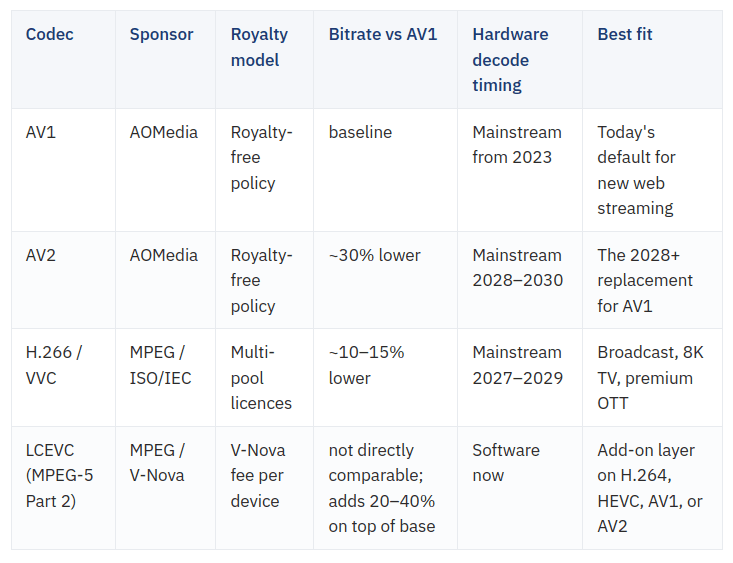
This week, the Alliance for Open Media provided an encouraging update on the community’s efforts to implement AV2 as the successor to AV1 and the royalty-based HEVC codec. HEVC is still the most widely-used codec for 4K HDR video streaming, but it is not open-source, which means streaming services have to pay licensing fees that are often passed onto consumers. That technology is at the heart of Disney+’s ongoing patent squabble with the U.S. firm InterDigital, and so there are good reasons to want to see it replaced.
Google Chrome’s vice president of engineering Jim Bankoski said partners including YouTube, Netflix and Amazon Prime Video are all looking at how they can implement AV2 as soon as possible. “Beyond faster, higher-quality streaming, AV2 lays the groundwork for new browser experiences, from better multi-view video to higher-resolution, more efficient video conferencing,” he said.
Of the main streaming services, Google-owned YouTube appears to have come along the fastest. It said it’s working to rollout AV2 on web-based video streams by the first quarter of next year. According to Des Keane, an engineering director at YouTube, more than 90% of the streaming platform’s content is already available in AV1.
“We’re excited to begin streaming in AV2, which brings even better video quality to users and unlocks new multi-video capabilities,” Keane said. “YouTube AV2 streams will be available for the web as soon as early 2027.
Meta Platforms is also looking to bring AV2 to services including Facebook and Instagram. Hassene Tmar, a technical program manager at the social media giant, said AV1 is already the most popular codec for Facebook and Instagram videos. “We’re committed to continuing that same path with AV2, carrying our investments through its productisation journey and making it as successful as AV1,” he insisted.
Despite the Alliance’s hard work, it’s going to take a long time until AV2 becomes the standard for video streaming on televisions, streaming dongles and mobile devices, because they lack the processing power required to utilise it.
The main challenge with AV2 is that it’s much more complex and requires around four-to-five times more computational power to decode compared to AV1. Running it on existing TVs and smartphones would require massive amounts of energy and likely result in rapid overheating of those devices.
Fortunately, the Alliance has a lot of influence over TV makers and chipmakers, and suppliers such as Amlogic, MediaTek and Realtek are all working on new processors that will integrate AV2 decoding blocks, with the first products expected to launch in late 2027 or early 2028. For smartphones, it will likely take a little longer. Semiconductor IP firms like Chips&Media and VeriSilicon are still finalising their designs for AV2 modules, and it typically takes around two-to-three years before such designs are integrated into new chips by companies such as Qualcomm.
That’s why we’ll initially see AV2 gaining traction through software-based implementations over the web. YouTube and Google are believed to be making good progress on a new software decoder called dav2d, which will enable them to implement web-based software streaming next year.
