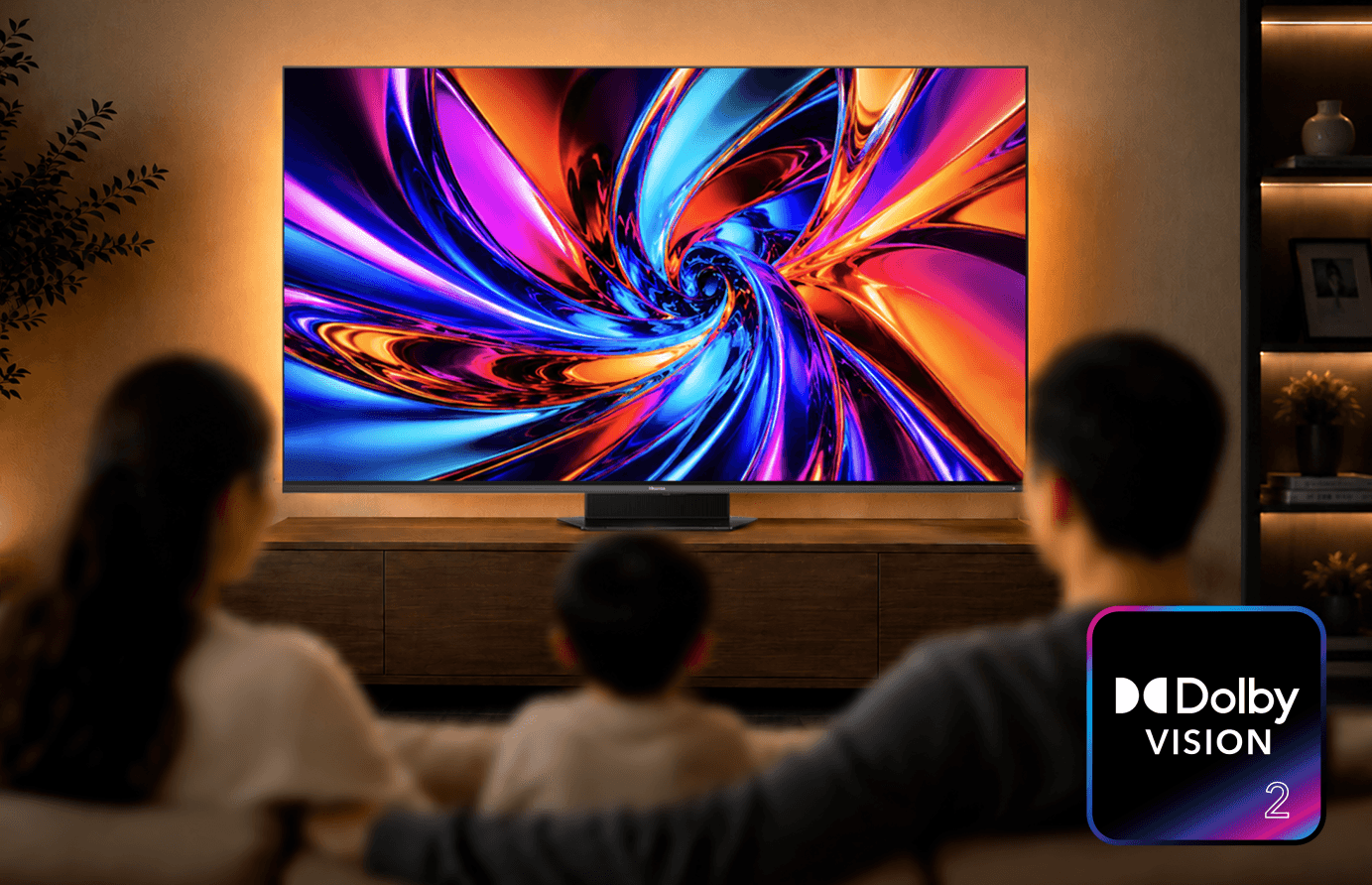
Dolby has announced that the Dolby Vision 2 HDR standard is ready to rock and roll on multiple Hisense TVs from today, and it will be coming to additional models, including some from TCL and Philips, in the coming weeks.
Hisense is getting first dibs on the enhanced HDR format though. The company is rolling out a firmware upgrade today in Europe, North America and Asia-Pacific, and there will be compatible content supplied by the U.S. streaming service Peacock, as well as the Chinese streamer iQIYI, the company said.
Dolby Vision 2 brings several entirely new features to HDR pictures, and it will also help ensure that existing Dolby Vision titles also look better on supported TVs, thanks to its upgraded image processing engine. According to Dolby, any movie or show that was mastered for the first generation of Dolby Vision will “look more captivating and authentic, offering a significant and immediate improvement.”
However, it’s the new media that’s been produced specifically for Dolby Vision 2 that should really look the part. The new standard introduces features such as Content Intelligence, which gives creators the ability to embed precise instructions about exactly how each scene should be rendered. This means it can dynamically adapt the picture on a scene-by-scene basis to ensure it hits all of those highlights across both brighter and darker parts. There’s also an intensity slider that allows viewers to customise exactly how intense they wish the experience to be.
You can check out this video from HDTVTest's Vincent Teoh last year to learn more about what makes Dolby Vision 2 so special:
There’s also Dolby Vision 2 Max, which is an enhanced version of Dolby Vision 2 for more advanced TVs that takes advantage of their greater processing power to enable two key features. These include Authentic Motion, which helps to generate more cinematic visuals while minimising judder and other artifacts that sometimes appear when excessive motion smoothing is applied. The other Max feature is Light Sense 2, which intelligently optimises the picture according to the level of ambient light in the room, so it doesn’t matter if you’re watching in pitch black darkness or a bright, sunny day. As per Dolby’s statement, Dolby Vision 2 is set to arrive on multiple TVs from today as a firmware update. Hisense’s 2026 models, including those running Vidaa OS and Google TV, will be the first to benefit. Dolby said five specific models are getting the upgrade immediately: the Hisense UX, Hisense UR9, Hisense UR8, Hisense U7 and Hisense U7 Pro.
What isn’t clear is which TVs will be getting Dolby Vision 2 next, nor when. All we know is that both TCL and Philips have promised firmware upgrades later this year. So we can expect that TCL’s high-end Super Quantum Dot TVs and RGB LED models will probably get it soon, along with Philips’ flagship OLED TVs, such as the OLED951, OLED911 and OLED811.
Vincent managed to get a quick glimpse of the Philips OLED951 showcasing Dolby Vision 2 just a couple of months ago, and the first impressions were pretty intriguing:
There are some technical considerations with Dolby Vision 2. The standard is currently only supported by MediaTek’s Pentonic 800 chip, so any TV that has different silicon is probably not going to be able to join the party anytime soon. However, Dolby has said that there are newer chips in the pipeline that will be able to support it in future.
It seems that Dolby has carefully planned its schedule for the rollout of Dolby Vision 2, because it had to work with multiple partners to coordinate everything. Samsung, on the other hand, probably found it easier because it’s one of the main contributors to the HDR10+ Advanced standard that rivals Dolby Vision 2, and that explains why it was able to announce that format’s launch just a couple of days earlier.
