
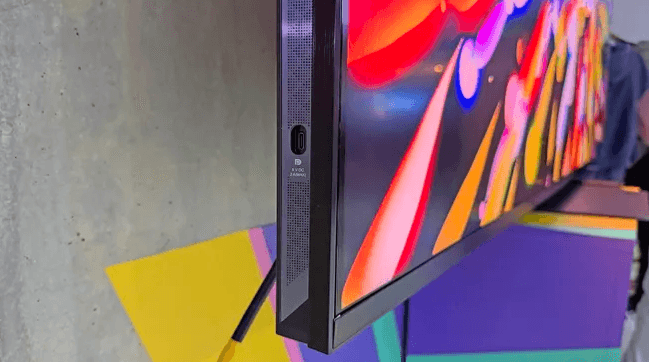
Hisense has revealed that its upcoming UR9S RGB Mini LED TV is going to have an extremely rare and unusual feature in the shape of a DisplayPort.
We learned about the Hisense UR9S for the first time last month, and it’s one of the higher-end models in the company’s 2026 lineup, featuring a colour-rich RGB LED backlight and the new Hi-View AI Engine RGB processor, which has been especially optimised for the new display technology.
However, it’s the DisplayPort connection that really sets this TV apart, although we should add that it’s not a full-size port, but a USB-C connector that officially supports the DisplayPort standard.
It’s an interesting feature because most high-end TVs default to HDMI 2.1 ports as their main inputs, and indeed, the UR9S – known as the UR9 in the U.S. – does have three of those. Hisense told TechRadar that the DisplayPort connector will support 4K resolution content at 170Hz or 180Hz, depending on the size of the model.
As to why the company decided to include it, it hasn’t actually said. But it could make sense given the fact that Hisense claims its RGB Mini LED TVs can cover more than 100% of the BT.2020 colour gamut. As TechRadar explains, by including DisplayPort, creative users should be able to achieve the maximum depth of colour available through the display, which might not be possible when using an HDMI 2.1 connection.
There is, of course, another reason to have a DisplayPort connector. That would be gaming, although the size of the UR9S, which will come in 65-inch, 75-inch and 85-inches in the U.K., will likely make it incompatible with most computer desks. But for PC gamers who are looking for a sofa setup, it could hold a lot of appeal. They’ll have the flexibility to use HDMI ports for their AV system, while the DisplayPort connector will enable them to take advantage of the higher refresh rates it supports. It means faster gaming experiences than what’s available with HDMI 2.1.
Hisense has said the UR9S supports AMD FreeSync, and although it hasn't confirmed support for Nvidia’s G-Sync technology, many of its older TVs are compatible with that standard too, even if they’re not officially certified.
Another intriguing aspect of this is that no RGB LED monitors currently exist, at least not to our knowledge, so that may also appeal to gamers that want a brighter experience than what’s available with the best OLED monitors. RGB LED displays use an LCD panel with a Mini-LED backlight, but unlike traditional Mini-LED, each light element has its own red, green and blue LED, which enables it to generate much finer detail and a more expansive range of colour. It therefore promises much greater colour accuracy, less blooming from light areas to darker ones, and higher brightness.
The TV also has a new anti-reflective matte coating that should ensure it works well during the daytime, when ambient light could be a problem.
While DisplayPort connectivity isn’t going to concern the majority of buyers, it’s an extremely novel feature that may appeal to some, all the more so considering that Hisense won’t be selling a UR9S TV that’s smaller than 65-inches.
Bear in mind that you’ll pay a steep price for the novelty, though. Hisense is selling the 65-inch version for $3.,499 in the U.S., and although we don’t have official U.K. prices yet, that works out at around £2,650.
