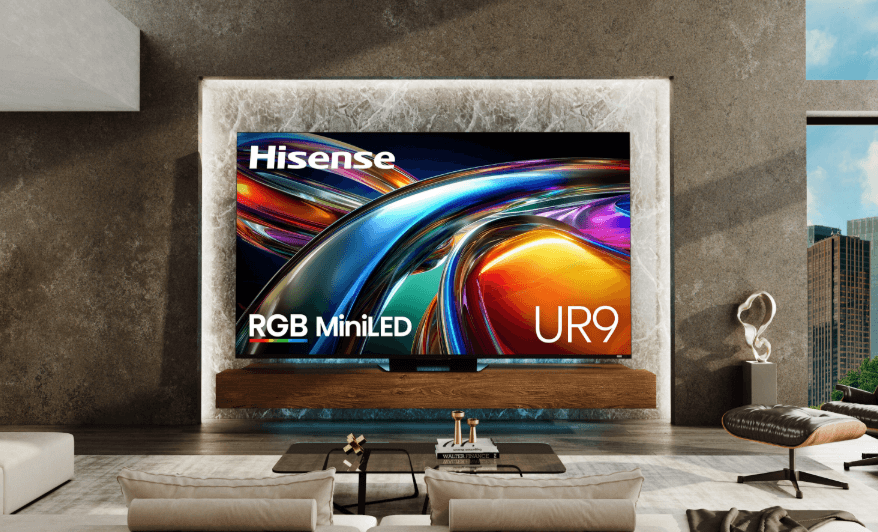
Hisense has unveiled its full lineup of TVs for the U.K. and Europe for this year, and there’s a lot to like, with the range headed by what should be some of the most affordable RGB LED models that money can buy.
The company was, along with Samsung, one of the first two brands to launch an RGB LED TV last year. That model was called the Hisense UX, and it was an absolute monster. Available in 100- and 116-inch sizes, it came with a sky-high price tag that still hasn’t come down much at all. The UX TVs will carry over into this year, the company said, but it will be joined by two models that should be within the reach of many more consumer’s budgets.
Hisense brands its RGB LED TVs as RGB Mini LED, and the higher-end of the new models is the Hisense UR9S, which will be sold in 65-, 75- and 85-inch sizes. It’ll be joined by the slightly-less capable Hisense UR8S, which will be available in the same sizes, plus a smaller 55-inch model and a bigger 100-inch version.
They’ll both come with powerful RGB Mini LED backlights and they’ll feature Hisense’s new Hi-View AI Engine RGB processor, which has been especially optimised for the new display technology. There’s an Anti-Reflection and Glare Free coating on both, and they’ll have a fast 180Hz native refresh rate, so they’ll be able to support 4K at 180Hz gaming, which is new, as most TVs run at either 120Hz or 240Hz.
The main difference between the UR9S and UR8S appears to be brightness, with the former capable of 4,000 nits and the latter restricted to a still very bright 3,500 nits. So regardless of which one you buy, expect great visuals even if there’s tons of ambient light. It’s likely that the UR9S has more dimming zones, though Hisense has not confirmed the number on either model yet
The UR9S comes with three HDMI 2.1 ports and a PC-friendly DisplayPort 2.1 connector, as well as a USB-C option. Meanwhile, the UR8S has four HDMI 2.1 ports, so connectivity may be a consideration for some buyers.
Both models will have a Devialet-tuned audio system, but the UR9S will be much more powerful. It comes with a 4.1.2-channel system, whereas the UR8S only has a 2.1.2-channel sound system.
One thing that has to be mentioned is Hisense’s new KiDoodle feature, which is a second remote control that’s designed for kids, and only allows them to access content that’s appropriate for younger viewers. It’s an interesting take on parental controls that should make life much easier for mums and dads that want to ensure their kids aren’t watching things they shouldn't. According to Hisense, the content accessible using that remote will be vetted by humans, rather than AI, so it should be pretty reliable.
If you’re not ready for the RGB LED revolution, Hisense has a few tasty looking Mini-LED sets on offer. The premium model here is the U8Q, which carries over from last year, and it’s followed by the all-new U7S Pro and U7S, which come in sizes ranging from 50-inches to 100-inches.
The U7S Pro appears to be the U.K. and Europe variant of the Hisense U7SG that launched in the U.S. earlier this month. It comes with a 165Hz native refresh rate and can achieve 330Hz when activating a special gaming mode, at the expense of lower resolution. It’s said to have a peak brightness of 3,000 nits, and the same Anti Reflection and Glare Free coating found on the RGB LED models.
The U7S offers 1,400 nits brightness, a 144Hz panel and has a “Glare Free” coating, which suggests it might be a tad less effective at dealing with ambient light. Devialet’s name is found on the US7 Pro’s 2.1.2-channel sound system, but not on the regular US7 TV, which is limited to just 2.1-channels.
A third Mini-LED option is available in the shape of the Hisense E8S TV, which offers peak brightness of 600 nits and a 144Hz panel, with the exception of the 50-inch variant, which appears to be capable of 1,000 nits.
It’s worth pointing out that Hisense did unveil the even more powerful UXS RGB MiniLED evo and MX MicroLED TVs at CES 2026 in January, but it’s not clear if either of those models will go on sale in Europe or the U.K. Most likely, they’ll be sold only in China and the U.S., but we could be wrong.
Last week, the company refreshed its popular gallery style Canvas TV, adding a smaller 50-inch size and a slightly more premium display, albeit still just QLED.
Another alternative is to buy one of Hisense’s popular “Laser TVs,” which is the branding it uses for its projector lineup. Just yesterday, the company announced its flagship XR10 tri-laser projector is available for pre-order in the U.S., though it will cost an arm and a leg with its eye-watering $6999.99 price tag. However, it’s a true beast, offering stunning 300-inch images with an eye-searing 6,000 ANSI lumens brightness.
We don’t have any prices for Hisense’s newest RGB LED and Mini-LED models just yet, but we are a tad worried that they might be more expensive than last year’s predecessors. In the last couple of years, Hisense’s TV prices have inched upwards as it tries to position itself as a true premium alternative to the likes of Samsung, LG and Sony. That’s in contrast to TCL, which has stuck rigidly to the aggressive pricing strategy that has helped it to almost surpass Samsung as the world’s top-selling TV brand.
