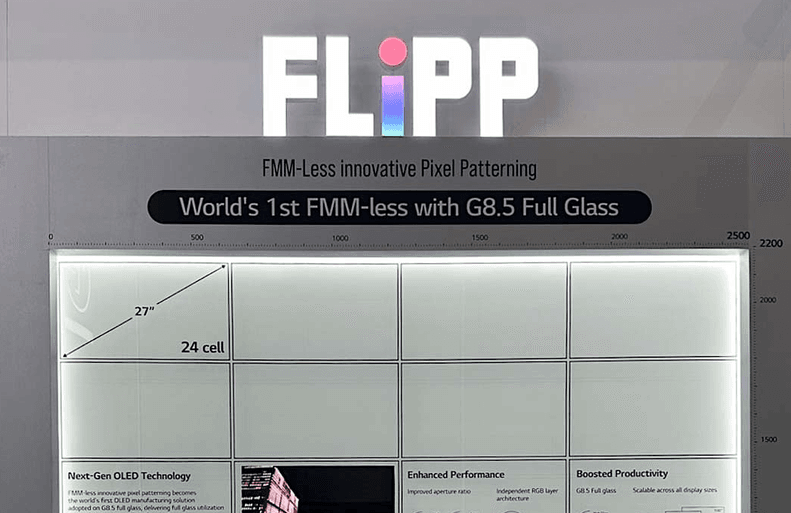
LG Display has flipped on the green light for its newest OLED display technology, and it promises to enable some impressive advances in picture quality, brightness and cost benefits when it finally makes its way into televisions.
The company has come up with a new acronym for the tech: FLiPP, which stands for FMM-Less innovative Pixel Patterning, with the FMM part referring to “fine-metal masks.” The most important thing to know is that these panels are FMM-less, which means the fine-metal masks have been eliminated from the production process entirely.
And apparently, that is quite a big deal. LG Display said that with FLiPP displays, the organic OLED pixels are deposited directly onto the panel substrate, before a protective layer is applied. Finally, the pixels are refined using etching and photolithography processes to ensure they’re perfectly shaped.
This new process has some big benefits, LG Display said. For instance, it makes production much more efficient. According to The Elec, the utilisation rate has been increased from 75% with the FMM process to more than 93% in FLiPP. What that means is that LG Display’s production costs should be lower, which means it might be able to sell its OLED panels at lower prices, which may then be passed on by TV makers to consumers.
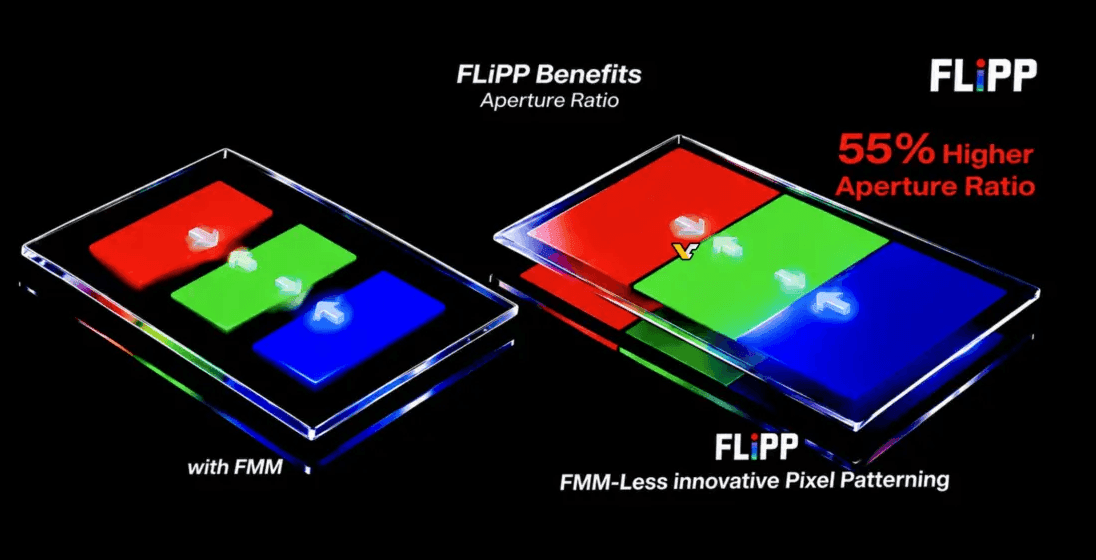
The FLiPP OLED panels are also superior in other ways, such as by improving the efficiency of the organic emissive materials themselves by a huge degree – up from 40% to 74%, LG Display said. The new process also enhances the pixel aperture ratio to 65%, which means more of the pixel actually generates light. As for luminance, FLiPP increases this by around 1.6-times, while longevity can be increased by 2.4-times, due to power consumption being decreased by around 13%.
What this means is that the next-generation OLED panels will be cheaper to produce, brighter and longer-lasting, with lower power consumption to boot. It’s all very impressive.
The only question is when we’ll see them, and The Elec has an answer. In an interview, LG Display Chief Technology Officer Choi Young-seok said that FLiPP is still at the development stage and that the company is now gearing up for a pilot production run. To do this, the company has procured a FLiPP deposition machine from South Korean equipment maker YAS for a price of around 300 billion won (around £112 million, these things aren't cheap!), which will be used for an initial production run of around 3,000 to 5,000 substrates per month.
Those initial substrates will be given to LG Display’s manufacturing partners, such as its parent company LG Electronics and other brands, so they can start developing actual products that use them.
The bad news is that LG Display is, for now anyway, focusing on smaller devices to begin with. It will initially slice those substrates into 23.5-inch panels, which means they’ll be used for computer monitors and laptop displays rather than televisions. In any case, Young-seok said they hope to perfect the manufacturing process for these smaller panels by next year, which means the first actual FLiPP OLED products could go on sale as early as 2028.
We imagine that LG Display will eventually be looking at using FLiPP to make larger OLED panels for TVs too, but this could be a year or two further out, depending on how everything goes. So, 2029 or 2030 looks like the best bet for when we might see the first FLiPP OLED TVs.
However, there is one important factor that could delay the arrival of FLiPP OLED TVs. Cho Heung-ryeol, who serves as the chief of LG Display’s Next-Generation Display unit, said the company is already looking at its existing LCD and WOLED production lines to see if they can be reused for manufacturing larger FLiPP products without extensive modifications. If that’s not possible, then it may have to build a brand new production plant, which would likely take a bit more time than retrofitting an older one.
