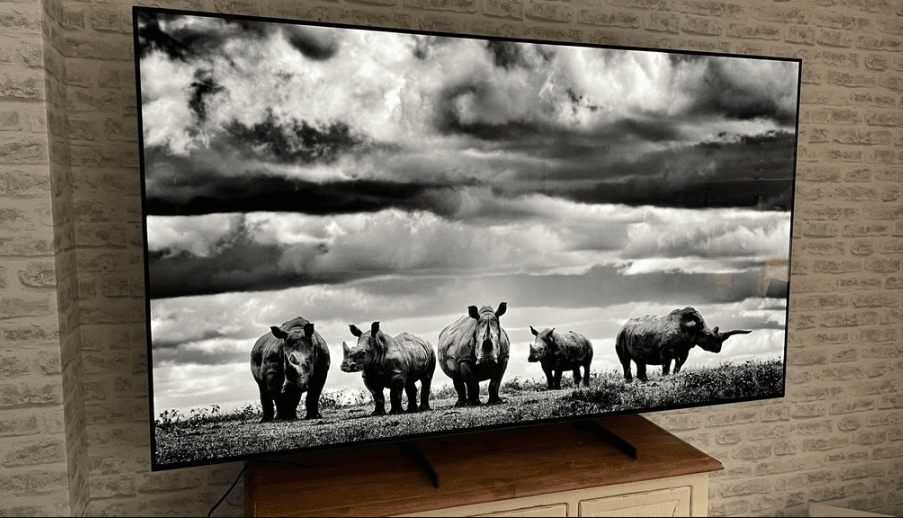
LG Display has confirmed what many people had already suspected, that it’s finally giving up on the 8K TV market. As a result, Samsung will be the only remaining major brand that still sells 8K TV models. ‘
The report comes from FlatpanelsHD, which said LG Display told it that it has decided to suspend the development of 8K OLED panels and will no longer be purchasing 8K LCD panels either, meaning that its parent company LG Electronics is not going to launch any new 8K TVs soon.
LG Display did say that it would consider resuming production of 8K OLED panels if market conditions change, but that doesn’t look like it’s going to occur any time soon. Which means there'll be no more 8K OLED TVs on sale anywhere once the last remaining stocks of its LG Z3 OLED TV are sold off.
The Korean company was one of the pioneers of 8K television, kicking off with the launch of its 88-inch Z9 OLED TV in 2019. It later refreshed its 8K range with the launch of the LG ZX in 2020, which added a 77-inch option to the mix, and then followed annual refreshes for the next three years with the arrival of the Z1, Z2 and finally the Z3, in 2021, 2022 and 2023, respectively.
That was the year that LG’s interest in developing 8K OLED started to wane, and the Z3 TV carried over into 2024 and then 2025, though it doesn’t appear that the company found many takers. The Z3 was officially discontinued towards the end of last year and no replacement was announced in this year’s lineup. That said, if someone out there does still have their heart set on buying an 8K OLED TV, there may still be some stock remaining somewhere at a few retailers, though it won’t be easy to find.
LG’s decision to bow out follows a trend that has seen several manufacturers give up on the idea of higher resolution TVs. Sony and TCL both exited the market in the last couple of years, and Hisense’s 8K plans appear to be on hold. With LG leaving too, that leaves Samsung also the last remaining TV brand to fly the flag. Philips and Panasonic apparently considered offering 8K TVs, with the former even showing off a few prototypes at trade shows a couple of years back, but ultimately decided it’s not worth the effort.
To be honest, it looks like Samsung may give up the ghost in the not too distant future too, for it has not been showing nearly as much enthusiasm as it used to do. A few years ago, the company was selling a range of 8K models aimed at different budget levels, but last year it only announced a single, extremely high-end model. It’s doing the same this year, but unlike in previous years it didn’t even bother to showcase its newest 8K model at CES, focusing on its newest QD-OLED and RGB LED TVs instead.
Indeed, Samsung’s lack of enthusiasm for 8K is apparent even with this year’s Micro RGB lineup (Samsung’s brand name for RGB LED). When it first showcased that technology at CES 2025, the prototype in question was an 8K model. But although it has announced several Micro RGB TVs for 2026, all of them are 4K TVs. Its sole 8K model this year will be a Neo QLED TV, essentially just a Mini-LED model.
LG’s exit isn’t a surprise because the 8K TV format just hasn’t caught on, and there are a couple of reasons for that. One problem, according to a lot of experts, is that the human eye simply isn’t sophisticated enough to appreciate the difference between 4K and 8K resolution. There’s only so much information that it’s able to perceive, and unless you’re watching a truly massive screen from an appreciable distance, the reality is that 8K is overkill – most people won’t be able to tell the difference between a 4K or an 8K screen.
Another key issue that has long been talked about is the dearth of native 8K content available to watch on these TVs. Movie makers and streaming giants like Netflix haven’t been convinced of the need to start producing content in 8K resolution, because very few people own an 8K TV. Just as important, there’s no easy way to get 8K content to people’s homes. Blu-ray discs max out at 4K resolution, and no streaming services support 8K due to bandwidth constraints. Warner Bros. said last year it had scanned a very limited number (less than 20) of big-name movies in 8K resolution, but it’s not clear how those movies will be distributed.
The reality is that the sheer brilliance of today’s high-end 4K TVs, the lack of content, the distribution problems and the high cost of 8K technology means that it just isn’t worth bothering with. While 8K does have some uses, such as in professional monitors where the extra pixels might be useful for fine-detail editing, and on massive screens like Samsung’s The Wall, it just isn’t that appropriate, nor practical, for most living rooms.
