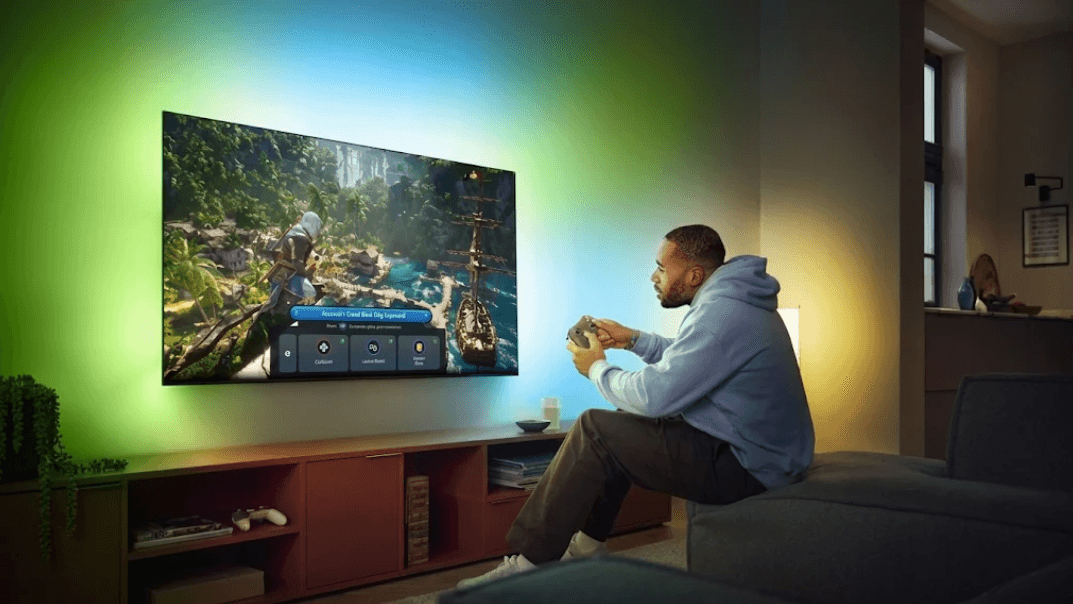
Earlier this year, Philips promised it will be bringing a new automatic game detection feature to its 2026 OLED and its RGB LED TVs, and it has finally made good on that promise, starting with Ubisoft’s latest Assassin’s Creed titles.
With the feature, Philips’ new OLED951 and OLED911 and MLED918 TVs, which all launched just a few months ago, will be able to automatically detect when someone starts playing a specific console game. For each game, users will be able to preconfigure their perfect game settings via the TV’s Game Bar, to ensure intricate aspects such as the crosshair, shadow detail contrast, Ambilight effects and motion interpolation for 30 frames-per-second games are saved.
TP Vision, the company that designs Philips TVs in Europe, is kicking things off with Ubisoft and the Assassin’s Creed franchise. To begin with, its TVs will only be able to detect two specific games – Assassin’s Creed Valhalla and Assassin’s Creed Black Flag Resynced – and instantly implement the player’s ideal settings. However, it plans to build an entire database of supported games that will add many more titles in time, so we do expect the feature to work with other AAA games and so it may not be too long until gamers can do the same for Grand Theft Auto, Call of Duty, Fortnite and so on.
Assassin’s Creed was always likely to be the first supported game, given that TP Vision already has an existing relationship with Ubisoft. Back in August, Philips was named as the Official Immersive TV Partner for the Assassin’s Creed franchise, and now it’s effectively repaying that favour by letting Assassin’s Creed be the first to benefit from automatic game recognition.
TP Vision said supported titles can be played on basically any games device, including consoles like the Xbox, PlayStation and Nintendo Wii, and also on personal computers.
TP Vision’s Innovation Team Lead Dieter Verlinde told HDTVTest that the company’s most advanced P5 AI Processor is already able to recognise on-screen content, such as different TV shows and movies, and optimise the picture settings on the TV accordingly. “We have now upgraded its AI capabilities to identify the specific game you’re playing,” he said. “P5 AI automatically recalls the settings you’ve previously configured for that game, making game-specific personalisation easier than ever.”
Verlinde said the TV doesn’t apply any picture or audio adjustments by itself. The first time the feature kicks in, it will create a new Game Bar profile for that game, and invite users to tweak things themselves to get the exact look and feel they prefer. They will also be able to select a “Reference” picture mode, which adjusts the settings to try and reproduce the game exactly as the developer intended.
Players will be able to store a number of settings. For instance, picture settings like brightness, colour, contrast, sharpness, HDR and game smoothness will all be stored. For sound, it will remember the ideal level of bass, treble and so on. The TV will also save additional “game helper” settings such as colour filter, shadow enhancement and crosshair settings for first-person shooter games.
Finally, users will be able to select their preferred Ambilight settings such as style, saturation and dynamics to help make their gaming sessions more immersive. After all, the Philips OLED951 and OLED911 and MLED918 TVs are all Ambilight TVs featuring the company’s most advanced and intelligent mood lighting effects.
Philips’ 2026 TVs have plenty of additional gamer-friendly features. They come equipped with four HDMI 2.1 ports and can support games at up to 4K resolution at 165Hz. They also have a new motion interpolation mode that can speed up a game’s frame rate from 30fps to 60fps, while increasing the input lag by around 10 milliseconds.
