
Samsung Display has showcased its latest QDEL display concepts at the SID Display Week 2026 event in Los Angeles this week, raising hopes that the TV could soon find itself in next-generation televisions and monitors.
QDEL technology was originally known as “QLED,” before that term was hijacked as a marketing label for more advanced LCD TVs, and has confusingly also been given various other names – including EL-QD, NanoLED, QD-LED, EL-QLED and AMQLED, and it’s not yet clear what term the industry will finally settle on.
The technology has long been hailed as “true QLED” because of the way the quantum dots become self-emissive. It uses electroluminescent quantum dots that conduct electricity and create their own light, without the need for separate light emitting diodes behind them. In other words, the quantum dots act as light-emitting diodes, eliminating the need for LEDs or OLEDs. That’s very different from the quantum dots we’re familiar with, which are really just colour filters and rely on LCD backlights.
According to Samsung Display and other companies pioneering the technology, such as Sharp, this will enable displays with superior picture quality and colour reproduction. The technology also allows for even thinner display panels because it uses few layers, meaning it could potentially lower costs, too.
Samsung Display, which is using the term “EL-QD,” presented two prototypes at the event, including an 18-inch panel with 500 nits brightness, and a second 6.5-inch panel that reaches 400 nits. “Compared to the previous year, brightness has improved by 25% and 33%, respectively – from 400 to 500 nits and from 300 to 400 nits,” the company added.
A spokesperson for Samsung Display also claimed that the tech’s energy efficiency has been improved. The company still refers to the panels as prototype products and hasn’t offered any timeline for commercial productivity, but Nanosys, which manufactures quantum dots, has previously mentioned 2029 as a possible date.
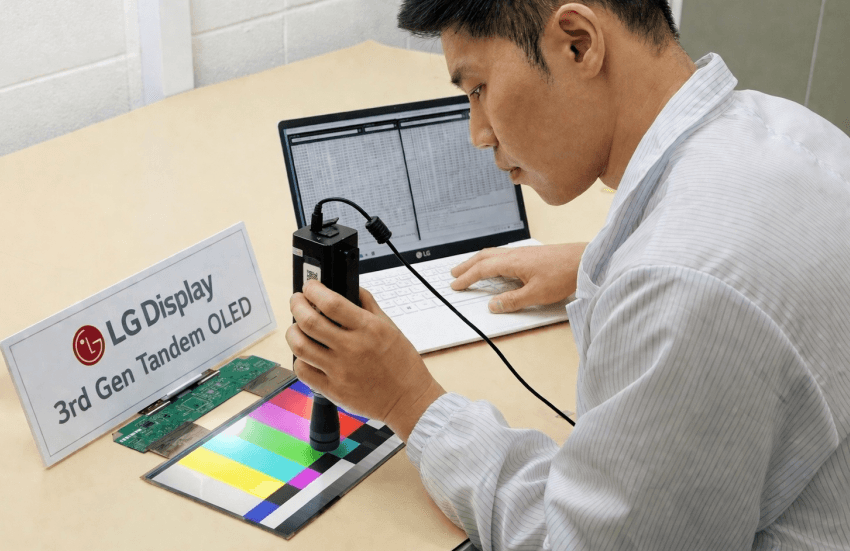
Samsung Display’s biggest rival LG Display was also participating in the event, and it took the opportunity to showcase its most advanced OLED panels. These include its 3rd generation Tandem OLED technology, which is aimed at smaller devices. The company said the displays on show are able to deliver 1,200 nits brightness, with an improved lifespan of more than 15,000 hours. They’re also more energy efficient than the previous generations, it said.
LG Display plans to commence mass production of its 3rd generation Tandem OLED panels for automotive displays, laptops and tablets later this year, which means we could see the first products on sale by autumn or winter, enabling OLED tech to make its mark in areas still dominated by LCD displays.
The company also used SID Display Week to showcase this year’s Tandem WOLED panels for televisions, which were first seen at CES 2026 in January. These include the most advanced, 4,500 nit panel that will be found in this year’s LG G6 flagship TV, and the first 27-inch RGB Stripe 5K panel, which is set to debut in high-end monitors later this year.
Finally, LG Display unveiled its first ever OLED panel for humanoid robots, capable of operating in temperatures ranging from -30 degrees Celsius all the way up to 85 degrees C, with brightness reaching up to 1,000 nits.
