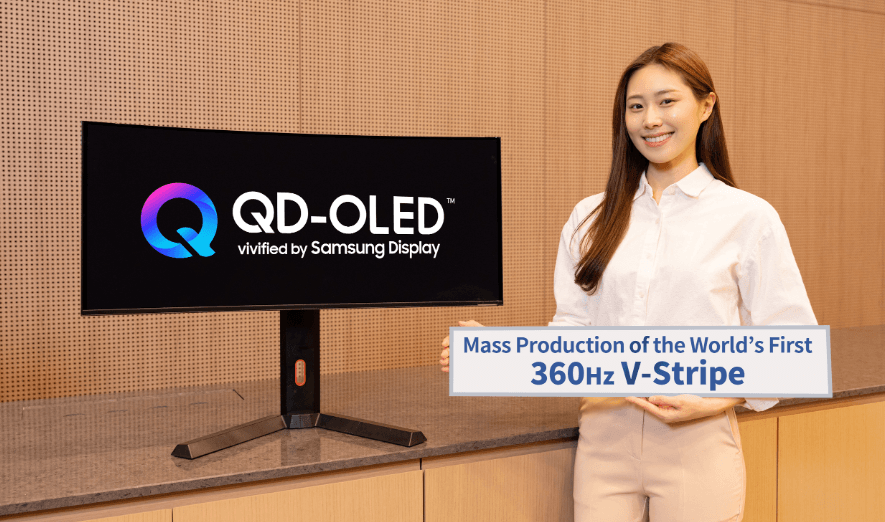
Samsung Display has just announced a new OLED panel technology for computer monitors as it strives not to be outdone by its arch-rival LG Display.
Just days after LG Display announced it’s moving to Tandem WOLED panels with an RGB stripe that eliminates the white sub-pixels to avoid colour fringing issues, Samsung Display has come up with a similar trick – it’s going to be using V-Stripe RGB pixels in its next-generation QD-OLED panels.
Samsung Display announced the move in a pre-CES 2026 announcement, saying that the V-Stripe structure aligns the red, green and blue sub-pixels in a vertical arrangement. That’s different from its existing QD-OLED panels, where the sub-pixels are arranged in a triangular fashion.
“Developed independently by Samsung Display for quantum dot elements, the V-Stripe structure improves the clarity of text edges, making it ideal for users engaged in text-intensive tasks such as document editing, coding, or content creation," the company said.
Samsung Display seems to be targeting the same colour fringing problem as LG Display, and it’ll be interesting to see which new sub-pixel structure is more effective. While Samsung Display did not provide any images of the V-stripe arrangement, FlatpanelsHD unearthed one courtesy of MSI, which is set to launch a new monitor based on the technology at CES next week.

As per MSI’s illustration, the sub-pixels differ in size, with red being the largest, followed by green and then blue. They’re aligned vertically to create a “V” shape, making it very different from LG Display’s RGB stripe format, which lays out the sub-pixels horizontally in equal sizes.
The first QD-OLED panel to use the new V-stripe structure will be an ultrawide 34-inch display with a 21:9 aspect ratio that can hit 1,300 nits peak brightness. Samsung Display also said it will have a 360Hz refresh rate with a 0.03 millisecond response time, making it suitable for gaming.
Along with MSI, brands including Asus, Acer and Gigabyte will also be using the panel, and it’s highly likely that Samsung Electronics will also launch a new monitor based on the tech, even if it hasn’t said so yet.
The launch of Samsung Display’s and LG Display’s new panels will likely help to boost the overall share of OLED displays in the premium monitor market at the expense of LCD. Research from Omdia shows that OLED panels accounted for 23% of all premium monitors in 2025, and forecasts that number to rise to 27% this year. The reason is that OLED is believed to offer superior HDR picture quality and faster gaming performance with superior colour representation and contrast.
Looking at OLED monitors specifically, QD-OLED panels held a 75% market share last year, with LG Display’s Tandem OLED panels accounting for less than 25%.
