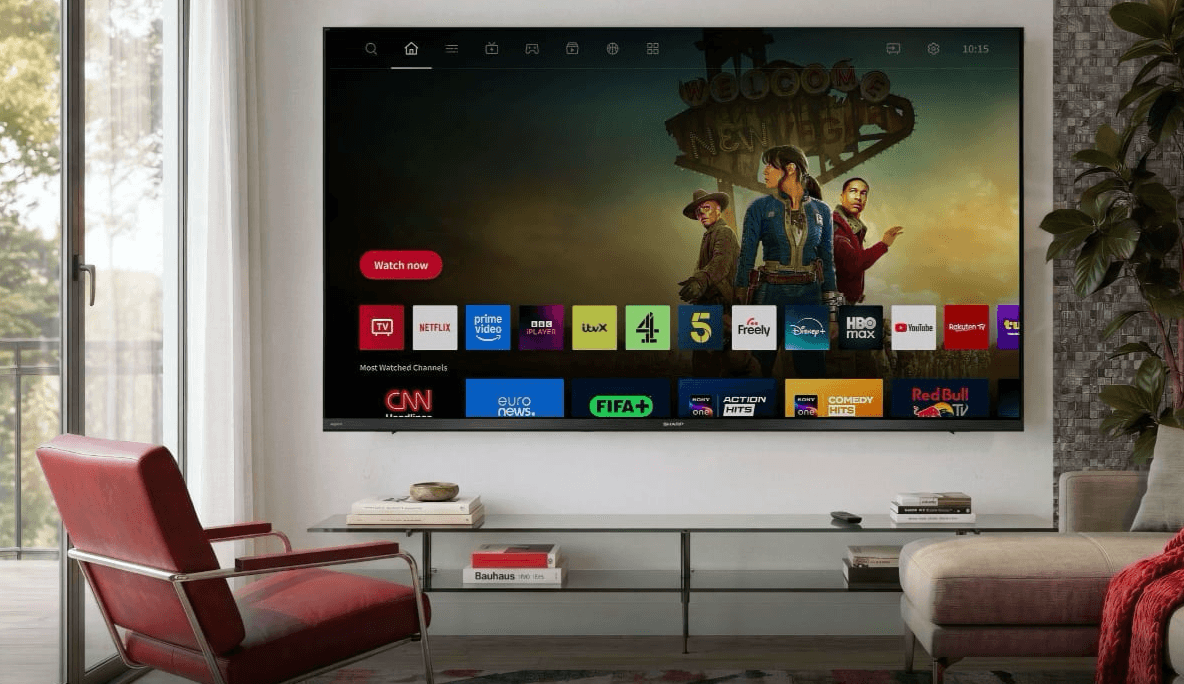
Sharp has joined Philips in embracing the new smart TV operating system Titan OS, saying that most of its European TVs sold this year with be powered by the platform, which is a rival to Google TV and others like Roku and Fire TV.
Titan OS is most famous for being the operating system in some of Philips TVs this year, but Sharp’s announcement should help it to become more widely known. Developed in Europe, with its headquarters in Barcelona, Titan OS supports all of the major streaming platforms, including Netflix, Disney+, Amazon Prime Video, Apple TV+ and YouTube, and also provides access to many other applications, though there are still some gaps in its catalog.
The OS also supports some cloud gaming platforms, notably Blacknut and Boosteroid.
Titan OS is a Linux-based operating system with a fundamental difference that sets it apart from the likes of Google TV, Samsung’s Tizen, LG’s webOS and others. All of its applications are web-based, which means that they’re not stored locally on the TV itself. Instead, they’re integrated as HTML-5 applications via URLs. What this means is that users are not accessing an onboard app, but rather the external web server of the app creator. The advantage is that these apps can be run on less powerful hardware, as all of the computations are done on backend, cloud-based servers.
Another key advantage of web-based apps is that there's no need for users to install updates on their TV. Instead, the app provider takes care of this by updating its own servers, which means they’ll never be unsupported on a Titan OS TV.
That’s not to say that everything is web-based. Titan OS makes an exception for Titan Channels, which is a dedicated app that’s embedded within the TV’s system-on-chip or SoC. Titan Channels is Titan OS’s dedicated FAST or free ad-supported streaming TV service, which allows users to livestream a collection of live TV channels at zero cost. They’re similar to YouTube, with users being forced to sit through an advertisement prior to viewing and then watch the occasional ad popping up in the middle of the show.
Like most FAST TV services, there’s an awful lot of garbage content on Titan Channels, but there are a few good ones available too. For instance, this week Titan OS signed a deal with Radial Entertainment’s FilmRise, giving it access to titles such as Z Nation, Iron Chef, Hot Ones, Kim’s Convenience, Forensic Files, Andromeda and Beyblade in European markets. So you can find something decent to watch.
TV manufacturers like Sharp are happy to have FAST channels, because they’re hopeful of making some decent revenue through them. Modern TVs collect lots of personal information from viewers, such as their location, the time of day they watch TV, their preferred content and so on, and use this data to deliver more targeted ads. Users can expect to see ads on the Titan OS home screen as well as its FAST channels. Crucially, whereas the likes of Google and Netflix keep all of this ad revenue for themselves, Titan OS plans to share the money it makes with its TV hardware partners. It’s likely this is one of the main reasons both Sharp and Philips become interested in Titan OS.
Sharp will continue to sell some Google TV models, such as the HR7 QLED TVs it debuted last week, but Titan OS is expected to power an increasing number of new Sharp TVs in future. It has not yet announced any specific Titan OS models this year.
In its joint announcement with Titan OS, Sharp said it will also cooperate with the European firm on manufacturing, but it did not elaborate on what this means.
Besides Philips and Sharp, Titan OS can also be found on televisions manufactured by JVC and AOC.
