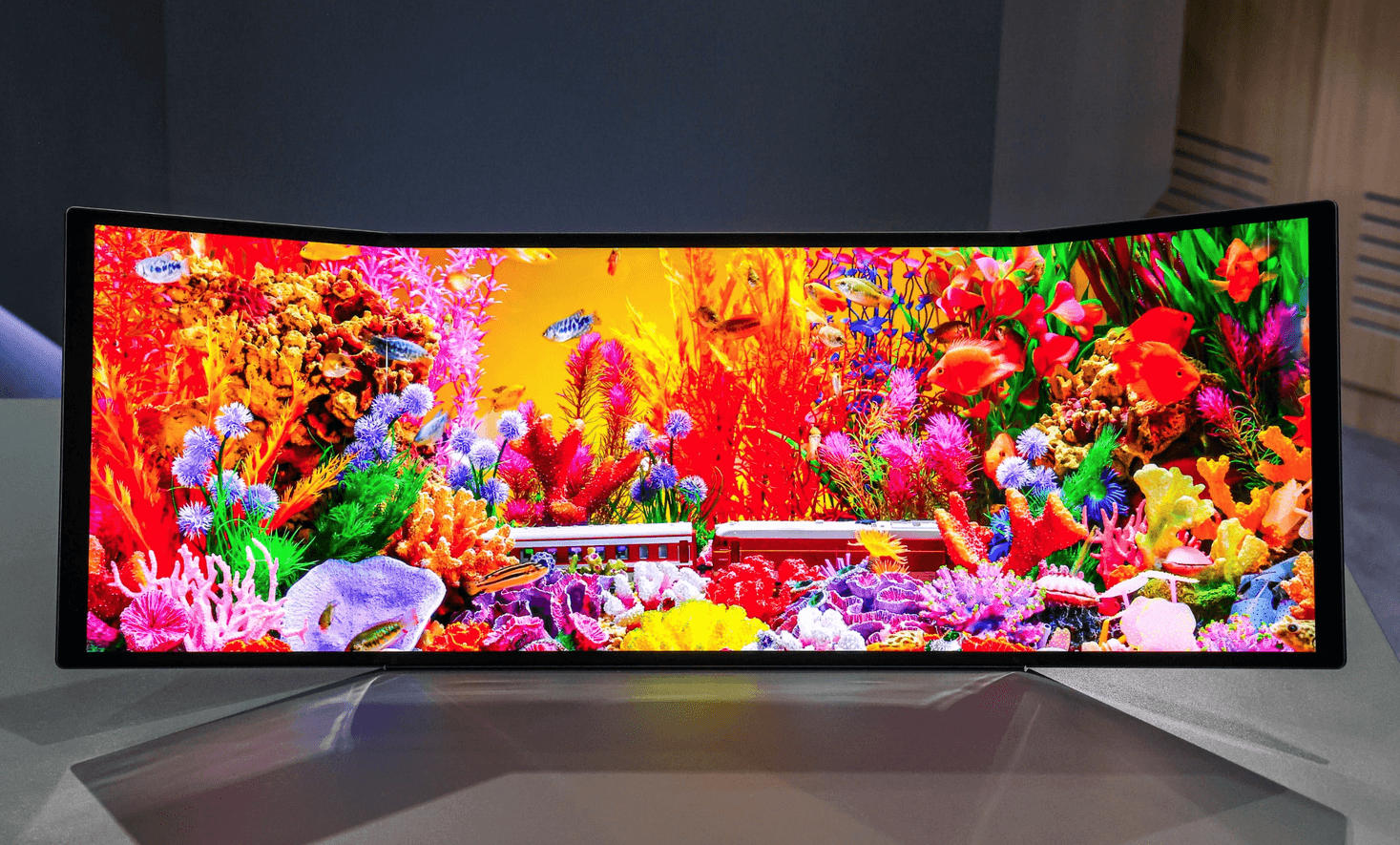
TCL CSOT is once again showing off the capabilities of what its new inkjet-printed OLED factory is capable of. At IFA 2026 last week, it showed off its prototype tri-folding OLED monitor panel that can transform from a compact, 16-inch display into a 28-inch ultrawide at the click of a button.
The panel has two fold lines rather than the single crease found on most foldable devices today. According to TCL CSOT, it has a bend radius of just 1.8 millimetres, and when the device is fully unfolded, it measures just 4.48mm thick. That’s thin enough to blur the lines between what could be a laptop screen or a rollable tablet device, and the company says it gives it a way to combine the portability of a regular notebook with the immersiveness of an ultrawide monitor, in a form-factor that can easily be slipped into a small bag.
The tri-folding design isn’t the only thing that’s new about this panel. It was developed using TCL CSOT’s new inkjet-printing process, known as IJP OLED, which has been under development for several years now and has finally come to fruition. There’s a lot of potential for IJP, because it can dramatically improve the efficiency of OLED manufacturing – the theory being that this will lead to reduced costs that can then be passed onto consumers.
With IJP, TCL CSOT does away with the fine-metal masks and vacuum evaporation that’s used by the likes of LG Display and Samsung Display to deposit the red, green and blue subpixels onto a panel substrate. Instead, it uses intricate machinery to print the organic OLED materials directly onto the glass or plastic substrate, similar to how ink is printed on paper.
The Chinese display maker says that the IJP method produces far less wasted materials than standard deposition techniques that use evaporation through a mask. Analysts have speculated that it could reduce the overall cost of manufacturing an OLED panel by around 35%. It also opens the door for more unusual and potentially larger OLED form-factors – like TCL CSOT’s tri-folding panel – because the removal of the fine-metal masks makes it much easier to create them.
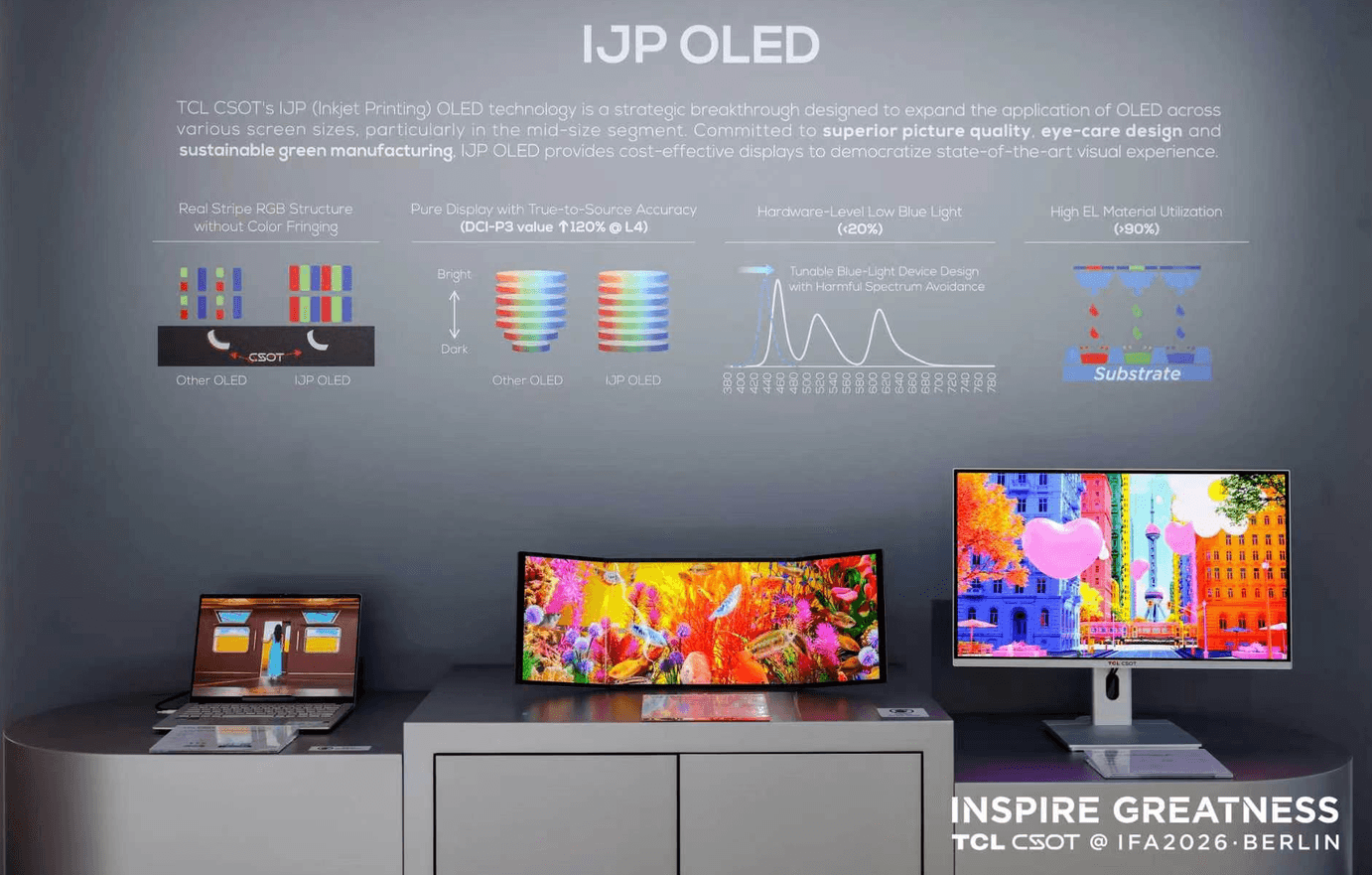
In addition to the tri-folding panel, TCL CSOT showed off a 14-inch 2K IJP OLED panel for laptops that offers 99% coverage of the DCI-P3 colour gamut and comes with an anti-glare coating to deflect those annoying reflections. While it’s a fairly standard form factor, it’s all about showing off the overall quality of these new-fangled panels, which seem every bit as good as those made by LG Display and Samsung Display, the companies that TCL CSOT wants to disrupt. To that end, it also showed off a 27-inch 4K IJP OLED panel with a 120Hz refresh rate that can hit 500 nits of full-screen brightness.
While IJP OLED has lots of people excited, it’s still unclear when these products will actually become commercially available. This isn’t the first time we’ve seen them, for they were first unveiled back in May during SID Display Week, and TCL CSOT still hasn’t said anything about getting them into the hands of customers. The company broke ground on its IJP OLED factory in late 2025, and it has made very good progress towards getting it up and running. In March, it was even claimed by Chinese media that the factory could start producing its first panels by July 2026, but this didn’t happen.
For now, these displays are still just a proof of concept, but it seems that TCL CSOT is definitely getting much closer to making them a commercial reality. The company will initially manufacture its IJP panels for smaller devices like laptops and monitors, but in the longer-term it also wants to build larger OLED panels for TVs.
