
Asus and Acer were the first brands to announce 540Hz/720Hz gaming monitors featuring advanced Primary RGB Tandem OLED panels, and now LG Electronics and ViewSonic have followed up with their own flavours of the same technology.
It’s a bit of a surprise to see LG’s new 27GX790B (pictured, above) arriving so late in the year, given that the Primary RGB Tandem OLED panel comes from its subsidiary LG Display, but it’s certainly better late than never.
The new panel first made its appearance in LG’s high-end 2025 smart televisions, such as the LG G5 and C5, and is designed to compete with the best QD-OLED panels in the business made by Samsung Display.
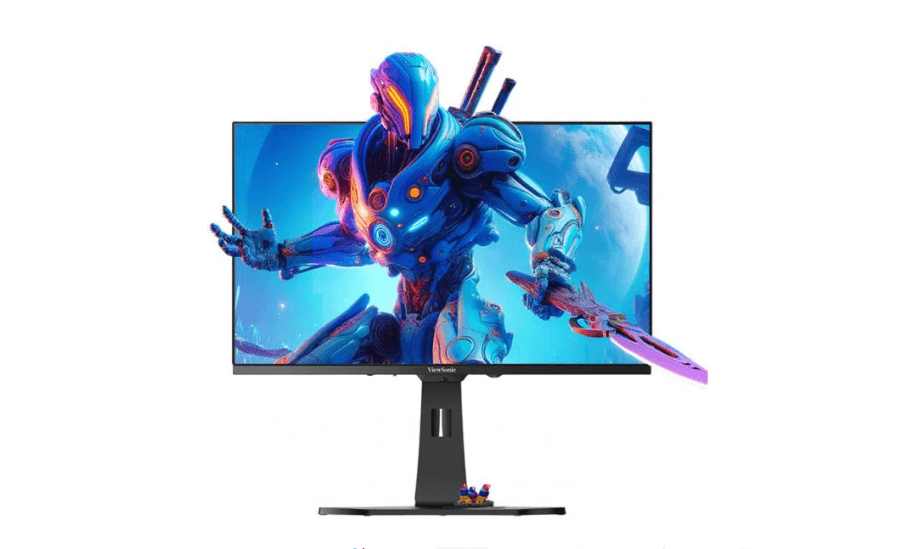
ViewSonic’s new monitor is known as the XG273F-2K-OLED (pictured below), and like the LG 27GX790B, it features an identical 27-inch, flat, ultra-wide OLED panel with 2560x1440 resolution. Both monitors offer 100% coverage of the DCI-P3 colour spectrum and true HDR support, and they’re much brighter than previous OLED generations. The companies say they can achieve 1,500 nits peak brightness in a 1.5% window, dropping to 335 nits on full-screen.
Both the LG 27GX790B and ViewSonic XG273F-2K-OLED have a 540Hz refresh rate at native resolution, but their dual-mode functionality allows this to be cranked up to 720Hz if the resolution is scaled back to 720p (HD). It’s a sacrifice, but it’s one that many competitive gamers may be willing to make for the sake of smoother gameplay.
The 720Hz speed isn’t the fastest refresh rate we have seen on a gaming monitor – that honour goes to AOC’s AGP277QK and Philips’ 27M2N5500XD monitors, which were both announced earlier this week. They can achieve an incredible 1,000Hz at 720p resolution, but despite being faster, they’re probably not going to outperform LG’s and ViewSonic’s new monitors, nor the 720Hz monitors launched by Asus and Acer. That’s because AOC’s and Philips’ new monitors are based on IPS LCD displays, which struggle to match the motion clarity performance of OLED, which has much lower 0.02 millisecond response times.
So in other words, the LG 27GX790B and ViewSonic XG273F-2K-OLED should be considered the Holy Grail of gaming monitors, along with the Acer Predator X27U F8 and Asus ROG Swift OLED PG27AQWP-W.
Users may be wondering, if all four of these monitors use exactly the same panel with the same specifications, what differences are there between them?
There are a few things to consider. For instance, the new LG and ViewSonic models both come with a glossy coating on the display, just like Acer’s Predator X27U F8. However, the Asus ROG Swift OLED PG27AQWP-W (pictured below) has gone with a matte coating that aims to reduce the display’s reflectivity and allow the gamer to remain more focused on the actual screen.
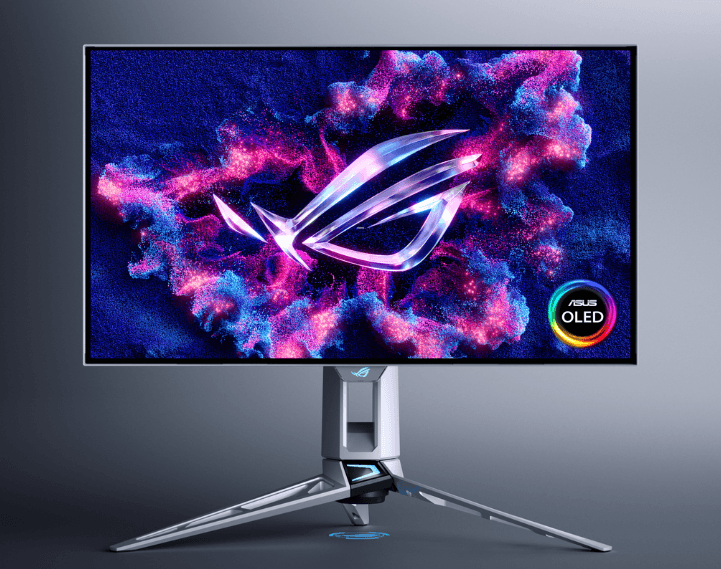
Another difference is that the LG 27GX790B offers DisplayPort 2.1 connectivity, though its bandwidth has not been confirmed. ViewSonic’s XG273F-2K-OLED is said to feature DisplayPort 1.4 connections, while the Asus model has DisplayPort 2.1a ports with 80Gbps bandwidth. The Acer monitor meanwhile features DisplayPort 1.4 with a bandwidth of up to 32.4 Gbps. All four models come with two HDMI 2.1 ports.
The LG 27GX790B and ViewSonic XG273F-2K-OLED have already gone on sale in China and are expected to launch in the U.K., Europe, U.S. and elsewhere in the coming months, and we will probably learn more about their availability at the CES 2026 show in January.
At present, we don’t have any idea of pricing, but Pricerunner shows that the Acer Predator X27U can be had for as little as £629, while the Asus ROG Swift OLED PG27AQWP-W currently costs around £948, according to Scan.co.uk.
