LG Display is reportedly trying to expand its display making repertoire with its first-ever 5-layer OLED panels for use in high-end televisions, monitors and laptops.
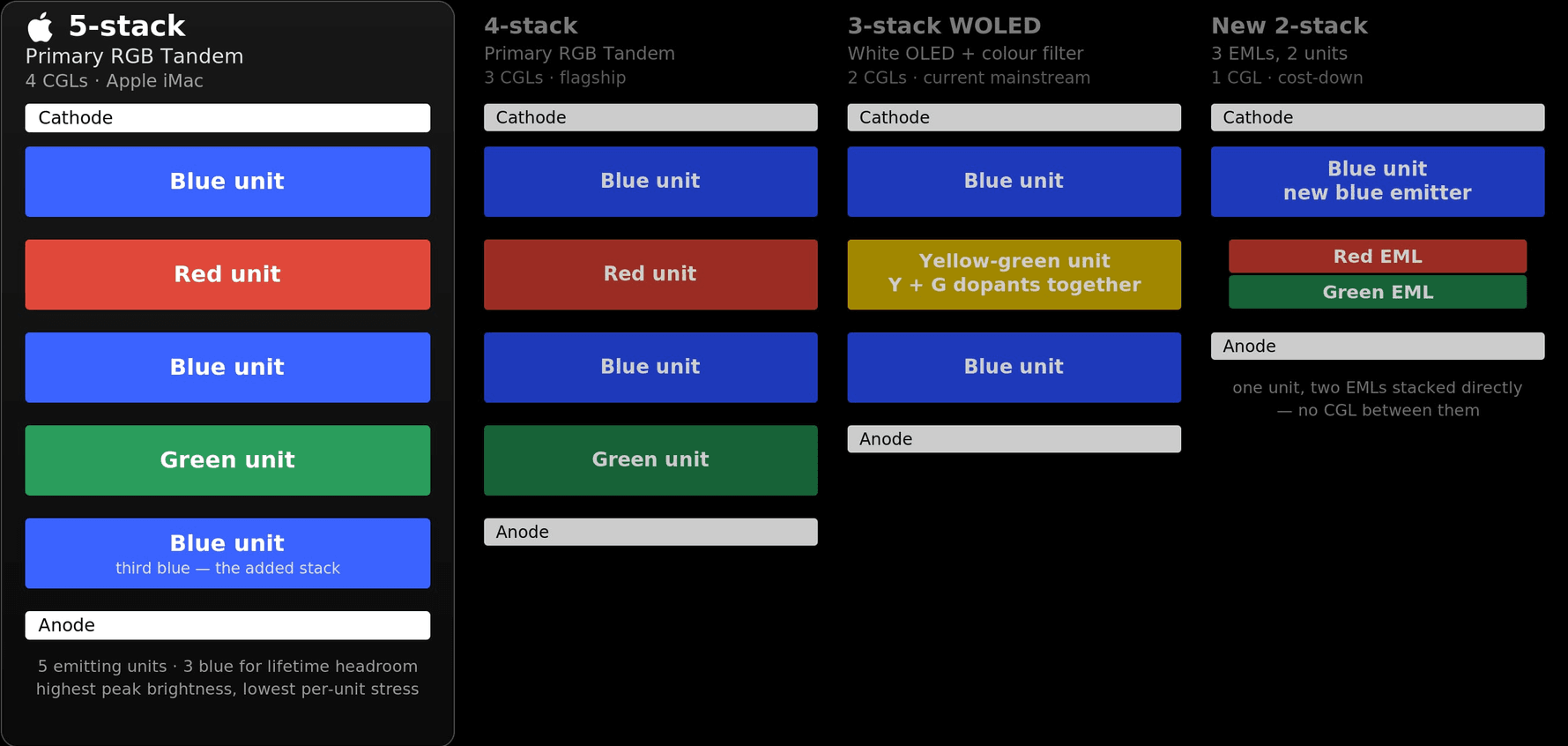
A report by the South Korean publication The Elec last week explained that the 5-stack OLED panel would be able to increase brightness and extend the lifespan of displays. They would have one extra emissive layer than its existing 4-stack Tandem WOLED panels.
The report is somewhat confusing because it appears to confirm that LG Display is looking to expand its OLED display manufacturing processes up and down at the same time. A couple of weeks ago, the company revealed that it also has a 2-stack OLED panel in the works, which is believed to be aimed at mid-range TVs and monitors, rather than high-end products. That’s down from the three emissive layers currently used in its standard OLED panels. LG Display said at the time that the 2-stack panels would be easier and cheaper to manufacture, and would use less energy.
However, for higher-end displays, it seems LG Display is thinking that bigger is most definitely better. The company believes that by building on Tandem WOLED’s four layers, it will be able to achieve higher brightness and make the panels last longer. With the new panel, there would be three blue emissive layers, up from two currently, together with one red and one green. The downside is that the additional layer would likely make them more expensive to produce, but that’s the price you pay for higher end products.
The Elec said LG Display is developing the 5-stack panel at the request of Apple, which would like to see a superior display for its next generation of iMac laptops. The company is also considering using it for TVs and PC monitors, as well.
LG Display already has a 4-stack 27-inch 5K OLED display that features its new RGB-stripe pixel structure, which is believed to be a candidate for future iMac laptops. However, Apple reportedly wants both LG Display and its rival, Samsung Display, to develop displays that can perform even better, so it can dazzle the market when it finally launches its first OLED iMac in 2029.
The move to a 5-stack architecture is not unprecedented, as Samsung Display’s latest Penta Tandem QD-OLED panels already have five emissive layers, up from four previously.
It’s possible that LG Display may be able to offset some of the higher costs that arise from having an additional emissive layer through its new “FLiPP” manufacturing process, which was announced last week. With FLiPP, LG Display eliminates the need to use fine-metal masks or FMMs, which are essentially stencils that are used to deposit the organic light-emitting materials onto the panel glass.
