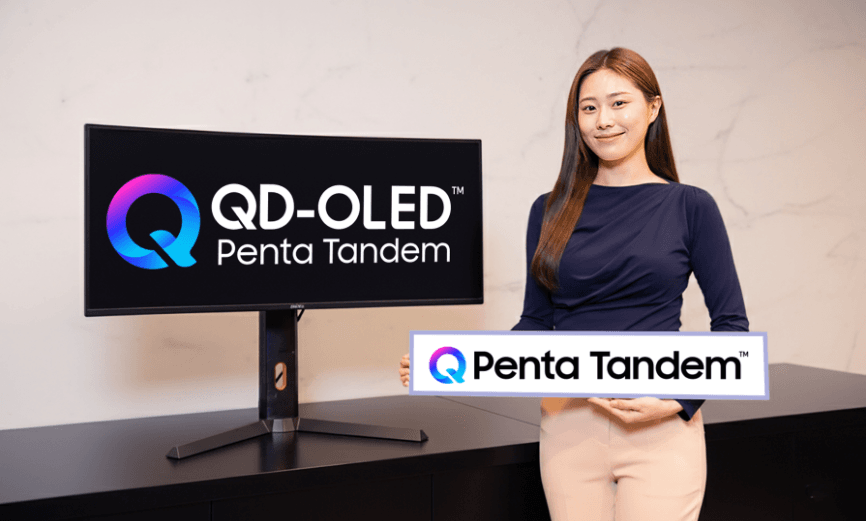
Samsung Display is taking a leaf out of its rival LG Display’s book, announcing a rebrand of its most advanced QD-OLED panels. From now on, they’ll be known as “QD-OLED Penta Tandem,” which is a name that reflects its use of a five-layer organic light-emitting structure.
The company said it has registered the QD-OLED Penta Tandem trademark, which was created to “highlight the distinctive value of its five-layer organic light-emitting structure applied to QD-OLED panels for premium monitors and TVs.”
The word “Penta” is Greek for “five”. Samsung’s most advanced QD-OLED panels stack five layers of blue and green OLED materials, which is one more than its previous generation display technology. LG Display, which rebranded its display tech as “Tandem WOLED” in December, currently uses a four-layer structure.
Although the name is new, the actual QD-OLED Penta Tandem panels aren’t. According to Samsung Display, the new brand label covers some of its older monitor panels from last year, such as the 27-inch 4K panel with a native 240Hz refresh rate. It also applies to some newer ones, including the upcoming 49-inch panel with 5,120x1,440 resolution, plus the new 32-inch and 34-inch WQHD panels. They’re set to be featured on dozens of new monitors later this year.
Samsung Display said some its 2026 OLED TVs will also feature QD-OLED Penta Tandem panels, including its upcoming 55-inch, 65-inch and 77-inch S95H and S99H models. However, users should note that not all of Samsung’s OLED TVs are based on QD-OLED technology. Some of its less premium models use LG Display’s Tandem WOLED panels instead.
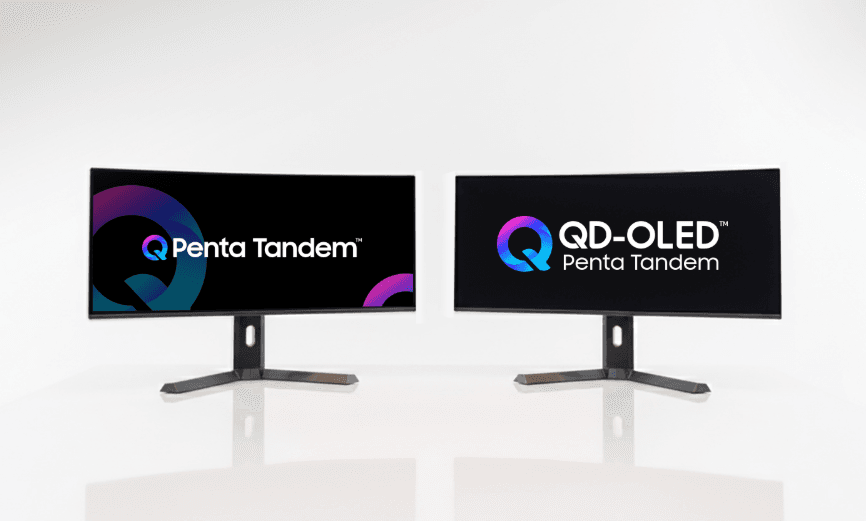
This year, monitor brands including Asus, Acer, Gigabyte, MSI, Dell and Sony, as well as Samsung Electronics, will all launch new products based on the QD-OLED Penta Tandem panels, but it’s up to each company if it actually refers to the branding in its marketing materials. Some like to highlight their use of QD-OLED, while others just market them as “OLED”.
According to Samsung Display’s chief of the Large Display Marketing Brad Jung, the extra layer on its QD-OLED Penta Tandem panels helps to improve brightness, picture quality and longevity, while enhancing energy efficiency. However, he pointed out that it’s not just a matter of slapping on more and more layers. “It requires deep expertise in selecting materials and optimising their thickness and combinations,” he said. "Penta Tandem, built on nearly five years of QD-OLED mass production experience since 2021, represents the ultimate choice for customers looking to demonstrate the premium value of QD-OLED."
The company has previously said that its most advanced QD-OLED monitor panels can achieve brightness of 1,300 nits in a 3% window, while the TV variants can reach an impressive 4,500 nits.
