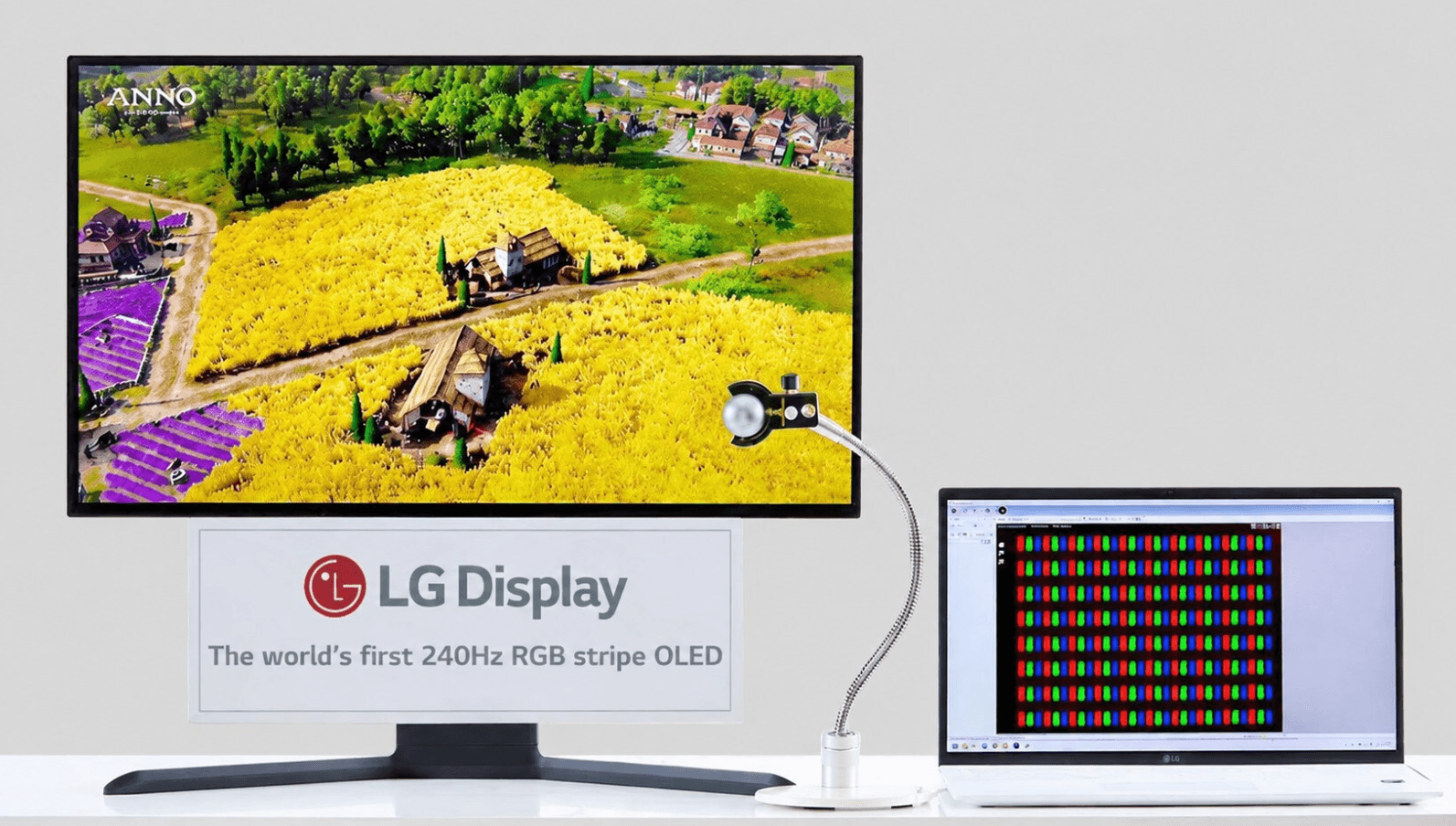
LG Display has said that it’s now mass-producing the world’s first 240Hz RGB Stripe OLED panel, and it promises to eliminate one of the most persistent complaints that have dogged the OLED monitor revolution.
The problem LG wants to tackle is the issue of “text fringing.” Anyone who has experienced using an OLED monitor for tasks such as coding, entering data into spreadsheets or writing has probably noticed that the text often looks a bit fuzzy around the edges. There’s also some noticeable colour bleeding that occurs around the edges of individual letters. This is the result of “fringing,” and it’s due to the unusual subpixel layouts employed by most OLED monitors. Because OLED monitors like LG’s traditional WOLED panels add a white subpixel, they utilise non-linear subpixel geometries.
Initially, this wasn’t so much of a problem with the first OLED monitors, because most were aimed squarely at gamers. But OLED is now starting to become popular with other kinds of PC users too, hence the need for an RGB Stripe layout. With its new 27-inch RGB Stripe OLED panels, LG Display says it’s trying to fix the fringing issue and prevent eye strain for non-gamers.
The RGB Stripe pixel layout arranges everything in a linear fashion, with the red, green and blue subpixels placed together side-by-side, in perfectly straight rows. This what operating systems including Windows, macOS and Linux are all designed to handle when it comes to rendering fonts. Admittedly, pure RGB stripe OLED panels aren’t a new technology, the few such monitors that do exist have slower 60Hz refresh rates.
With its new panel, LG Display is crushing that speed limitation. It boasts a tight pixel density of 160 pixels-per-inch and renders them at a blazing-fast 240Hz. The company has also integrated its Dynamic Frequency & Resolution technology to enable dual-mode displays, giving users the choice to run at 4K resolution at 240Hz, or Full HD resolution at 480Hz. This means it has the flexibility to support both intricate creative work, where detail is everything, and also ultra-competitive gaming, where every microsecond counts.
We should note that you can’t yet actually buy a 240Hz RGB Stripe OLED monitor. LG Display has merely started manufacturing the panels at scale, and still needs to ship them out to its customers – the companies that actually make the monitors. Nonetheless, it’s an encouraging sign, because the panel is the main component of every monitor, and it probably won’t take those companies too long to put them into finished products once they get their hands on them. Given the advantages RGB Stripe OLED provides, we can expect to see many of the best-known monitor brands lining up to procure them.
We’re still in the first half of 2026, so it seems a sure bet that we’ll see the first such monitors going on sale before the year is out.
Although RGB Stripe looks like it will be the first non-fringing OLED technology to market, we can't rule out Samsung Display getting there first. Earlier this year, LG's biggest rival announced its own fringing solution - a new V-Stripe QD-OLED panel that arranges the subpixels in a vertical alignment. We don't yet know which solution will be superior, but there may be other factors for minitor buyers to consider, because Samsung Display's first V-Stripe QD-OLED panels will be made in 34-inche sizes, rather than 27-inches.
In this video, HDTVTest's Vincent Teoh discusses some of the differences between the two subpixel layouts:
