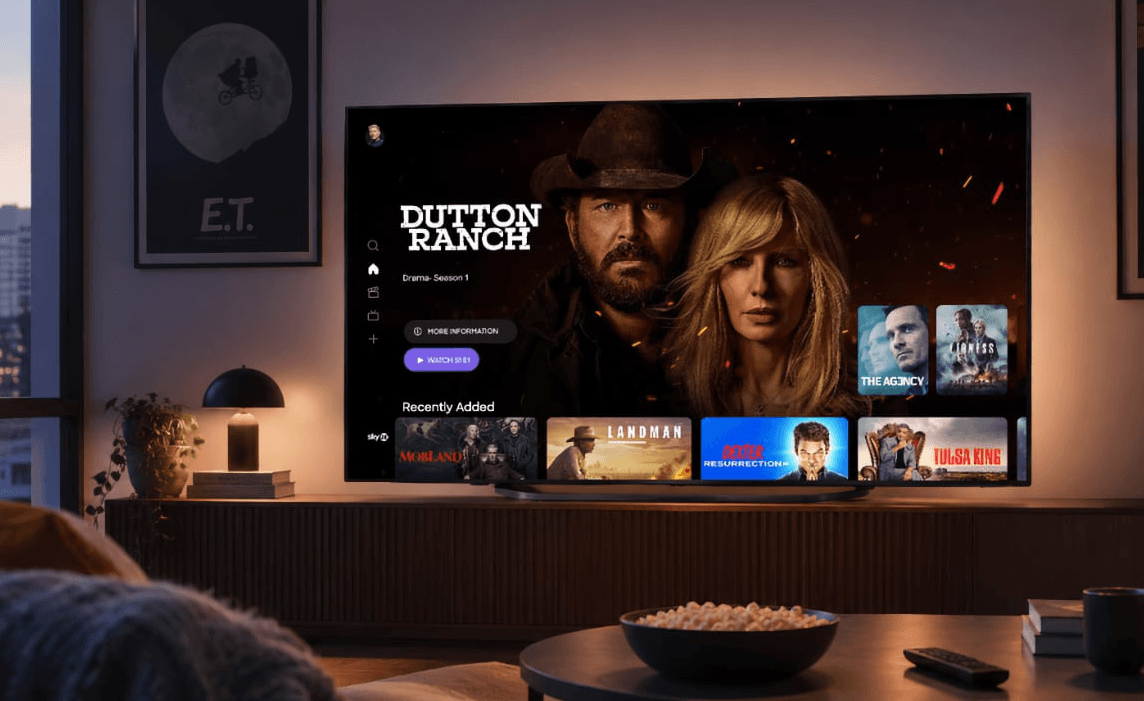
The web-based Titan OS platform is adding to its application ecosystem with the launch of the SkyShowtime app in dozens of European countries, just weeks after it added Apple TV+.
This is good news for anyone who’s interested in buying one of Philips’ new 2026 TVs, for that company has finally completed its transition to the Titan OS platform this year, moving on from Google TV. Until recently, Philips relied on Google TV to power its most premium OLED televisions, but this year it has decided to drop that platform in favour of the younger upstart.
The move completes a transition that began last year when Philips launched a number of LCD models based on Titan OS, such as the Philips MLED950 Mini-LED TV from 2025.
Titan OS is a relatively new TV operating system that was developed in Europe as a competitor to Google TV, Roku, Fire TV and other platforms. It’s also found on TVs made by Sharp, and it features all of the major streaming applications, including Netflix, Amazon Prime Video, Disney+, YouTube, HBO Max and Apple TV+, but it still lacks support for a lot of regional applications.
The platform also supports many cloud gaming platforms, including Boosteroid and Blacknut. One reason why it has been able to get all of the major apps on board so quickly is that it’s based on the Linux operating system and has a fundamental difference from its competitors., Whereas the likes of Google TV, webOS and Tizen et al require developers to build a platform-specific version of their app that’s stored on the TV, Titan OS runs web-based HTML-5 apps that are integrated with TVs via URLs.
What this means is that users aren’t actually using an app, but rather just accessing one over the web. It provides advantages, because web apps can run on any platform so there’s no need for the developer to adapt their code each time. It also means the apps can run on even the most basic TVs, because they’re not using its onboard hardware. Instead, all processing is done on a cloud-based server. On the downside, web-based apps may struggle with latency issues if the user’s broadband connection isn’t great, but in most households this shouldn’t be an issue.
Web-based apps can also be updated more easily, for developers simply deploy the code onto the cloud-based server where they run, rather than issuing firmware updates to every TV. It means Titan OS apps will never be unsupported by any TV.
The launch of the SkyShowtime app on Titan OS is a big deal for Europeans. Launched last year, it has quickly become one of the biggest streaming apps in Europe, available in 22 countries including Spain, Poland, the Netherlands, Sweden, Denmark, Hungary, and others.
The app was created by a joint venture ran by Comcast, the owner of Sky, and Paramount, and provides access to a range of popular streaming services. It was designed for markets where Sky TV isn’t available, and features movies and TV shows, including many originals, from Universal Pictures, Paramount Pictures, Nickelodeon, DreamWorks Animation, Paramount+, SHOWTIME, Peacock and Sky itself. Because the UK has Sky TV and NOW TV, the SkyShowtime app is not available there, as users can get most of the above content by subscribing to those services instead.
“Bringing SkyShowtime to the Titan OS ecosystem is an important milestone in our mission to deliver the best European and international entertainment directly to viewers,” said Titan OS CEO Jacinto Roca.
SkyShowtime didn’t confirm if the Titan OS version of the app supports 4K, HDR and Dolby Atmos, though those premium formats can all be found on other versions of its app, such as on Tizen, webOS and Google TV.
New Philips TVs in 2026 that will ship with the Titan OS platform include the flagship Philips OLED951 and the next-best Philips OLED911, which both come with LG Display’s latest Primary RGB Tandem WOLED 2.0 panel, a powerful MediaTek Pentonic 800 chipset and the company’s new AmbiScape mood lighting experience. They will also be some of the first TVs in the world to add support for Dolby Vision 2 Max, which is set to arrive via a firmware update later in the year.
Other new Philips TVs with Titan OS include the Philips OLED811 and OLED761, which both come with older OLED panels, and the Philips MLED918, which is first-ever RGB LED TV, boasting an impressive 11,520 local dimming zones and peak brightness of 2,500 nits. Cheaper models begin with the new Philips PQS9001 TV, branded as “The One,” which features a standard QLED panel rather than anything fancy.
