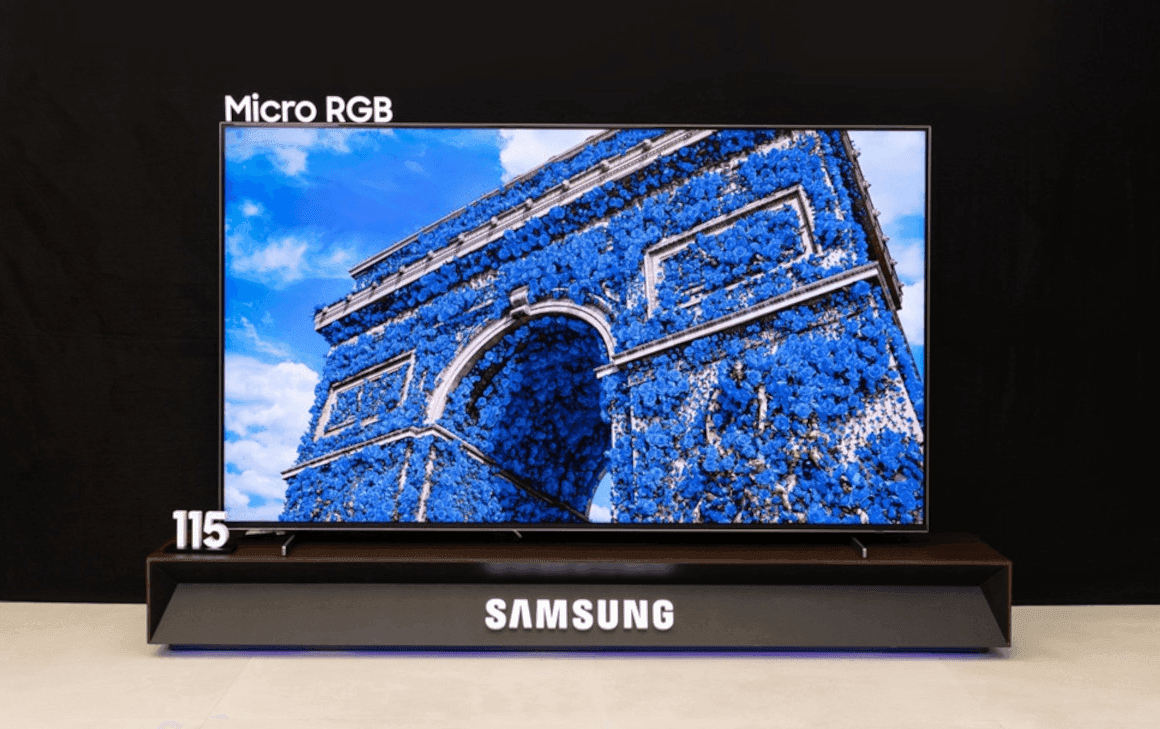
It has been more than nine years since Samsung Electronics unveiled its first MicroLED TV, known as “The Wall,” but prices for these fantastic quality and fantastically-large displays are still sky-high.
That is a shame, because if there’s one display technology that really can surpass the picture quality of OLED TVs, it will be MicroLED.
What’s so special about MicroLED? If you’ve ever seen one installed in a premium cinema or in a building such as an airport, you may have noticed. They utilise millions of miniature LEDs, with each one representing an individual pixel that can be independently controlled, enabling superior contrast and brightness compared to even the most advanced OLED displays.
Samsung has waxed lyrical about the quality of MicroLED for years, and it has vowed to reduce the cost of the technology and make it more affordable for consumers, but so far it has been unsuccessful in making that happen. To see a MicroLED TV in someone’s living room is a rare treat indeed, as these things still cost upwards of $100,000 in most cases.
But with any luck, Samsung Display’s newly announced partnership with the LED lighting and semiconductor firm Osram may help to change that. This week, it revealed it has agreed to become the largest stakeholder in the German company in a deal that will see it acquire 9.1% of its shares at a cost of around 210 million euros, or £175.6 million.
The more interesting part of the announcement is the partnership. Samsung Display said it’s going to work with Osram on the development of “ultra-small MicroLED technology for display applications.” The goal of this research, it said, is to “accelerate the potential commercialisation” of MicroLED displays, with one of the most important goals being to “improve its cost competitiveness.”
Improved cost competitiveness is the key to making MicroLED TVs commercially viable, so that everyone can benefit from their “higher brightness, longer lifespan and freeform design capabilities,” Samsung Display said.
Regular readers of HDTVTest may recall that Samsung Display has been making these kinds of promises for years, with little success. MicroLED TVs are still far too cost prohibitive for the average consumer to consider buying. Meanwhile, OLED technology has come on in leaps and bounds, with regular advances in terms of enhanced brightness, contrast, picture quality and affordability.
It remains to be seen if Osram and Samsung Display can help MicroLED to finally challenge OLED, but it’s clear that both companies still believe the technology has greater potential, and they’re going to try.
“Its potential is not limited to any particular product category," said Samsung Display President and Chief Executive Chung Yi. “It extends across an exceptionally broad range of applications, from ultra-small to ultra-large displays.”
