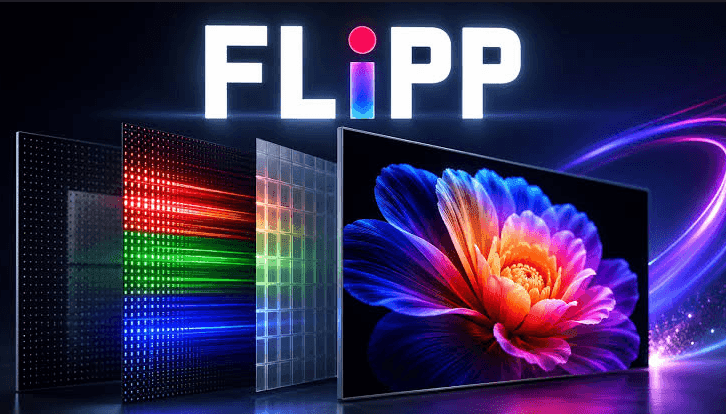
Earlier this week, LG Display said it’s scrapping plans to invest $2.5 billion into its display production plant in Paju, South Korea, in order to convert production lines to manufacture large-sized OLED panels. And now we know why.
The company will instead retrofit one of its existing facilities at Paju to make smaller panels using its new “FLiPP” maskless process, which promises to be better and more efficient and deliver advances in picture quality, brightness and cost.
According to a report by the South Korean news publication Aju Press, the company will strip out the existing machines at its 8.5-Gen P8 plant and install new FLiPP production equipment that will be used primarily to make 23.5-inch panels for monitors and laptops.
FLiPP, which stands for “FMM-Less innovative Pixel Patterning,” is a new manufacturing process that basically describes how the new OLED panels are made. The “FMM” part refers to “fine metal masks,” which can be thought of as stencils. They’re basically metal sheets that have been peppered with microscopic holes. The FMMs are laid on top of the glass or plastic substrate and carefully aligned so that the holes are placed where the red, green and blue pixels are meant to go. LG Display then uses a technique known as deposition to deposit the sub-pixel structures onto the substrates with extreme accuracy, so there’s no bleeding into adjacent spaces.
While these FMMs allow for extreme precision, they add a lot of cost to the manufacturing process. The masks are also difficult to manufacture, especially if you want them for larger screen sizes.
FLiPP does away with these masks. Instead, the organic OLED pixels are deposited directly onto the panel substrate, before a protective layer is applied. Finally, the pixels are refined using etching and photolithography processes to ensure they’re perfectly shaped. LG Display first described the process in August.
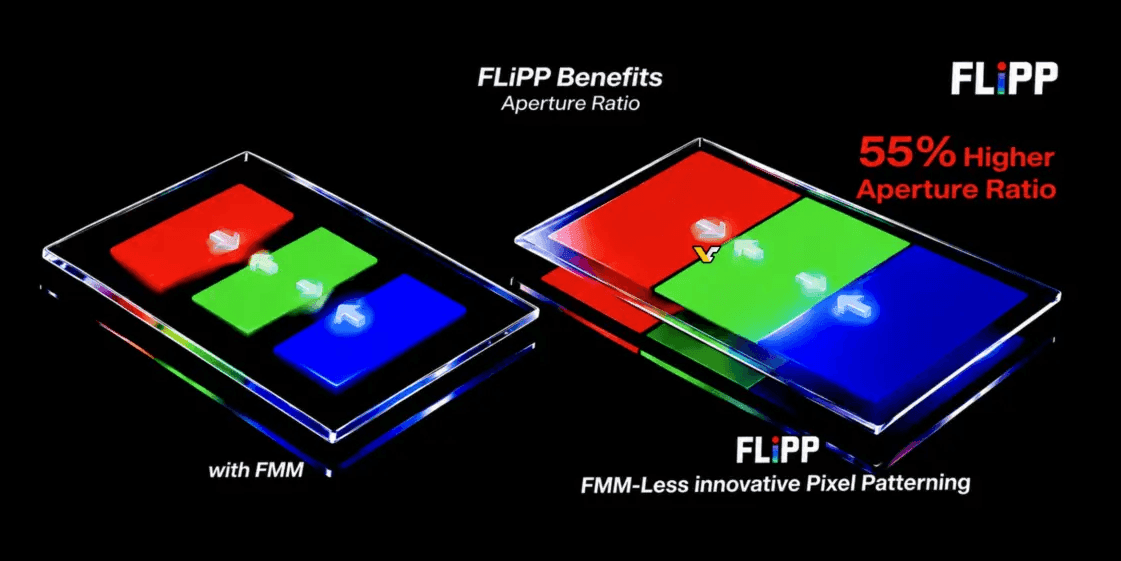
This new process has some big benefits. For instance, it makes production much more efficient. The utilisation rate has been increased from 75% with the FMM process to more than 93% in FLiPP. What that means is that LG Display’s production costs should be lower, which means it might be able to sell its OLED panels at lower prices, which may then be passed on by TV makers to consumers.
The FLiPP OLED panels are also superior in other ways, such as by improving the efficiency of the organic emissive materials themselves by a huge degree – up from 40% to 74%, LG Display said. The new process also enhances the pixel aperture ratio to 65%, which means more of the pixel actually generates light. As for luminance, FLiPP increases this by around 1.6-times, while longevity can be increased by 2.4-times, due to power consumption being decreased by around 13%.
What this means is that the next-generation OLED panels will be cheaper to produce, brighter and longer-lasting, with lower power consumption to boot. It’s all very impressive.
Last month, LG Display said it had procured a FLiPP deposition machine from the South Korean equipment maker YAS for a price of around 300 billion won (around £112 million), which will be used for an initial production run of around 3,000 to 5,000 substrates per month.
The company hasn’t said anything about that trial run, but if the report by Aju Press is to be believed, it seems to have gone well, for the company has now made the decision to start converting the P8 facility to FLiPP early next year. According to that report, it hopes to have everything in place to begin mass production of FLiPP OLED panels by 2029 at the latest.
As was previously stated by HDTVTest, the company will initially focus on smaller panels for monitors, laptops and tablets. While LG Display expressed confidence it can make FLiPP panels of up to 100-inches, the reinvigorated factory will exclusively churn out “mid-sized OLED panels.” So if you’ve been dreaming of buying a FLiPP OLED TV, you will, unfortunately, have to wait a while longer.
What’s interesting about this report is that it shows LG Display appears to be pursuing a more economically-friendly strategy to its biggest rivals in the display making industry. The plan to convert its existing 8.5G production line to 8.6G is different from Samsung Display, TCL CSOT and BOE, which have all built new 8.6G OLED plants from scratch. LG Display’s decision to retrofit should mean it ends up saving a lot of money, but it also means it will be later to the game.
Samsung Display’s 8.6G plant, which manufactures QD-OLED panels, is already up and running, while BOE’s and TCL CSOT’s plants are almost complete, with mass production slated to begin next year.
