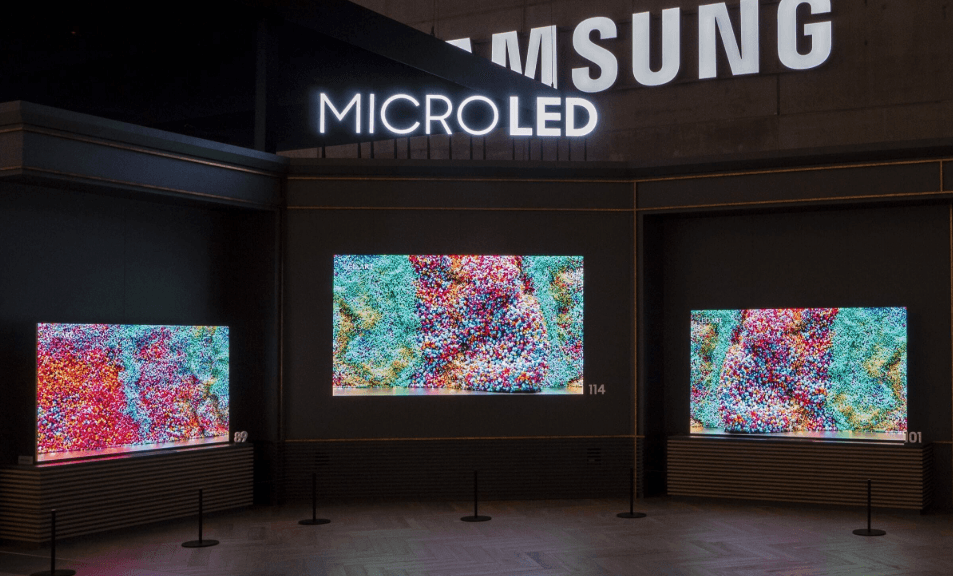
TV enthusiasts have been drooling at the prospect of more affordable MicroLED TVs for years, but a new report makes it clear that such a thing is unlikely to become reality for a while yet.
MicroLED displays are a premium technology that’s considered to be far superior to anything else yet available – including OLED and RGB LED. It’s not exactly a new technology, and we’ve seen a fair few MicroLED TV models launched over the years, including Samsung’s original version that debuted way back in 2020, LG’s Magnit and more recently, the spectacular 163-inch Hisense model that was showcased at CES 2026.
Samsung also showcased a stunning new model at that event, featuring a dazzling bezel that’s also a screen.
Every single one of those MicroLED TVs looks stunning. But what doesn’t look quite so good is the price someone has to pay to actually own one of them. In every case, the cost runs into six-figure sums.
We now know why. Thanks to UBI Research’s new “101-inch Micro-LED TV Set BOM Analysis Report,” we have been given a full breakdown of the costs of your average MicroLED TV, and it’s quite an eye opener. “
BOM means “bill of materials” and when it comes to MicroLED TVs, it’s fairly excessive. UBI says that the BOM for a 101-inch MicroLED TV will average around $52,000 (approximately £38,500), but unfortunately that’s just one aspect of the overall cost.
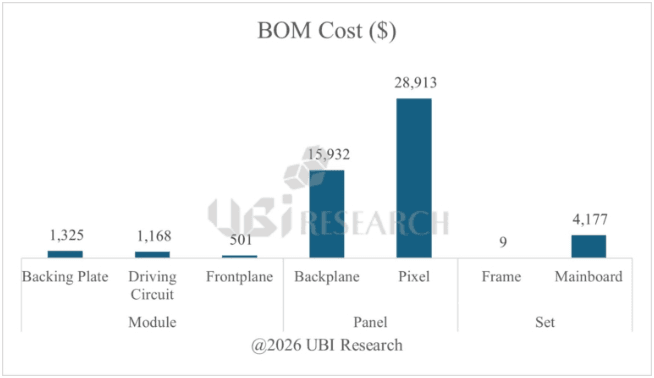
UBI Research’s analysis breaks things down into 46 different items that go into your average MicroLED TV, and works out that the actual MicroLED pixels that make up the display account for just over 86% of the total cost. This includes the backplane, which costs $15,932, the pixel layer ($28.913), the mainboard ($4,188), driving circuit module ($1,168), the back plate ($1,325), the frontplane ($501) and the metal frame (a snip at just $9).
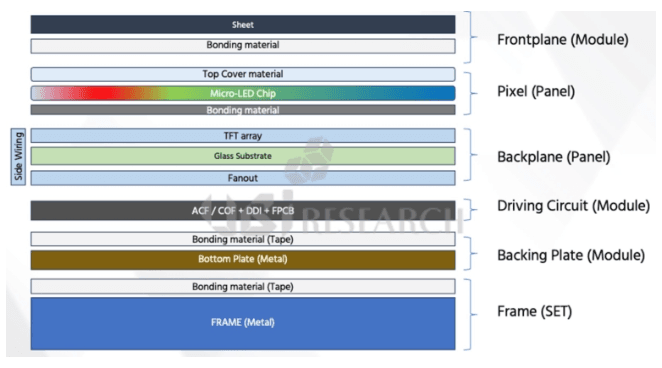
UBI said these components are so excessively priced because TV display makers haven’t yet been able to achieve economies of scale. There's a lot that goes into each individual component, as the below graphic illustrates. OLED displays and Mini-LED panels are mass produced by the millions, enabling far greater manufacturing efficiencies compared to MicroLED. There’s a lot less wastage involved, too. Hence, those technologies are relatively affordable.
But there are other costs to consider, too. For instance, the costs of labor for those big-earning engineers who know how to put all of these components together, and other processing costs. On average, the BOM only accounts for around half the total price of manufacturing a TV and getting into the stores. That’s why a 100-inch MicroLED TV sells for around $100,000 – compared to around $24,999 for LG’s 97-inch G5 OLED and less than $10,000 for an equivalent-sized MiniLED TV. Even the new RGB LED TVs, such as Hisense’s 116UX, which measures 116-inches, costs a lot less at $30,000.
UBI Research analyst Joohan Kim said MicroLED display makers are going to need to reduce costs through a combination of vertical integration and improved manufacturing yields if they want to make them at prices consumers can afford. But they have been struggling to do this for years, with little success. That’s why Kim says we’re unlikely to see much cheaper MicroLED TV sets anytime soon.
