
Just weeks after security researchers called out LG Electronics and Samsung Electronics (twice in its case!) for spying on their TV buyers, Hisense has been accused of doing much the same.
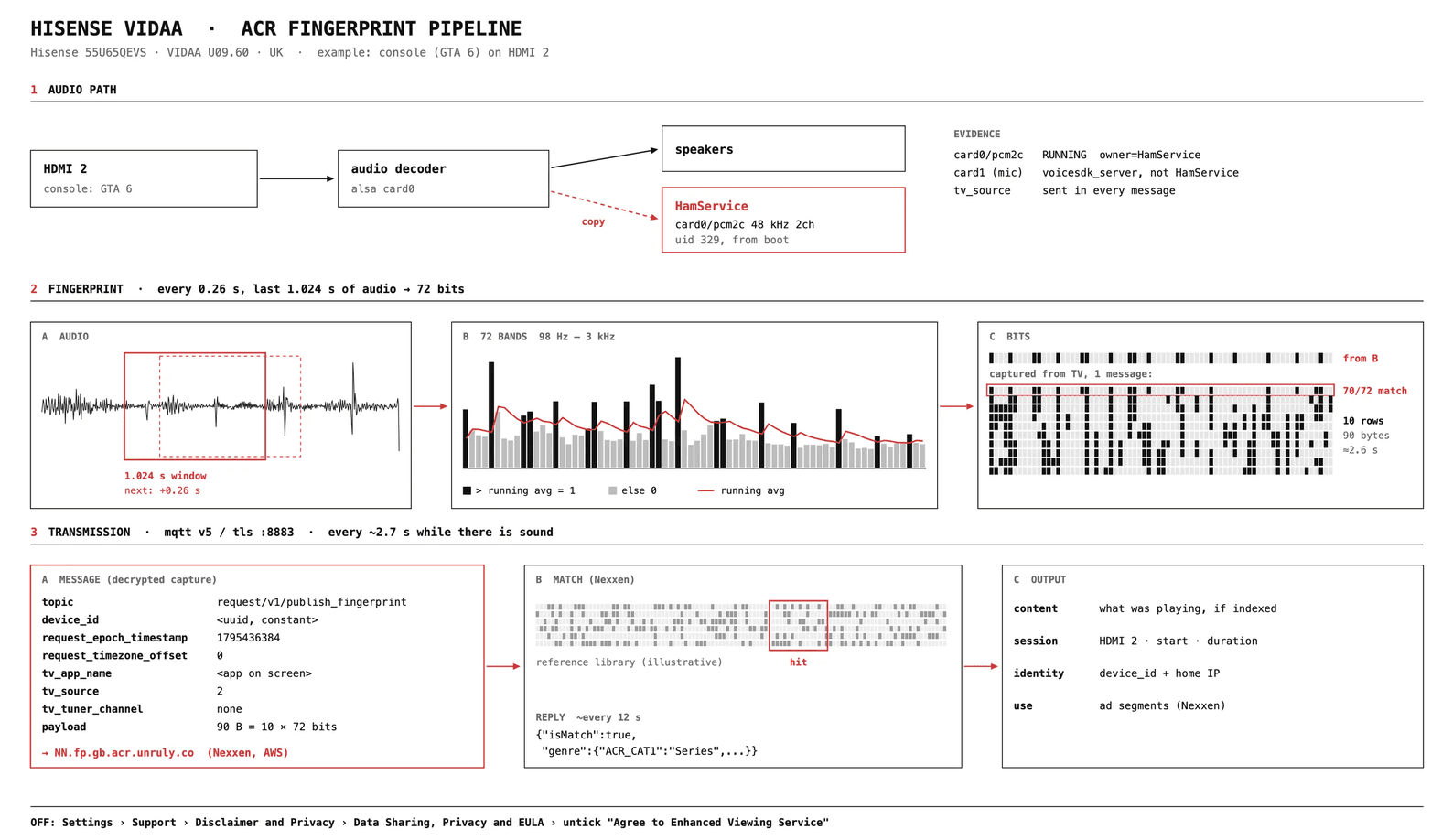
In a post on X, International Cyber Digest revealed that a user has unearthed evidence that their Hisense TV appears to be collecting audio data from the programmes they’re watching and converting that information into a 72-bit string. Once that’s done, the TV then sends the data to an Israeli advertising firm in Tel Aviv, transmitting a fresh batch every 2.7 seconds.
The audio data is reportedly rich enough that the company should have little trouble identifying on-screen visuals, including the shows and movies someone is watching and the ads they’re using and interacting with.
In addition, the data contains a unique device identifier that never changes, allowing the Israeli firm Nexxen to link user behavior to a specific device.
What this means is that, if you own a Hisense TV, the company and its Israeli ad partner almost certainly knows a lot about you – things such as the films and TV shows you’re interested in, which ads you actually pay attention to, what time you go to bed and all that jazz. With those insights, they can then adjust their advertising algorithms to show ads that are more likely to hit home and spark a reaction.
The findings will heap further pressure on a TV industry that has been accused of showing an almost callous disregard for its customers’ privacy. The spying saga kicked off in September when the popular YouTube research channel Gamers Nexus exposed the surveillance mechanisms used by LG TVs, which include allegedly listening in to users conversations through the TV’s built-in microphones.
LG has denied it spies on viewers and insists it respects their privacy at all times, and only uses its surveillance tools to “enhance” viewer’s experiences if they choose to opt in. But a consumer association in Portugal has slapped it with a class action lawsuit anyway, asking authorities there to pull certain LG TV models from sale and order it to fix those that have already been sold.
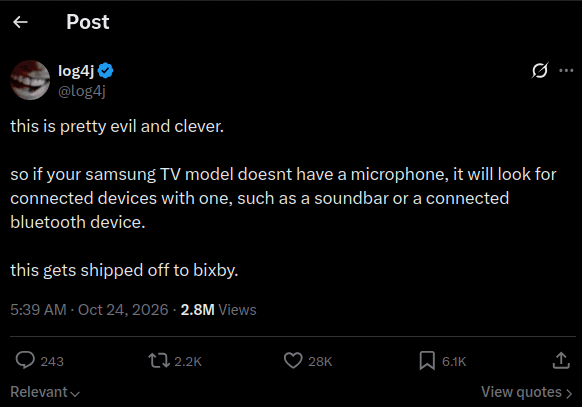
Meanwhile, Samsung has been accused not once, but twice, of spying on TV owners in different ways. For instance, it’s alleged by a security researcher that some of its less-smart TV models that lack a built-in microphone instead search for mics on other devices that are connected to the same network as the TV.
Then, in a second report by researchers at Northeastern University in the U.S., Samsung, together with Vizio and Roku, was accused of not respecting the wishes of consumers who opted out of its Automatic Content Recognition or ACR system for tracking what users watch. In that study, it was discovered that when users chose not to participate, Samsung’s TVs continued to send data on what viewers were watching to a centralised server controlled by the Korean company.
Like LG and Samsung, Hisense is probably doing this so it can serve targeted ads to viewers. And that in itself is fine – after all, TVs are basically the only consumer electronics products that haven’t seen massive price increases in the last few months due to the “RAMaggedon” crisis sparked by AI. But what is not fine is when TV companies decide to track what people are watching without informing them of it first. All the more so when that data is being sent to a third-party such as Nexxen, which could very well be selling it to others.
Making it even worse, the user report seems to indicate that users are not even given a choice. According to International Cyber Digest, the TV comes with audio data collection set up by default straight out-of-the-box.
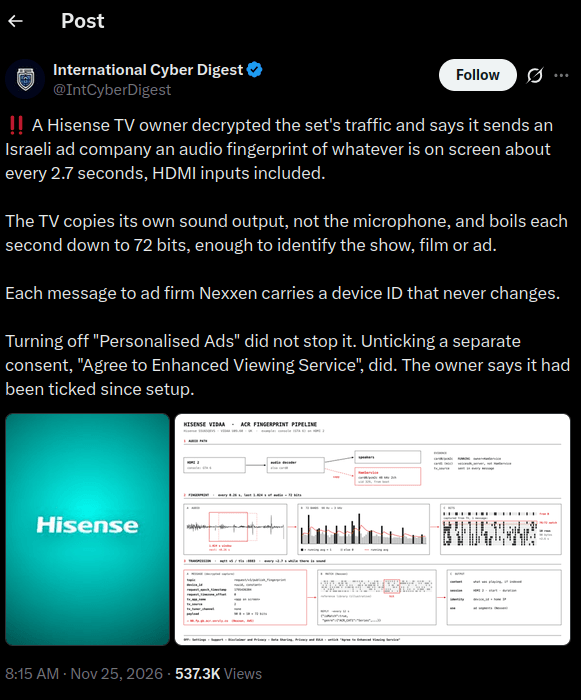
The good news is that the anonymous user who decoded the data leaking from their Hisense TV to discover what it’s up to has also found a fix. By going to Settings > System > Advanced Settings, they disabled an option that says “Agree to Enhanced Viewing Service,” to finally put a stop to the data collection.
Nevertheless, the fact Hisense automatically agrees to this service on behalf of users is not a good sign. In fact, it’s pretty shameful that any globally-renowned company would feel the need to stoop so low. We understand that the smart TV industry is extremely competitive, and that one of the reasons Hisense does so well is because it sells some very nice TVs at very nice prices. To offer such affordable prices, it needs to be able to make money elsewhere, and showing ads to viewers is one of the best ways to do that.
No doubt, TV makers choose to covertly collect data on their customers because they’re concerned that many would opt-out if they’re aware of it. Perhaps if they tried to find a way to convince people that targeted ads are at least better than random ads, they wouldn’t have to resort to such questionable tactics.
