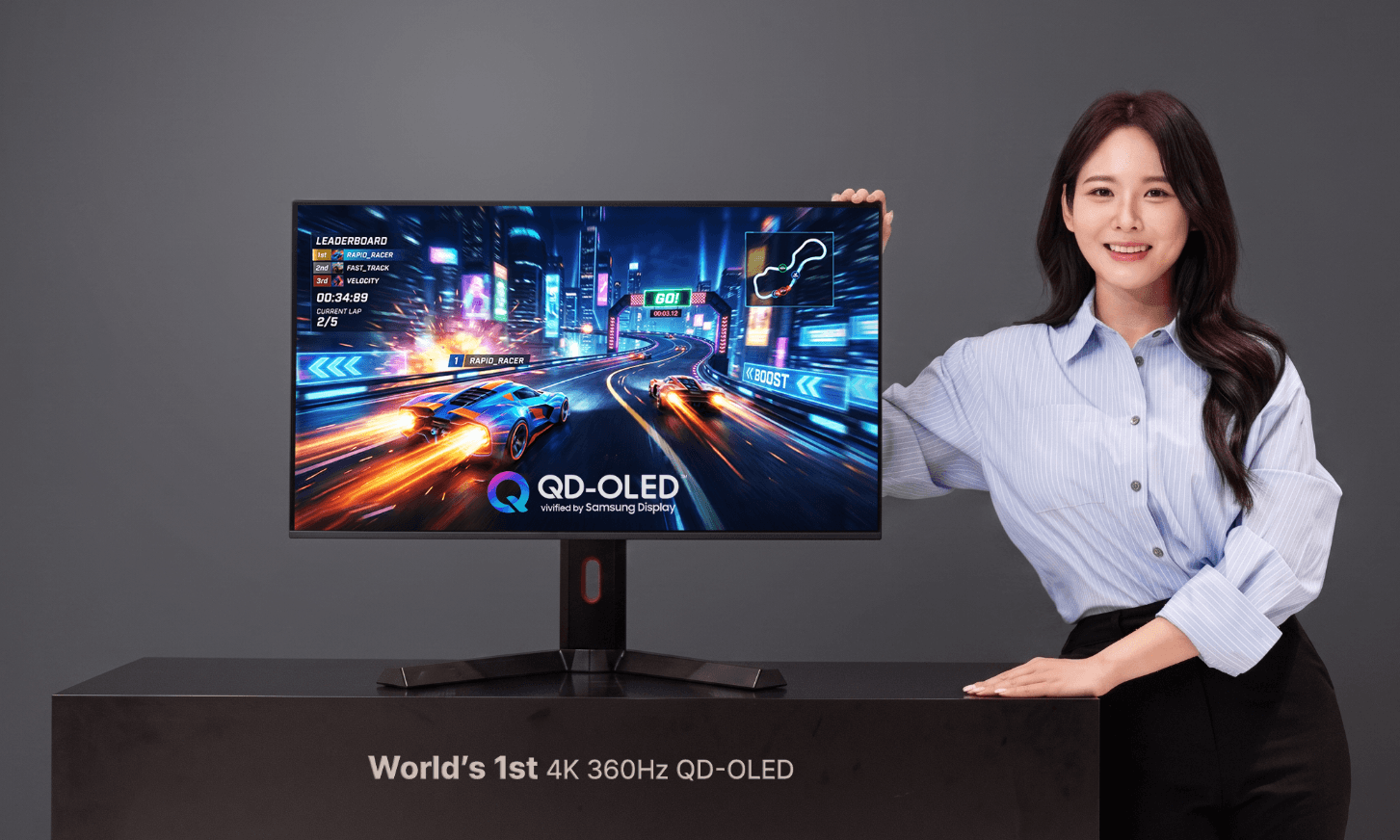
Not to be outdone by LG Display, Samsung Display has lifted the veil off of its newest QD-OLED display, which is a 32-inch 4K resolution panel for monitors that features V-Stripe pixels to enhance text rendering and comes with a blazing-fast 360Hz refresh rate.
Samsung Display first showcased the upcoming panel at CES 2026 in January, where it explained that the V-Stripe pixel structure was designed to fix the problem of “fringing” that occurs on existing QD-OLED panels when rendering text. Fringing occurs because of the non-linear sub-pixel arrangement of existing QD-OLED displays. This is a sub-optimal layout that makes individual letters look “fuzzy” and exhibit some “bleeding” around the edges.
Initially, this wasn’t so much of a problem with the first OLED monitors, because most were aimed squarely at gamers. But OLED is now starting to become popular with other kinds of PC users too, hence the need for a superior sub-pixel arrangement that fixes this issue.
With the new pixel structure, the red, green and blue sub-pixels are aligned in a vertical arrangement. That’s different from its existing QD-OLED panels, where the sub-pixels are arranged in a triangular fashion, as you can see in this graphic:

According to Samsung Display, this enables "sharper rendering of text edges" and is an "optimal monitor solution for users who are particularly sensitive to text readability, including those working on documents, coding, graphics and content creation.”
It’s notable that Samsung Display’s V-stripe sub-pixel arrangement differs from LG Display’s new RGB-Stripe design – whereas Samsung stacks the sub-pixels vertically, its rival has gone with a horizontal alignment. It remains to be seen which approach will be superior.
We’ll be interested to see these new displays under a microscope to see which design best eliminates text fringing, but the efficiency of the sub-pixels won’t be the only factor in people’s buying decisions. That’s because size is an issue, with LG’s first RGB-Stripe panel measuring 27–inches, as opposed to Samsung’s 32-inch display.
Similar to LG Display, Samsung Display is shooting for a 360Hz refresh rate, up from its previous best speed of 240Hz at 4K or 360Hz at 1440p. The advantage of having a native 360Hz panel is that it can be cranked up to a whopping 680Hz at 1080p resolution thanks to its dual-mode feature. So users will be able to opt for higher speeds but less sharp details (ideal for some games) and richer detail at slower speeds when performing productivity-related tasks.
Samsung Display did not reveal the brightness of the new panel, but it has been certified for VESA DisplayHDR True Black 600, which means that it’s capable of doing at least 600 nits peak brightness, though in all likelihood, it’s probably significantly brighter than this.
The company said it’s expecting to begin mass production of its first V-stripe QD-OLED monitor panels in the second half of the year. That’s a tad later than LG Display, which has already kicked off volume production. According to Samsung Display, it’s currently in discussion with 10 leading monitor brands to supply them with the new panels. It didn’t name any of the brands, but we’d be surprised if Samsung Electronics isn’t one of them, and the likes of Asus, Dell and MSI will probably be on board, too.
"Many customers have described the new 31.5-inch 4K 360Hz product as a near-perfect monitor that delivers everything consumers expect from a premium monitor, including ultra-high resolution, an ultra-high refresh rate, high brightness, and enhanced readability," Samsung Display’s head of large display Brad Jung said.
Samsung Display said it will showcase the new display at Computex 2026, which is being held in Taipei, Taiwan, next week.
