
UBI Research says that OLED monitors have become one of the fastest-growing segments in the display industry, and expects sales to increase by between four- and five-times by the end of the decade.
The monitor industry was dominated by LCD displays for almost two decades, and has continued to do so even while the transition to OLED was already well underway in TVs and smartphones. But that’s finally changing, and more consumers and professionals are now embracing OLED monitors, which provide a most welcome breath of fresh air.
While today’s best LCD monitors do offer higher resolution and faster refresh rates, there has been little improvement in terms of contrast, and the result is that most are unable to display proper HDR quality content. Because of this, progress in areas such as video and photography hasn’t accelerated as it should.
UBI Research said in a recent report that the transition to OLED first kicked off in 2023, and it believes that it’s going to accelerate markedly in the next few years. It estimates that around 3.2 million OLED monitors were sold globally in 2025, up 64% from the year before, and believes that this number will increase to 5 million by the end of this year. The pace of sales will accelerate for the rest of the decade, with 15 million-plus annual OLED monitor sales by 2023, representing a five-fold increase from 2025.
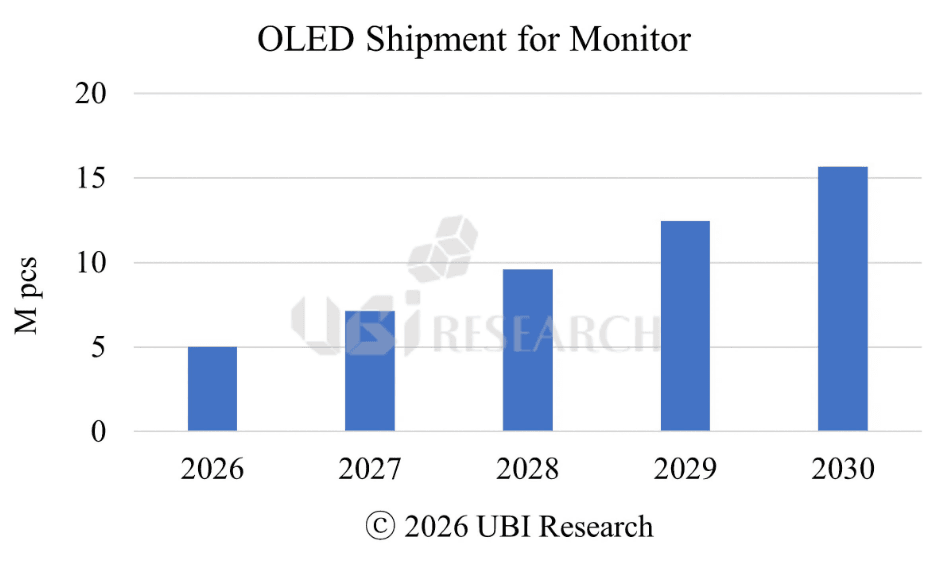
The forecast is good news for display makers, and not only Samsung Display and LG Display, which currently manufacture the vast majority of OLED monitor panels available today. TCL CSOT and a number of other Chinese display makers are also building out large-scale OLED display manufacturing facilities, and most are targeting the monitor segment.
“Chinese panel makers are actively entering the OLED monitor market with their own technologies, and the OLED monitor segment is expected to continue growing as applications expand across gaming, creator and premium IT devices," said Changwook Han, VP at UBI Research.
The transition is expected to accelerate because OLED monitors are going mainstream. Initially, the vast majority of OLED monitors were targeted at gamers looking for a high-end experience, but this year will see the launch of newer products targeted at professional workloads such as graphics and video editing, as well as office work and general media consumption.
UBI Research said this shift is driven by recent developments in OLED, including LG Display’s new RGB stripe WOLED panels and Samsung Display’s V-Stripe RGB QD-OLED technology, which introduce improved pixel structures to make them more suitable for tasks such as text editing.
