While the cost of most electronics products has jumped sky-high this year, OLED monitor prices have actually declined, and according to a new report by Omdia, they’ll get even cheaper next year.
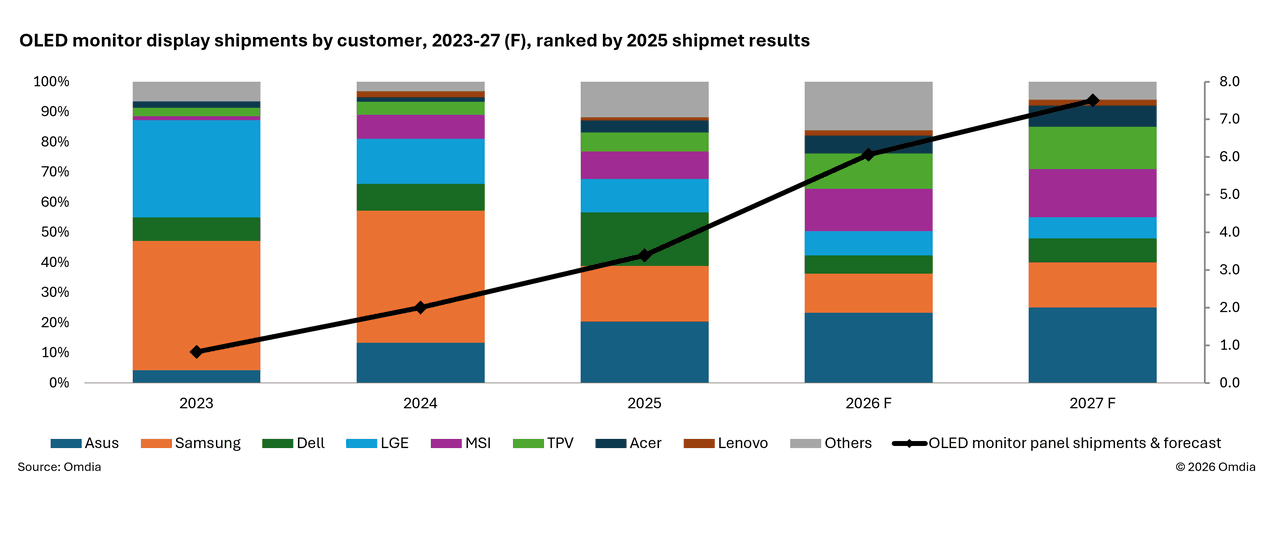
The report revealed that Omdia expects global sales of OLED monitor panels to top 6 million by the end of the year, up 79% from 2025. It’s a rapidly accelerating trend, driven chiefly by gamers, who are eager to secure the considerable advantages OLED displays provide, including high contrast, deep blacks, vivid and natural colours, and much faster response times compared to LCD. The research firm said this trend will continue in 2027, when it expects OLED monitor sales to exceed 7 million.
Omdia said Asus sits at the top of the pile as the world’s best-selling OLED monitor brand, commanding a 23% market share. It’s followed by MSI in second place, with Samsung Electronics third, TPV (which controls the Phiipps, AOC and Great Wall sub-brands) in fourth and LG Electronics in fifth. Dell, Acer and Lenovo make up the rest of the top eight, according to Omdia.
The rising sales of OLED monitors is not surprising for anyone who follows this industry, but Omdia’s findings about the cost of those products will likely raise quite a few eyebrows. The reason is that, unlike many other consumer electronics products, whose prices are dictated by components like RAM, the most expensive thing in any monitor is the panel itself. And they’re getting cheaper all the time, Omdia says, especially with the introduction of Samsung Display’s newer QD-OLED Edge panels, which is a scaled-back version of the company’s more advanced QD-OLED technology.
Another factor that’s driving cheaper prices is Samsung Display’s and LG Display’s push to make OLED monitors useful for more than just gaming, targeting professional video editing applications and such with their new pixel structures. Omdia said the growing adoption of OLED monitors is a trigger for superior economies of scale.
“Mainstream 27-inch 240Hz OLED gaming models have seen price cuts of more than 40% in 2026,” Omdia revealed. “Prices for premium OLED monitors reached the $350 range in the first half of 2026 and are expected to approach $300 by 2027.”
Some high-end OLED monitors are even cheaper than this. For instance, INNOCN is currently selling a 27-inch 240Hz OLED monitor on Amazon for just $230.
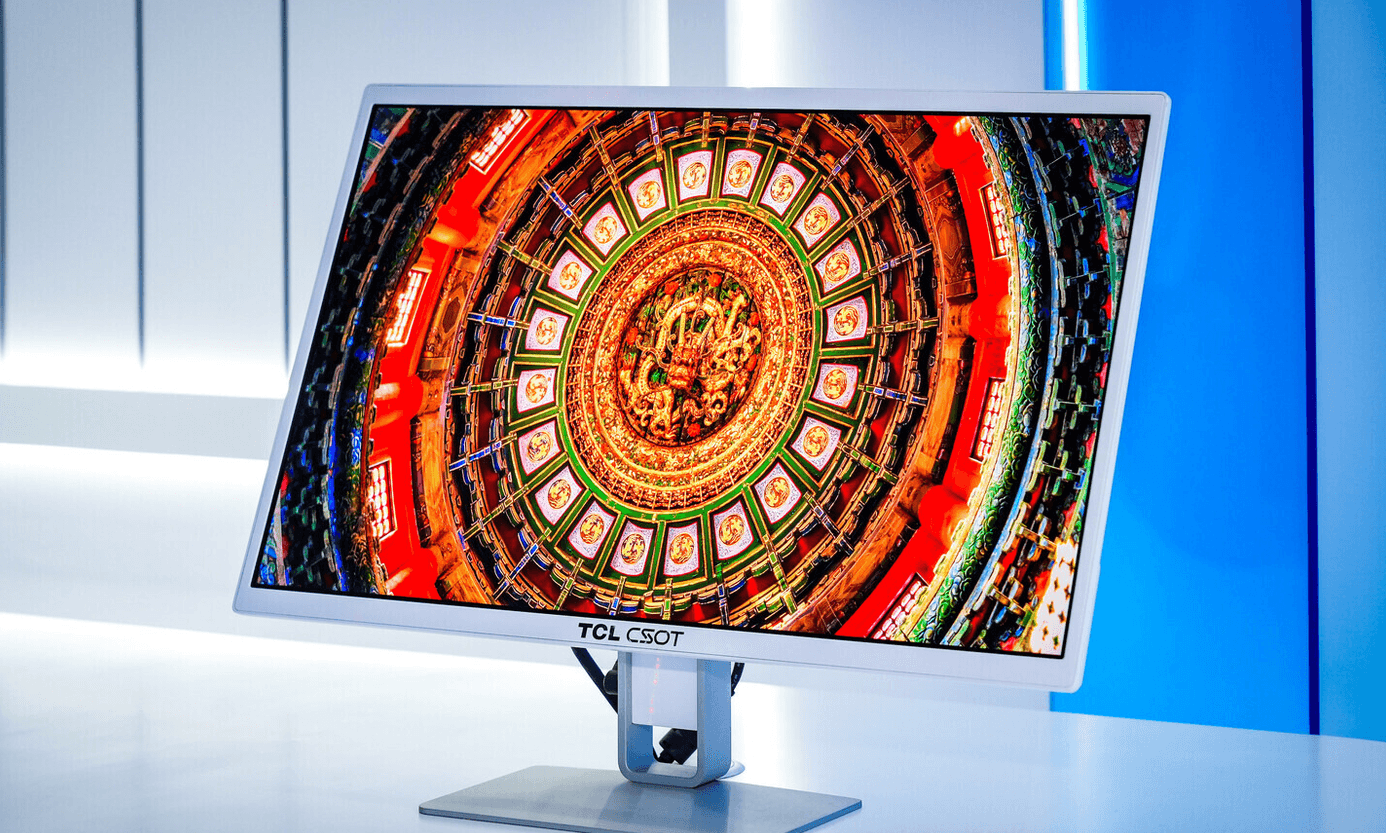
Beyond 2027, Omdia says there will be yet another major driving force that’s likely going to reduce OLED monitor prices further. That would be TCL CSOT, the Chinese display giant that’s owned by TCL Electronics, which has just started ramping up production of OLED panels at its new, multibillion-dollar Gen 8.6 OLED plant in China. TCL CSOT expects that operation to be in full flow by the end of next year, and its much-touted inkjet-printing manufacturing process is widely expected to reduce production costs even further. Add to that, TCL has a long history of undercutting its Korean rivals on prices, and serious ambitions to break the stranglehold of LG Display and Samsung Display.
TCL CSOT’s facility has been designed to manufacture 32-inch and 34-inch OLED panels with refresh rates of 700Hz. “TCL China Star’s Gen 8.6 IJP OLED capacity is projected to reshape OLED monitor supply chain dynamics,” said Omdia analyst Nick Jiang.
LG Display and Samsung Display aren't standing still either. Both companies are reported to be working on new manufacturing processes that should reduce costs while also resulting in higher-quality OLED panels.
